
As we step into 2025, According to research and analysis by Maximize Market Research (MMR), the Fast-Moving Consumer Goods (FMCG) industry continues to navigate an era of transformation and innovation. Shifting consumer expectations, rapid technological innovation, and a volatile global economy are redefining the way businesses operate. Success in this evolving landscape requires a deep understanding of emerging trends and a commitment to proactive adaptation. To thrive in this dynamic environment, FMCG companies must anticipate change, embrace innovation, and respond to evolving market demands with agility and purpose. In this blog, we explore the key trends shaping the future of the FMCG industry and the strategies that will drive success in the year ahead.
FMCG Trends: Leading with Sustainability, Digital Innovation, and Personalization
The FMCG industry in 2024 has seen sustainability evolve into a critical growth driver as companies respond to environmentally conscious consumers. Key initiatives, such as reducing single-use packaging, implementing energy-saving technologies, and adopting circular economy principles, are becoming standard practices. For example, leading companies have committed to achieving net-zero emissions by 2050 and are accelerating the use of recyclable and reusable packaging by 2025. Additionally, personalization has taken center stage, with 75% of consumers preferring tailored offerings, pushing FMCG companies to utilize big data and advanced analytics to customize products and services. AI-driven tools are enabling deeper consumer insights, optimizing marketing strategies, and enhancing overall customer satisfaction.
Digital transformation and innovation remain at the forefront of FMCG operations as companies adopt technologies like AI, AR, and automation to streamline processes and improve consumer engagement. Brands are leveraging augmented reality (AR) to provide interactive shopping experiences, such as virtual product trials, enhancing brand loyalty and purchase confidence. Direct-to-consumer (DTC) models are expanding, enabling companies to build stronger connections with customers and deliver personalized offerings. Furthermore, influencer-driven marketing has grown significantly, with 60% of younger consumers reporting that their purchasing decisions are influenced by social media creators. As the FMCG sector moves into 2025, sustainability, digitalization, and personalization will remain key pillars for growth, with companies embracing innovative strategies to align with evolving consumer preferences and market demands.
Generative AI: Revolutionizing Consumer Appliances and Customer Experience in 2024 and Beyond
The adoption of generative AI is accelerating across industries, particularly in the consumer appliances and retail sectors. In 2024 alone, companies like Haier and Samsung introduced advanced generative AI capabilities, such as HomeGPT and Bespoke AI, reflecting the steady growth in smart appliances. Smart appliance adoption rose from 17% of retail units sold in 2020 to 26% in 2024, and this trend is expected to gain momentum as technological advancements continue. Retailers are enhancing customer experiences with AI-powered virtual assistants like Taobao Wenwen (Alibaba), Beauty Genius (L’Oréal Paris), and IKEA’s AI Assistant, which improve product recommendations and streamline search capabilities.

`
However, overreliance on AI poses risks; poorly trained chatbots can frustrate users, emphasizing the need for continuous testing and human oversight for complex queries. Beyond customer-facing solutions, MMR expect that generative AI will optimize supply chains through automated vendor and order management in the coming years, improving efficiency and reducing costs. While concerns about job redundancies persist, businesses are urged to use AI as a tool to empower productivity, upskill employees, and enhance governance frameworks. Success in leveraging generative AI will depend on finding the right use cases, balancing automation with human intelligence, and maintaining transparency to earn consumer trust.
Sustainability Driving Growth and Innovation in FMCG Industry
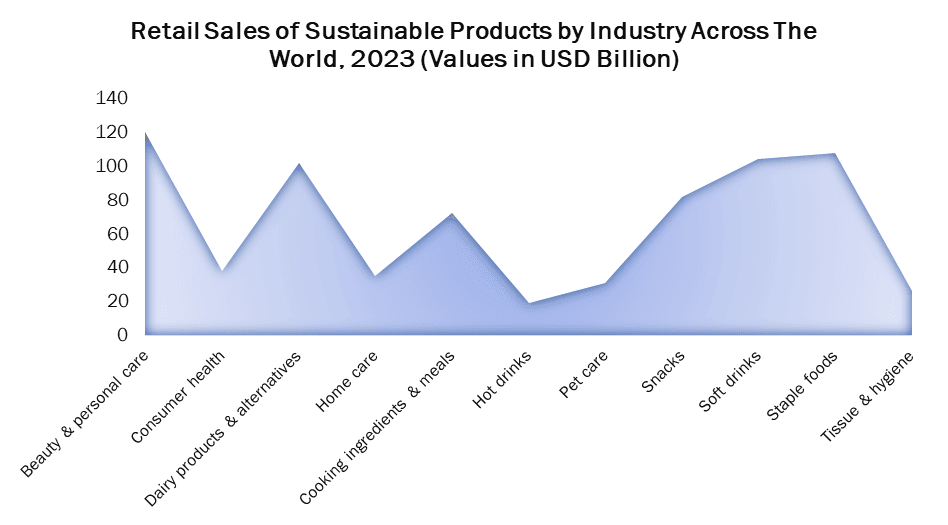
Sustainability continues to be a defining force in FMCG product developments. The expanding selection of sustainable products and sustainability packaging reflects growing consumer demand for values-driven purchasing, as retail sales of such products consistently trended upward between 2020 and 2023. Brands with a clear sustainable proposition experienced a 1.5% higher growth rate compared to their non-sustainable counterparts during this period. Beauty and personal care led the charge, generating over USD 120 billion in sales from sustainable products in 2023, the highest among all FMCG industries. Meanwhile, pet care products with sustainability claims recorded the strongest compound annual growth rate (CAGR) between 2018 and 2023, signaling accelerated demand in various sectors. Approximately 25% (home care) to 50% (beauty and personal care) of online products made sustainability claims in 2023, highlighting the competitive landscape and the importance of precise product positioning and messaging. Nearly 50% of companies now ensure sustainability features are integrated into new product launches, underscoring the industry’s commitment to meeting consumer expectations and navigating evolving regulatory demands.
“Transformation in Consumer Products Industry: Challenges, Trends and Opportunities by 2032”
The consumer products market is undergoing profound change, driven by evolving consumer expectations, technological advancements, and the need for sustainable practices. An MMR Research predicts that 70% of consumers will expect companies to take more responsibility for things like environmental sustainability, social fairness, and privacy by 2025. These shifts are influencing market dynamics, pushing businesses to redesign product portfolios and adopt inclusive approaches to cater to more diverse and value-conscious consumers. Additionally, MMR expect drastic transformations in supply chain operations, with firms leveraging cutting-edge technologies such as blockchain and artificial intelligence to enhance transparency, agility, and efficiency, reducing lead times and environmental impact.
To stay competitive, companies are heavily investing in digital transformation and rethinking operational frameworks. AI, particularly generative AI, is gaining traction, automating repetitive tasks like content creation and customer service, boosting productivity by 20–30%, and cutting marketing costs by up to 25%. Organizational restructuring is also on the rise, with top firms consolidating regional operations and fostering collaborative leadership models to break down silos and increase responsiveness. The FMCG industry’s total investment in AI-driven innovations is expected to exceed $50 billion by 2025, enabling rapid advances in areas like material science and biotech. As these trends converge, the industry is positioned for rapid innovation, with exponential advances in areas like material science and biotech expected to dwarf the progress of the past decade, reshaping the mechanics of how work is executed and value is created.
Revolutionizing Fast-Moving Consumer Goods Market (FMCG): How Technology and Innovation are Reshaping the Industry
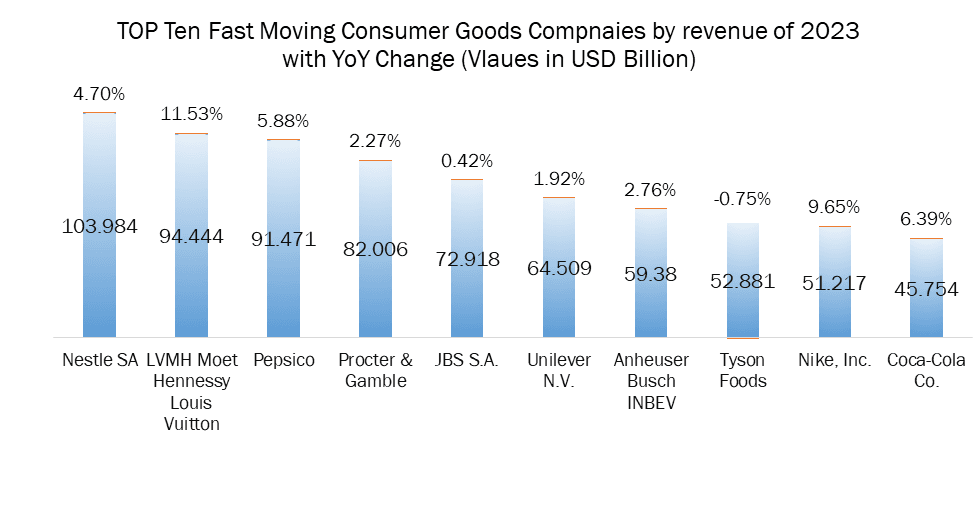
In fiscal year 2024, the Top ten Consumer Goods Companies collectively generated over $750 Billion in revenue, reflecting their resilience in a challenging economic environment. Food companies faced the toughest hurdles, as consumers reduced grocery budgets by an average of 10%, prompting a shift toward private-label products. Inflation and higher commodity prices forced manufacturers to adopt cost-saving strategies while investing in innovation. More than 65% of top-performing companies implemented artificial intelligence (AI) to streamline supply chain operations, reducing lead times by 20% and cutting costs by up to 25%.
As FMCG companies navigate 2025, adopting advanced logistics strategies has become imperative to stay competitive. Leveraging Artificial Intelligence (AI) and Machine Learning (ML) is transforming supply chain operations, enabling up to 90% improvement in demand forecasting accuracy and 40% enhancement in delivery precision through route optimization. Warehouse automation, using technologies like Autonomous Mobile Robots (AMRs) and Automated Storage and Retrieval Systems (AS/RS), has shown to increase order fulfilment speed by 20-30% while reducing errors by up to 70%, driving significant cost efficiencies. Additionally, the shift to circular economy principles is a growing focus, with eco-friendly packaging and recycling initiatives improving waste management by 30% and enhancing brand loyalty among environmentally conscious consumers.
The exponential growth of e-commerce demands that FMCG companies strengthen their online channels, with e-commerce sales expected to account for over 28% of FMCG revenue in 2025. Direct-to-consumer (DTC) models are proving successful in cutting logistics costs by 15-20% and fostering stronger customer relationships. Enhancing customer experience through digitalization, including the use of augmented reality (AR) and virtual reality (VR), offers immersive shopping experiences, boosting conversion rates by 25%. Additionally, supply chain resilience has become a top priority, with diversification of suppliers and risk mitigation strategies leading to 30% faster recovery from disruptions like geopolitical or climate-related challenges. These strategies collectively enable FMCG companies to optimize operations, reduce costs, and meet evolving consumer expectations.
Regional Growth Trends and Strategic Outlook
The FMCG industry in the United States is expected to grow by 4–5% in 2025. The growth is attributed to evolving consumer preferences, sustainability initiatives, and advancements in digital technology. Urban and suburban markets dominate, with increasing adoption of e-commerce platforms and direct-to-consumer models. FMCG companies in the U.S. are investing heavily in AI-driven supply chain optimization, expected to reduce operational costs by 15–20%. Sustainability remains a major focus, with over 70% of FMCG firms adopting eco-friendly packaging and waste reduction initiatives. Furthermore, inflationary pressures and price-sensitive consumers are pushing companies to innovate with affordable product lines, maintaining competitiveness in a dynamic market.
The FMCG Market in Europe is expected to witness a steady growth at a CAGR of 3–4% annually, with a strong focus on sustainability and regulatory compliance. The United Kingdom has seen regulatory scrutiny around price gouging, pushing companies to innovate with competitive pricing strategies. Germany, Europe’s largest FMCG market, continues to focus on eco-friendly products and supply chain optimization, with 65% of German consumers prioritizing brands with strong sustainability commitments. France and Italy are also key markets, with France advancing food price negotiations to combat inflation and Italy experiencing increased demand for organic and locally-produced goods. E-commerce now accounts for 25–30% of FMCG sales across Europe, as companies invest in direct-to-consumer models and digital platforms to meet changing consumer preferences. Regulatory compliance, particularly with the EU’s Corporate Sustainability Reporting Directive (CSRD), is reshaping operations, encouraging investments in green technologies and ESG initiatives.
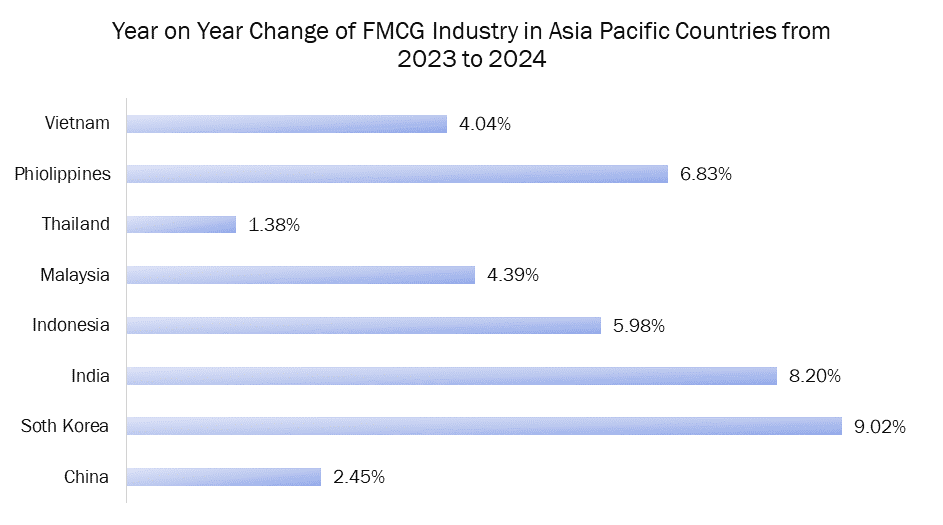
The FMCG industry in the APAC region is a high-growth market, expected to expand by 8–10% annually, fueled by rising incomes, urbanization, and increasing e-commerce penetration. China, Japan, India, and Southeast Asian countries are leading this growth, with China’s FMCG market alone projected to reach $2.1 trillion by 2025. In Japan, an aging population is fueling demand for health-oriented and convenience products, while Vietnam and Thailand are emerging as key players due to rising incomes and increasing urbanization. E-commerce platforms now account for over 25% of FMCG sales in the region, driven by mobile-first consumer behaviour and digital payment adoption. The shift toward health-conscious and sustainable products is evident, with 40% of APAC consumers opting for organic and environmentally friendly options. Additionally, companies are leveraging AI and IoT technologies to improve supply chain efficiency and reduce costs. As consumer preferences evolve rapidly, FMCG firms in APAC are focusing on localized strategies and advanced digital tools to capture growth opportunities and cater to diverse market needs.
The Indian FMCG Market, a critical contributor to the economy and the fourth-largest sector, continues to exhibit remarkable growth, with a reported 25% increase in 2024. This growth is expected to continue, with forecast indicating another 20% rise in the next fiscal year. A key development has been the narrowing consumption gap between urban and rural markets, driven by improved accessibility, targeted rural strategies, and favorable economic policies. In India, Digital transformation is playing a pivotal role in this evolution, with sales automation streamlining processes, reducing manual tasks by up to 30%, and optimizing workforce productivity. The post-pandemic era has underscored the need for adaptive strategies, emphasizing customer-centric approaches and environmental responsibility. As the sector embraces digitalization and rural market expansion, it is poised to sustain its robust growth and contribute significantly to India’s economic development.
Navigating Regulatory Complexity: Key Challenges and Opportunities for the Consumer Products Industry in 2025
The regulatory environment in 2025 will continue to evolve, presenting significant challenges and opportunities for the consumer products industry. Companies are preparing for stricter Corporate Sustainability Reporting Directive (CSRD) requirements in the European Union, with the first ESG reports due by January 1, 2025. These regulations demand comprehensive disclosure of environmental, social, and governance (ESG) impacts, aiming to ensure transparency and comparability across businesses. Simultaneously, authorities are intensifying efforts to combat greenwashing, enforcing stricter rules on sustainability-linked claims in corporate communications and strategies. Businesses will need to prove the authenticity of their sustainability efforts, aligning goals with measurable outcomes, to maintain trust and regulatory compliance.
In the food and beverage sector, companies face heightened scrutiny under the EU’s deforestation regulations, requiring them to verify that commodities like palm oil, soy, coffee, cocoa, and beef are not linked to recently deforested land. This rule is expected to take effect by the end of 2024, but 2025 will mark the first year of full implementation, creating ripple effects throughout global supply chains. Additionally, the US Food Safety Modernization Act (FSMA) Rule 204, although set for a compliance deadline of 2026, will see companies ramp up investments in traceability technologies in 2025 to ensure they meet tracking and reporting standards. Businesses anticipate an average increase of 20% in compliance spending to adapt to these requirements while leveraging advanced tools like blockchain and AI to enhance transparency, optimize supply chains, and build consumer trust. As sustainability and traceability emerge as key regulatory themes, businesses will need to strike a balance between compliance and innovation to stay competitive.
Conclusion
As the FMCG industry transitions into 2025, it stands at the forefront of global economic transformation, driven by sustainability, digital innovation, and evolving consumer behaviours. Companies that embrace these changes—integrating eco-friendly practices, leveraging advanced technologies like AI, and delivering personalized customer experiences—are best positioned for success. However, the path forward requires a delicate balance between meeting regulatory demands, maintaining consumer trust, and fostering innovation. By aligning business strategies with emerging trends and adapting to shifting market dynamics, the FMCG sector has the opportunity to not only overcome challenges but also unlock sustainable growth in an increasingly competitive landscape.