

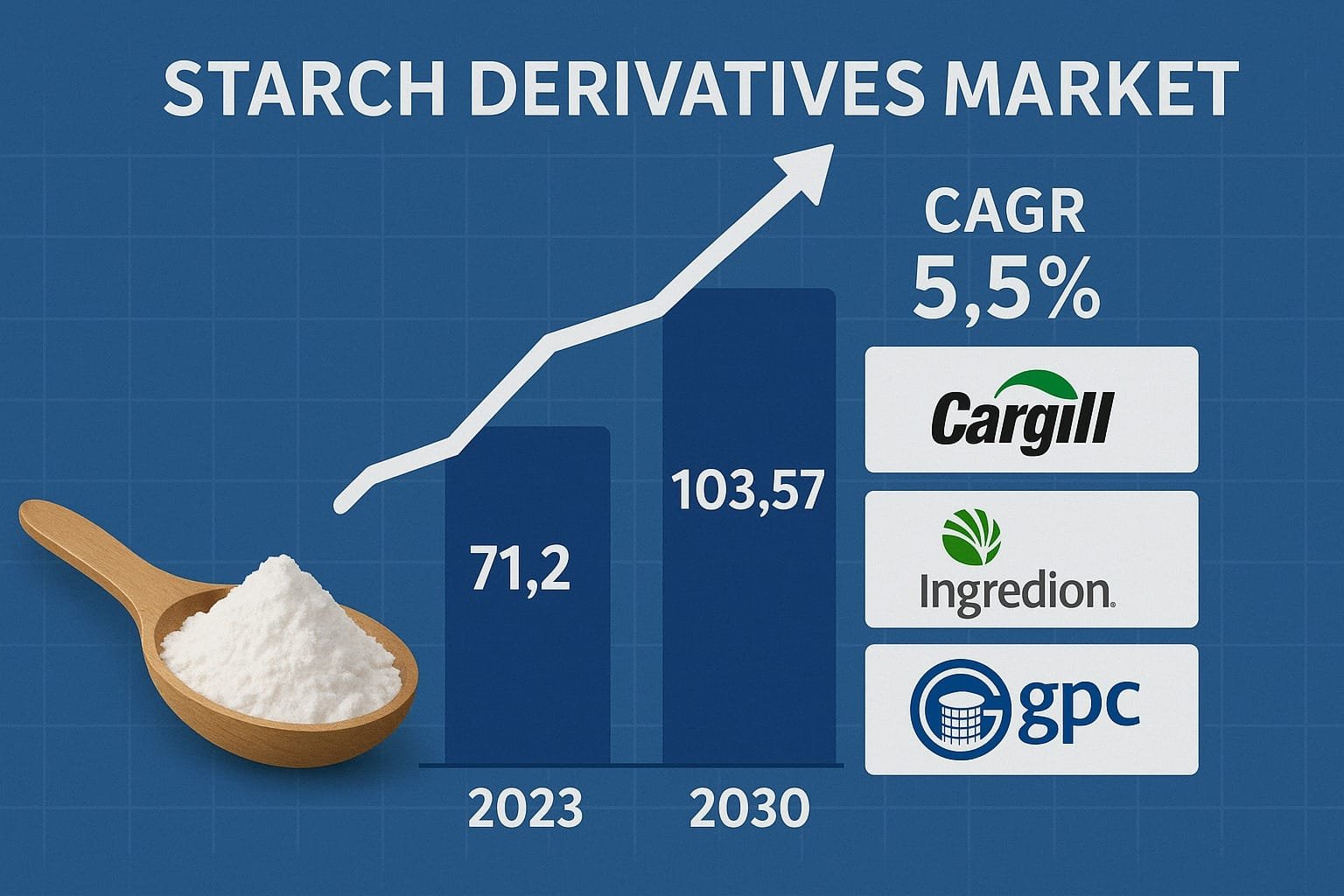
Starch Derivatives Market size was valued at USD 71.2 Billion in 2023 and the total Starch Derivatives revenue is expected to grow at a CAGR of 5.5% from 2024 to 2030, reaching nearly USD 103.57 Billion by 2030
Starch Derivatives Market & Definition:
The Global Starch Derivatives Market, refers to a wide array of modified starches—such as maltodextrin, glucose syrup, cyclodextrin, and hydrolysates—derived from starch via chemical, physical, or enzymatic treatments to enhance functional properties. These derivatives are integral in a variety of sectors, from food and beverages to cosmetics, pharmaceuticals, paper, and textiles, due to their thickening, stabilizing, emulsifying, and binding capabilities.
In its essence, the Global Starch Derivatives Market captures the transformation of native starch from corn, potato, wheat, and tapioca into specialized ingredients. These derivatives cater to evolving consumer demands, including clean-label, non-GMO, gluten-free, and plant-based options. Their adaptability across liquid and dry forms ensures wide-ranging use—from sauces and snacks to drug excipients and sustainable packaging.
Starch Derivatives Market Growth Drivers & Opportunities:
One of the primary growth drivers for the Global Starch Derivatives Market is the booming processed and convenience foods sector, where derivatives enhance texture, shelf life, and consistency. The food & beverage industry accounts for over 40–65% of market share, underpinning a projected CAGR of 4–6% from 2025 to 2030 . Rising obesity, diabetes, and health-aware trends are boosting demand for resistant starch and clean-label fibers. In the U.S. alone, development of low-glycemic and prebiotic starches targets growing dietary needs.
Meanwhile, opportunities are expanding in non-food industries like pharmaceuticals, cosmetics, paper, animal feed, and bio-plastics. Over 60% of solid oral medicines now contain starch derivatives as excipients, while biodegradable packaging and sustainable adhesives offer a rich field for. Regions such as Asia‑Pacific—led by China and India—are expected to outpace most markets, with India posting a growth rate of ~6.1% and China at ~5.6% CAGR.
Starch Derivatives Market Segmentation:
by Type
Maltodextrin
Liquid Maltodextrin
Powder Maltodextrin
Cyclodextrin
Other
by Function
Thickening
Stabilizing
Binding
Emulsifying
Others
by Raw Material
Wheat
Corn
Potato
Sorghum
Tapioca
Others
Starch Derivatives Market Key Companies Covered in this Research Report:
1. Cargill, Incorporated (United States)
2. Archer Daniels Midland Company (United States)
3. Ingredion Incorporated (United States)
4. Grain Processing Corporation (United States)
5. Penford Corporation (United States))
Major Contributors in the Starch Derivatives Market in Europe:
6. Tate & Lyle PLC (United Kingdom)
7. Roquette Frères (France)
8. Avebe (Netherlands)
9. Tereos S.A. (France)
10. AGRANA Beteiligungs-AG (Austria)
11. Emsland Group (Germany)
12. Südzucker AG (Germany)
13. ALOJA-STARKELSEN LTD. (Latvia)
Major Leading Players in the Starch Derivatives Market in Asia Pacific:
14. Global Bio-chem Technology Group Company Limited (China)
15. SPAC Starch Products (India) Limited (India)
16. Thai Flour Industry Co., Ltd. (Thailand)
17. Universal Starch Chem Allied Ltd (India)
18. Zhucheng Xingmao Corn Developing Co., Ltd. (China)
19. Everbright Starch Co., Ltd. (China)
20. Manildra Group (Australia)
Starch Derivatives Market Country-Level Analysis:
Vietnam: Growth & Opportunities
Vietnam’s starch derivatives market is steadily growing, supported by its role in regional supply chains. There’s increasing interest from pharma and food producers for clean-label, locally-sourced starch. However, detailed deal data is limited.
A key trend involves Vietnamese ingredient processors exploring joint ventures with Southeast Asian firms, aiming to meet rising demand and food safety standards.
Thailand: Trends & Development
Thailand is a major tapioca starch producer, with starch derivatives derived from tapioca seeing notable growth. Cargill expanded its specialty tapioca starch business in APAC through a partnership with Starpro in Thailand.
Thailand is emerging as an innovation hub in modified starch for food and biodegradable packaging applications.
Japan: Growth & Consolidation
Japan’s starch derivatives market is mature, with emphasis on pharmaceutical excipients and food-grade solutions. Key domestic players include Japan Corn Starch Co. Ltd. Recent consolidation has focused on partnerships and licensing to enable tech sharing and global access.
Japan continues to lead in R&D investment into enzyme-modified starch and specialty starches.
South Korea: Opportunities & Updates
South Korea prioritizes clean-label and bio-based applications. Companies are collaborating with European and US partners, especially in biodegradable materials. Specific M&A data is private, but trend aligns with regional sustainability thrust.
Singapore: Trends & Growth
As a regional hub, Singapore attracts both global ingredient companies and startups focusing on clean-label formulations. Efforts are underway to develop starch derivatives for nutraceutical and pharmaceutical use, though detailed M&A news remains minimal.
United States: Consolidation & Opportunities
The US market is strong—valued at about US $14.1 billion in 2024, with a ~3.7% CAGR projected through 2034. Key deals include Arcadia Biosciences selling its non-GMO resistant starch trait to Corteva Agriscience for US $4 million, and Roquette launching LycaGel Flex hydroxypropyl pea starch for pharma use.
Large players like ADM, Cargill, Tate & Lyle, Ingredion, and Roquette are investing in product portfolios and technologies .
Europe: Trends, Growth & Consolidation
Europe accounted for the second-largest share, with Germany leading and the UK the fastest-growing market within Europe . Key players include AGRANA, Tate & Lyle, Roquette, and Cargill. M&A focuses on expanding clean-label and specialty starch lines—e.g., Grain Processing Corp launched its Fybrin RS resistant starch.
Starch Derivatives Market Conclusion:
In summary, the Global Market is on a strong upward trajectory, propelled by expanding processed food demand, healthcare and clean-label trends, and sustainability initiatives such as biodegradable packaging and plant-based products. Valued at approximately USD 84–85 billion in 2024–2025, the market is projected to grow to USD 120 billion or more by 2030, with CAGRs ranging from 4 to 6%.
Strategic opportunities lie in enhancing resistant starch for health, investing in biodegradable and pharmaceutical applications, and scaling production in high-growth regions like Asia‑Pacific. Continued technological innovation, combined with addressing raw-material variability and regulatory challenges, will shape the next phase of growth in the Global Market.

