

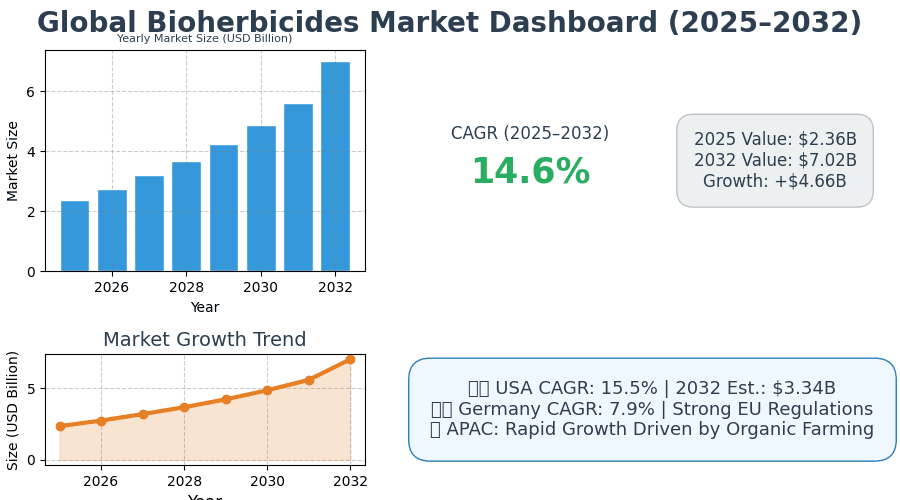
A new report reveals that the Global Bioherbicides Market reached a valuation of USD 2.36 billion in 2024 and is projected to surge to approximately USD 7.02 billion by 2032, registering a robust CAGR of 14.6% from 2025 to 2032. This comprehensive press release outlines detailed market size estimates, key growth drivers, segmentation trends, country-level insights for the USA and Germany, competitive landscape assessment, and forward-looking conclusions.
1. Global Bioherbicides Market Market Estimation & Definition
Bioherbicides are biologically-based weed control agents—derived from natural microbes (bacteria, fungi), plant extracts, or biochemicals—that offer an eco-friendly substitute to traditional chemical herbicides. They are used in both agricultural and non-agricultural settings to manage invasive weeds, reduce environmental impact, and align with sustainable farming and regulatory goals.
2024 Market Size: USD 2.36 billion
Forecast for 2032: USD 7.02 billion
2025–2032 CAGR: 14.6%
This explosive growth highlights a global shift driven by sustainability imperatives, regulatory reforms, and technological innovation in crop protection.
2. Global Bioherbicides Market Growth Drivers & Opportunities
Key Drivers:
Environmental and Health Awareness: Heightened concerns about synthetic herbicides harming soil, water, biodiversity, and human health are fueling demand for natural herbicidal solutions. Farmers and consumers alike are increasingly choosing eco-safe options.
Regulatory Pressure and Sustainable Agriculture Policies: Governments worldwide are implementing stricter restrictions on chemical herbicides and offering subsidies for biological alternatives, which supports bioherbicide adoption.
Resurgence of Herbicide-Resistant Weeds: The rise of resistant weed species like glyphosate-tolerant Palmer amaranth is pushing farmers toward integrated weed management strategies that include bioherbicides.
Technological Advances: Innovations in microbial formulations, consortia, and targeted delivery systems are enhancing bioherbicide effectiveness and shelf life—bridging the gap with conventional chemicals.
Opportunities:
Integrated Pest Management (IPM): There’s growing integration of bioherbicides into IPM systems, combining microbial, cultural, and mechanical control methods.
New Formulations: Development of liquid and granular products that fit large-scale mechanized agriculture and precision application.
Global Expansions in Emerging Regions: Asia-Pacific, Latin America, and Africa present high-growth markets, supported by organic farming trends and government-led initiatives.
Crop Diversification: Expanding bioherbicide use into new agricultural segments—like turf, plantation crops, and non-food sectors—offers revenue expansion opportunities.
3. Global Bioherbicides Market Segmentation Analysis
Based on the report, the market is categorized as follows:
By Source:
Microbial, Biochemical, Others
By Formulation:
Granular, Liquid, Others
By Mode of Application:
Seed Treatment, Soil Application, Foliar, Post-harvest, Others
By Application Sector:
Agricultural Crops, Fruits & Vegetables, Non-agricultural Crops, Turf & Ornamentals, Plantation Crops, Others
Highlights:
Microbial bioherbicides dominate due to broad-spectrum efficacy and scalable mass production.
Liquid formulations are rapidly gaining in popularity, particularly for ease of application and compatibility with large-scale mechanized systems.
Foliar and soil application modes are leading due to effective weed suppression at key growth stages.
Agricultural crops and turf/ornamental sectors stand out in terms of revenue share and adoption momentum.
4.Global Bioherbicides Market Country-Level Analysis
United States
The U.S. bioherbicide market is a major global driver due to:
Strong research investment and farm adoption of sustainable inputs.
Consumer demand trends favoring non-GMO and organic produce.
Regulatory constraints on chemicals like glyphosate.
Estimated 2024 market size: ~USD 0.79 billion; projected 2032 value: USD 3.34 billion with a 15.5% CAGR.
Germany
Germany plays a leading role in Europe due to:
Rigorous environmental regulations under EU directives and national farm policies.
Active pilot schemes offering incentives for biological weed control.
Adoption of bioherbicides in conventional and organic farming—especially cereals and lawful herbicide replacements.
The German market is expected to grow at ~7.9% CAGR through the forecast period.
5.Global Bioherbicides Market Competitor (Commutator) Analysis
Leading players in the global bioherbicides landscape include:
Marrone Bio Innovations
Valent BioSciences Corporation
Bayer CropScience
Emery Oleochemicals
BASF SE
Syngenta
Novel Biotech Firms (e.g., Harpe Bio, Deer Creek, BioSafe Systems)
Competitive Dynamics:
R&D Focus: Heavy investment in microbial strain isolation, genetic enhancement, and improved formulation design.
Strategic Alliances: Partnerships with biotech firms, universities, and agri-tech startups to accelerate product pipelines.
Regulatory Compliance: Firms obtaining USDA organic, non-GMO, and EU eco-certifications to address diverse market demands.
Merger & Acquisition Activity: Consolidation to enhance global distribution infrastructure and product breadth.
6. Global Bioherbicides Market Conclusion & Strategic Outlook
The Global Bioherbicides Market is poised for exponential growth, fueled by strong demand from sustainability-aligned consumers and increasing regulation of agrochemicals. With its USD 2.36 billion valuation in 2024 and forecast to swell to USD 7.02 billion by 2032 at a 14.6% CAGR, bioherbicides are becoming integral to modern agriculture.
Read Full Report In Detail: https://www.maximizemarketresearch.com/market-report/global-bioherbicides-market/68389/
Key Takeaways:
Microbial liquid formulations and IPM integration hold exceptional market promise.
North America, particularly the USA, remains the epicenter of growth, underpinned by innovation and regulation.
Germany is leading the regional adoption wave in Europe through rigorous ecological standards.
Competitive outskirts are dominated by R&D-centric agritech firms and strategic mergers.
Strategic Imperatives for Stakeholders:
Invest in R&D to enhance product efficacy, environmental resilience, and shelf life.
Expand regulatory partnerships and certifications to ensure market acceptance globally.
Collaborate with IPM integrators, agribusinesses, and green certification bodies to expand reach.
Scale manufacturing and market outreach in developing regions like Asia-Pacific and Latin America in tune with organic agriculture growth.
Media Contact:
Maximize Market Research
📧 sales@maximizemarketresearch.com
About Maximize Market Research:
Maximize Market Research is a global full-service market intelligence firm delivering strategic insights and growth advisory services across sectors such as agrochemicals, biotechnology, and sustainable agriculture.
Want’s to Know About :
Table Olives Market : https://fmcgpresswire.com/table-olives-market-size/

