

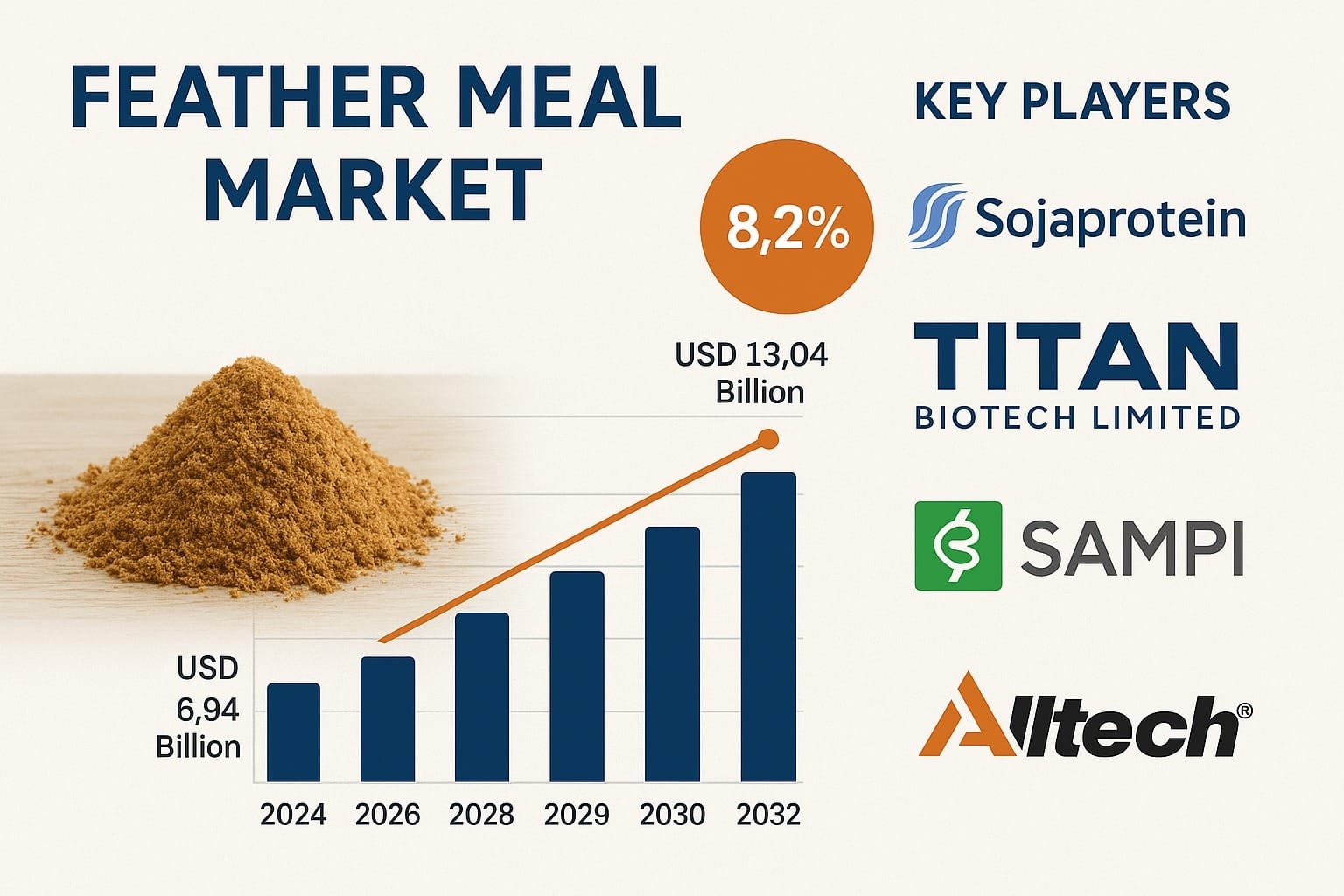
Feather Meal Market size was valued at USD 6.94 Billion in 2024 and the total Feather Meal revenue is expected to grow at a CAGR of 8.2% from 2025 to 2032, reaching nearly USD 13.04 Billion.
Feather Meal Market & Definition:
Feather meal, a high-protein byproduct derived from poultry feathers, is gaining significant traction in the global market. Through a hydrolysis process involving high temperature and pressure, poultry feathers are transformed into a nutrient-rich powder. This product boasts a protein content ranging from 80% to 90%, making it an invaluable component in animal feed formulations and organic fertilizers. The global feather meal market was valued at USD 6.94 billion in 2024 and is projected to reach USD 13.04 billion by 2032, growing at a CAGR of 8.2% from 2025 to 2032.
The versatility of feather meal extends beyond its nutritional profile. Its application in organic fertilizers is particularly noteworthy, given its high nitrogen content, which is essential for plant growth. As the demand for sustainable and eco-friendly agricultural inputs rises, feather meal stands out as a cost-effective and environmentally responsible option. Its production also aligns with waste reduction goals, converting poultry industry byproducts into valuable resources .
Feather Meal Market Growth Drivers & Opportunities:
Several factors are propelling the growth of the feather meal market. The increasing demand for high-quality animal protein sources has led to a surge in the use of feather meal in livestock and aquaculture feeds. Its rich amino acid profile, particularly in cysteine and methionine, enhances animal growth and feed efficiency. Moreover, the rising awareness of sustainable farming practices has amplified the adoption of organic fertilizers, with feather meal being a prime candidate due to its nutrient density and organic nature.
Technological advancements in processing techniques have further augmented the market. Innovations in hydrolysis and rendering processes have improved the digestibility and safety of feather meal, broadening its applicability across various animal species. Additionally, governmental support for sustainable agriculture and waste management practices has created a conducive environment for market expansion. These factors collectively present lucrative opportunities for stakeholders in the feather meal industry.
Feather Meal Market Segmentation:
by Nature
Organic
Conventional
by End User
Meat Industry
Animal Husbandry Industry
Fishing Industry
Agriculture Sector
Others
by Distribution Channel
Supermarket
Specialty Store
Wholesale
B2B
E-Commerce
Others
Feather Meal Market Key Companies Covered in this Research Report:
Sojaprotein
Titan Biotech Limited
SAMPI
Alltech
Nutraferma LLC
Prinova Holdings
Calysta Inc.
Sotexpro
Fenchem
Proliver BvbA
Green Labs LLC
SOPROPECHE
Nutrifish
Valley Proteins, Inc.
North Country Organics
Wudi Musen Biological Ltd.
Boyer Valley Company
FASA Group
Jakom
J.G. Pears
Feather Meal Market Country-Level Analysis:
Feather Meal Opportunities in Vietnam
Vietnam’s burgeoning aquaculture industry is creating substantial demand for high-protein feed ingredients like feather meal. The country’s focus on sustainable farming practices and the government’s support for organic agriculture are further propelling the feather meal market. Local producers are increasingly adopting advanced processing technologies to enhance product quality and meet international standards.
Feather Meal Growth in Thailand
Thailand’s well-established poultry industry provides a steady supply of raw materials for feather meal production. The country’s emphasis on sustainable agriculture and organic farming practices is driving the adoption of feather meal as a natural fertilizer. Collaborations between local producers and international partners are expected to enhance production capabilities and market reach.
Feather Meal Trends in Japan
Japan’s stringent environmental regulations and the growing demand for organic products are influencing the feather meal market. The country’s advanced technology infrastructure supports the development of high-quality feather meal products. Japanese companies are investing in research and development to innovate processing methods and expand the applications of feather meal in various industries.
Feather Meal Consolidation in South Korea
South Korea’s focus on sustainable agriculture and waste management is contributing to the growth of the feather meal market. The country’s robust poultry industry ensures a consistent supply of raw materials. South Korean companies are exploring partnerships and mergers to strengthen their position in the global feather meal market.
Feather Meal Updation in Singapore
Singapore’s strategic location and advanced logistics infrastructure make it a vital hub for the feather meal trade in Southeast Asia. The country’s commitment to sustainable practices and innovation is fostering the development of high-quality feather meal products. Singaporean companies are leveraging technology to optimize production processes and meet the growing regional demand.
Feather Meal Opportunities in the US
The United States holds a substantial share of the global feather meal market, driven by its extensive poultry industry and emphasis on sustainable practices. The integration of feather meal into animal feed is enhancing feed efficiency and reducing reliance on conventional protein sources. Additionally, the growing organic farming sector is utilizing feather meal as a natural fertilizer, contributing to soil health and crop productivity.
Feather Meal Trends in Europe
Europe’s feather meal market is characterized by a strong focus on environmental sustainability and circular economy principles. The utilization of feather meal in organic fertilizers aligns with the region’s agricultural policies promoting eco-friendly practices. Furthermore, advancements in processing technologies are improving the quality and safety of feather meal, facilitating its acceptance across various applications.
Feather Meal Market Conclusion:
The feather meal market is poised for robust growth, underpinned by its multifaceted applications in animal nutrition and sustainable agriculture. Its high protein content and organic nature make it a valuable asset in addressing the global demand for efficient and eco-friendly agricultural inputs. As technological innovations continue to enhance its quality and applicability, and as sustainability becomes a central theme in agriculture, feather meal is set to play an increasingly pivotal role in the industry. Stakeholders are encouraged to capitalize on these trends to drive growth and contribute to a more sustainable agricultural future.

