

Global Apple Juice Market Estimation & Definition
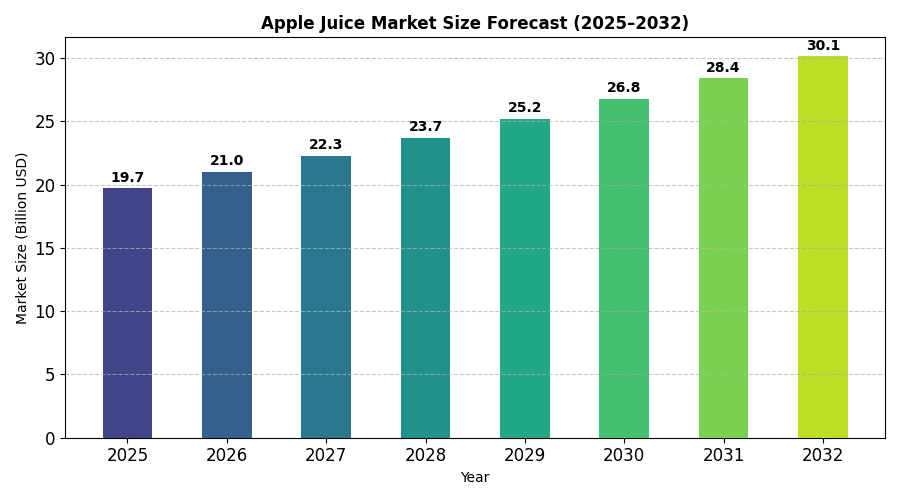
The global apple juice market is projected to expand from USD 18.57 billion in 2024 to USD 30.14 billion by 2032, registering a CAGR of 6.24% during the forecast period. This growth is propelled by evolving consumer preferences, product diversification, and increasing awareness regarding health and wellness.
Apple juice is a liquid extract obtained from the pressing of fresh apples, followed by filtration and pasteurization to enhance clarity and shelf life. It is available in filtered and unfiltered forms and is often produced as a concentrate for long-distance distribution. Its nutritional value, appealing taste, and natural sweetness make it a staple in both household consumption and food processing industries.
Global Apple Juice Market Growth Drivers & Opportunities
Health Consciousness & Nutritional Benefits:
Consumers are increasingly opting for beverages that are both natural and health-enhancing. Apple juice offers vital nutrients such as Vitamin C, potassium, antioxidants, and polyphenols. As a result, it has emerged as a preferred option among health-aware individuals, especially within the post-COVID functional beverage landscape.
Product Innovation & Diversification:
Manufacturers are investing in new formulations such as sparkling apple juice, fortified variants, probiotic blends, and low-sugar organic options. These innovations target broader demographic segments—especially children, fitness enthusiasts, and urban professionals.
Convenient & Sustainable Packaging:
The rise of convenience culture has led to a surge in ready-to-drink formats. At the same time, eco-conscious packaging innovations such as biodegradable bottles and aseptic cartons are playing a pivotal role in brand differentiation and consumer retention.
Rising Demand in Emerging Economies:
Developing countries, especially in Asia-Pacific and Latin America, are showing rapid growth in juice consumption. Rising disposable income, urbanization, and exposure to Western dietary trends are supporting increased per capita consumption of apple-based beverages.
Organic and Filtered Trends:
Filtered apple juice accounts for the largest market share due to its aesthetic clarity and longer shelf life. However, organic and unfiltered products are gaining popularity due to perceived naturalness, especially among environmentally-conscious consumers.
Global Apple Juice Market Segmentation Analysis
The global apple juice market is categorized into the following key segments:
By Type:
Filtered Apple Juice: Dominates the market due to consumer preference for clarity and purity.
Unfiltered Apple Juice: Gaining appeal for retaining more fiber and nutrients, though still niche.
By Nature:
Organic: Witnessing strong growth due to increasing demand for chemical-free, eco-friendly beverages.
Conventional: Continues to hold a significant market portion, especially in price-sensitive regions.
Global Apple Juice Market By Form:
Liquid: The most commonly consumed form, used in households and the food service industry.
Powder: Increasingly adopted in the supplement industry and for convenience in bulk preparation.
Tablets & Capsules: Used in the nutraceutical segment as a source of apple extract or concentrate.
By End Use:
Household/Retail: Represents the largest share, driven by increasing at-home consumption.
Food Industry: Used as a base in processed foods, baked goods, and sauces.
Dietary Supplements: Fast-growing niche due to the use of apple-derived nutrients in wellness formulations.
Global Apple Juice Market Country-Level Insights: United States & Germany
United States:
The U.S. remains a dominant force in the apple juice market with high per capita consumption. Consumers prefer filtered, organic options, with clear growth in premium and health-oriented variants. The country’s robust distribution channels—from supermarkets to online stores—support both established brands and innovative startups. Moreover, increasing use of apple juice in functional foods and dietary supplements is a key trend shaping market dynamics.
Germany:
Germany is among Europe’s top consumers of apple juice and has a strong cultural preference for natural, locally-sourced beverages. Filtered juice is particularly popular, but organic and unfiltered options have also gained traction due to rising ecological awareness. The country boasts efficient supply chains, a regulated organic certification system, and a high demand for cold-pressed and artisanal variants.
Both countries are trendsetters in terms of sustainable packaging, plant-based nutrition, and health-centric beverage innovation, making them critical markets for both global and regional players.
Global Apple Juice Market Competitive Landscape
The apple juice market features a mix of multinational conglomerates, regional manufacturers, and niche health brands. The competitive focus is shifting toward:
Health-Driven Formulations:
Players are investing in R&D for fortified juices with added vitamins, dietary fibers, and immune-boosting ingredients.Brand Differentiation through Sustainability:
Transparency in sourcing, use of biodegradable or recyclable packaging, and ethical marketing are becoming key differentiators.Strategic Collaborations and Expansions:
Mergers, acquisitions, and regional expansion strategies are helping companies penetrate untapped markets and diversify portfolios.
Global Apple Juice Market Key Industry Players Include:
Leading food & beverage corporations with extensive distribution capabilities.
Organic-focused brands offering cold-pressed and additive-free juices.
Nutraceutical companies leveraging apple extracts for supplements.
Local artisan brands delivering unique blends and packaging aesthetics.
These players are leveraging digital platforms for direct-to-consumer sales, enhancing product accessibility while collecting consumer insights for targeted innovation.
Apple Juice Market, Key Players are:
1. PepsiCo, Inc. 2. The Kraft Heinz Company 3. GNC Holdings, Inc. 4. White House Foods Company 5. Carl Kühne KG (GmbH & Co.) 6. Castelo Alimentos S/A 7. Pompeian, Inc. 8. Manzana Products Co. 9. Solana Gold Organics 10. Aspall Cyder Ltd. 11. Nutraceutical Corporation 12. Eden Foods, Inc. 13. Higher Nature Limited 14. Vitane Pharmaceuticals, Inc. 15. Bragg Live Food Products, Inc. 16. Swanson Health Products, Inc. 17. Mautner Markhof Feinkost GmbH 18. Viva Naturals 19. Musselman Premium 20. Mishpacha Apple Juice 21. Motts 22. Simply Balanced Organic Apple Juice 23. Cadia Organic
Global Apple Juice Market Press Release Conclusion
The global apple juice market stands at the intersection of health, convenience, and taste. With a projected rise from USD 18.57 billion in 2024 to USD 30.14 billion by 2032, the sector is not only resilient but thriving on innovation. The shift toward healthier living and clean-label consumption is encouraging companies to adapt rapidly.
The market is ripe with opportunity—particularly in organic, low-sugar, probiotic, and supplement-based formats. Countries like the USA and Germany are providing a blueprint for market success, combining consumer sophistication with regulatory frameworks and supply chain efficiency.
While challenges such as fluctuating raw material prices and short shelf-life persist, innovation in packaging, logistics, and natural preservation methods are actively mitigating these risks.
Call to Action:
Companies seeking to enter or expand within the apple juice market must focus on health-forward innovations, sustainable practices, and tech-enabled distribution. Investing in product diversification, particularly targeting emerging markets and wellness-focused demographics, will be essential to secure long-term growth.
The apple juice market, once a conventional segment, is now a dynamic and evolving arena—where wellness meets innovation, and global demand shows no signs of slowing down.
Read More : https://fmcgpresswire.com/global-carbonated-beverages-market/

