
Linerless Label Market to Reach USD 2.57 Billion by 2032, Driven by Sustainable Packaging Solutions and Expanding Demand Across Food, Retail, and Logistics Industries
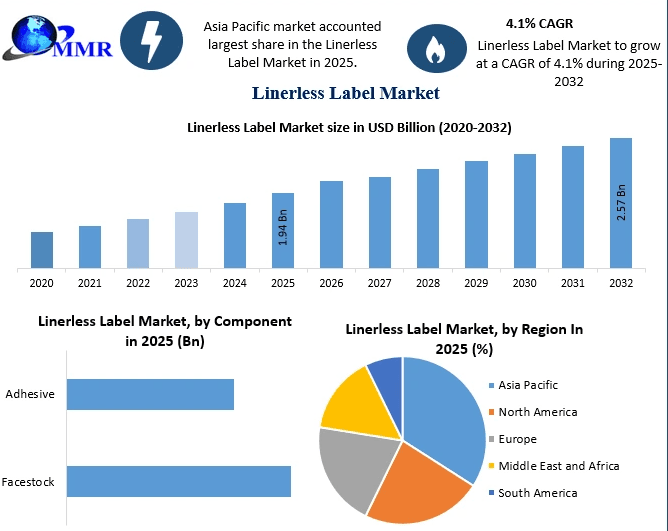
The global Linerless Label Market is witnessing steady expansion as industries increasingly prioritize sustainable packaging, operational efficiency, and cost-effective labeling solutions. According to the latest market analysis, the Linerless Label Market was valued at USD 1.94 billion in 2025 and is projected to reach USD 2.57 billion by 2032, growing at a CAGR of 4.1% during the forecast period (2026–2032).
Intrigued to explore the contents? Secure your hands-on sample copy of the report: https://www.maximizemarketresearch.com/request-sample/122602/
The growing emphasis on reducing packaging waste, improving supply chain efficiency, and meeting stringent environmental regulations is encouraging manufacturers and end-users to adopt linerless labeling technologies. As industries such as food & beverages, retail, pharmaceuticals, and logistics continue to expand globally, linerless labels are emerging as a preferred labeling solution due to their environmental and economic advantages.
Market Overview
Linerless labels are pressure-sensitive labels manufactured without the traditional release liner or backing paper. Unlike conventional labels, these labels eliminate the need for a disposable liner, significantly reducing material consumption, transportation costs, storage requirements, and industrial waste. The absence of liner material also enables manufacturers to improve operational efficiency while supporting sustainability initiatives.
These labels provide excellent product identification, branding, traceability, and regulatory compliance across numerous industries. Their ability to withstand moisture, dust, and environmental contaminants makes them suitable for demanding applications in food packaging, logistics, retail, pharmaceuticals, and personal care.
The increasing adoption of sustainable packaging strategies worldwide, coupled with rising investments in advanced printing technologies and environmentally friendly adhesives, continues to strengthen market growth prospects. Companies are also focusing on enhancing label durability, print quality, and application efficiency to address evolving customer requirements.
Intrigued to explore the contents? Secure your hands-on sample copy of the report: https://www.maximizemarketresearch.com/request-sample/122602/
Key Market Trends
Smart & AI Integration
Digital transformation is gradually influencing the linerless label industry. Manufacturers are integrating smart manufacturing technologies, AI-driven quality inspection systems, and automated printing solutions to improve production accuracy and reduce operational downtime. Artificial intelligence is also supporting predictive maintenance, print optimization, and defect detection, allowing manufacturers to improve productivity while minimizing waste.
Smart labeling technologies integrated with QR codes, RFID, and digital tracking capabilities are gaining popularity across logistics, retail, and pharmaceutical sectors for enhanced inventory management, product authentication, and supply chain transparency.
Multi-Fuel Versatility
Although primarily associated with packaging innovation, the linerless label market is increasingly benefiting from broader industrial versatility. Modern linerless labeling systems are being designed to support multiple packaging materials and production environments, enabling manufacturers to handle diverse product categories with greater flexibility. Compatibility with various printing technologies, adhesives, and substrates allows businesses to optimize operations while reducing equipment changeover times and production costs.
Portability
Portable label printing systems have become increasingly important across logistics, warehouse management, retail operations, and healthcare facilities. Compact linerless label printers enable on-demand labeling while reducing inventory requirements for pre-printed labels. Their ease of use, mobility, and operational efficiency support faster product identification and improved workflow management across multiple industrial environments.
Sustainability
Sustainability remains the defining trend in the linerless label market. Since linerless labels eliminate release liners, manufacturers consume less raw material while significantly reducing packaging waste. This contributes to lower carbon emissions throughout production, transportation, and disposal processes.
Governments and organizations worldwide continue implementing stricter environmental regulations that encourage sustainable packaging solutions. Consequently, businesses are increasingly replacing conventional labels with linerless alternatives to achieve corporate sustainability goals, reduce waste management costs, and improve resource efficiency.
Top Market Drivers
One of the primary drivers fueling the linerless label market is the global transition toward environmentally responsible packaging solutions. Companies are actively seeking alternatives that reduce landfill waste while improving operational performance.
The rapid growth of the food & beverage industry continues to create significant demand for attractive, durable, and food-safe labels that support branding and regulatory compliance. Increasing consumption of packaged and convenience foods, particularly in emerging economies, further strengthens market expansion.
The booming e-commerce sector also represents a major growth catalyst. Online retailers require efficient, high-volume labeling solutions for shipping, warehousing, and inventory management. Linerless labels help improve operational speed while minimizing material waste and lowering logistics costs.
Additionally, expanding retail infrastructure, growing pharmaceutical production, rising personal care product consumption, and continuous technological advancements in printing equipment are creating new growth opportunities for market participants worldwide.
Despite these positive factors, the market faces certain challenges, including limitations in producing highly customized label shapes, fluctuating raw material prices, and relatively limited awareness regarding advanced linerless labeling technologies in developing markets.
Market Segments
The linerless label market is segmented based on component, adhesion type, printing technology, printing ink, application, and region.
Based on component, the facestock segment dominates the market due to its essential role in label manufacturing. Growing demand for chemically resistant, durable, and sustainable facestock materials such as sugarcane paper, metallized paper, and vellum paper continues to support segment growth.
Based on adhesion type, permanent adhesive labels currently account for the largest market share owing to widespread adoption in logistics and retail applications. However, repositionable labels are expected to experience significant growth during the forecast period as industries increasingly require flexible labeling solutions.
Among printing technologies, flexographic printing maintains market leadership because of its high production speed, cost efficiency, versatility, and compatibility with numerous packaging substrates. Digital printing is also gaining traction due to increasing demand for customized and short-run label production.
Regarding printing ink, water-based inks account for the largest market share because they comply with environmental regulations while providing high-quality printing performance with reduced environmental impact.
By application, the food & beverages segment remains the largest revenue contributor. Rising global consumption of packaged foods, rapid urbanization, expanding supermarket chains, and increasing demand for product traceability continue driving linerless label adoption across food packaging applications. Other significant application areas include pharmaceuticals & personal care, retail, logistics, and industrial packaging.
Intrigued to explore the contents? Secure your hands-on sample copy of the report: https://www.maximizemarketresearch.com/request-sample/122602/
Regional Performance
The Asia-Pacific region continues to dominate the global linerless label market and is expected to maintain its leadership throughout the forecast period. Rapid industrialization, expanding manufacturing activities, growing urban populations, increasing packaged food consumption, and strong economic development across countries such as China, India, Japan, and Southeast Asian nations continue supporting market expansion.
North America remains a significant regional market due to the presence of advanced retail infrastructure, mature logistics networks, and widespread adoption of sustainable packaging technologies. Growing e-commerce activities and increasing investment in automated labeling systems further strengthen regional demand.
Europe continues to experience stable growth driven by stringent environmental regulations, strong pharmaceutical manufacturing, and increasing adoption of recyclable and sustainable packaging materials. The region’s emphasis on circular economy initiatives is encouraging companies to invest in linerless labeling technologies.
Meanwhile, South America and the Middle East & Africa are expected to register gradual market growth as retail modernization, industrial development, and packaging innovation continue expanding across these emerging regions.
Major Key Players
Leading companies operating in the global linerless label market are focusing on production capacity expansion, strategic acquisitions, sustainable product innovation, and advanced adhesive technologies to strengthen their competitive positions.
Major market participants include:
- Coveris
- Avery Dennison Corporation
- Lexit Group AS
- Hub Labels
- Optimum Group
- Bostik
- Ravenwood Packaging
- Innovia Films
- Constantia Flexibles
- Reflex Labels Ltd.
- Proprint Group
- L&N Label Company
- Weber Packaging Solutions
- SATO Europe GmbH
- DuraFast Label Company
Several notable industry developments have accelerated market innovation. Companies have expanded linerless production facilities, introduced environmentally friendly adhesive technologies, invested in advanced coating equipment, and pursued strategic acquisitions to enhance product portfolios and strengthen regional market presence.
Key Trends Shaping the Future
The future of the linerless label market will be influenced by several emerging trends:
- Growing adoption of sustainable and recyclable packaging solutions.
- Increasing implementation of AI-powered printing and quality control systems.
- Rising demand for smart labels featuring QR codes and RFID technologies.
- Expansion of digital and flexographic printing technologies.
- Higher investments in environmentally friendly adhesives and water-based inks.
- Continued growth of e-commerce logistics requiring high-speed labeling solutions.
- Increasing use of portable printing systems for warehouse and retail operations.
- Expansion of linerless label applications across healthcare, pharmaceuticals, and industrial sectors.
As businesses continue prioritizing operational efficiency and environmental responsibility, linerless labels are expected to play a central role in the future of global packaging and labeling industries.
Frequently Asked Questions
1. What was the size of the global Linerless Label Market in 2025?
The global Linerless Label Market was valued at USD 1.94 billion in 2025.
2. What is the expected market value by 2032?
The market is projected to reach approximately USD 2.57 billion by 2032.
3. What is the projected CAGR during the forecast period?
The market is anticipated to grow at a compound annual growth rate (CAGR) of 4.1% between 2026 and 2032.
4. Which region dominates the global market?
Asia-Pacific held the largest market share in 2025 and is expected to maintain its leadership throughout the forecast period due to rapid industrialization, growing packaged food demand, and expanding manufacturing activities.
5. Which application segment holds the largest market share?
The Food & Beverages segment leads the market owing to increasing demand for packaged food, product branding, food safety compliance, and retail expansion.
Most performing reports:
High Protein Coffee Market https://www.maximizemarketresearch.com/market-report/high-protein-coffee-market/75174/
Global Bee Venom Extract Market https://www.maximizemarketresearch.com/market-report/global-bee-venom-extract-market/87246/
India Chocolate Market https://www.maximizemarketresearch.com/market-report/india-chocolate-market/24126/
Connect With Us:
MAXIMIZE MARKET RESEARCH PVT. LTD.
2nd Floor, Navale IT park Phase 3,
Pune Banglore Highway, Narhe
Pune, Maharashtra 411041, India.
+91 9607365656
sales@maximizemarketresearch.com
About Maximize Market Research:
Maximize Market Research is one of the fastest-growing market research and business consulting firms serving clients globally. Our revenue impact and focused growth-driven research initiatives make us a proud partner of majority of the Fortune 500 companies. We have a diversified portfolio and serve a variety of industries such as IT & telecom, chemical, food & beverage, aerospace & defense, healthcare and others.

