
Market Overview
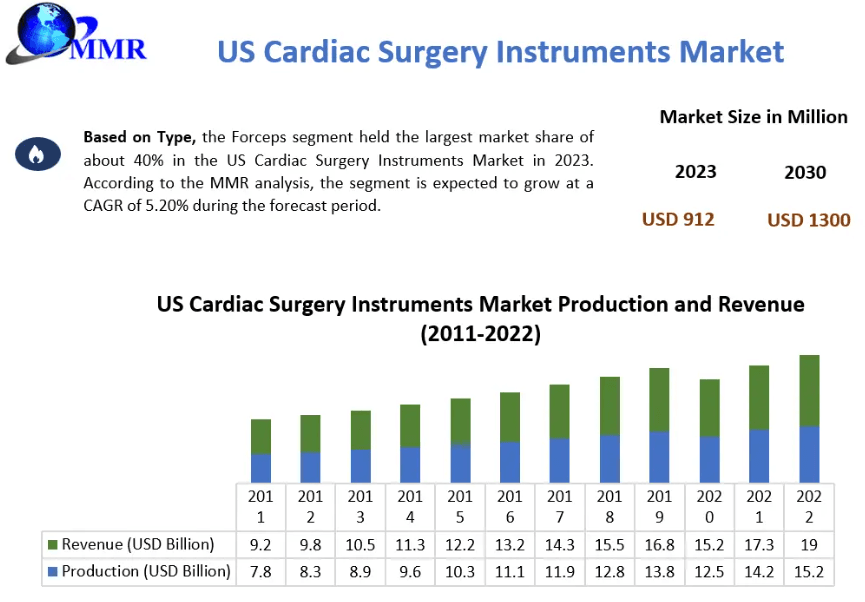
The US Cardiac Surgery Instruments Market was valued at approximately USD 912 million in 2023 and is projected to reach nearly USD 1,300 million by 2030, expanding at a CAGR of 5.19% from 2024 to 2030. The market represents an important segment of the US medical device industry, encompassing specialized surgical instruments used in cardiac procedures, including coronary artery bypass grafting (CABG), heart valve surgery, and paediatric cardiac surgery.
Request Sample Link for More Details: https://www.maximizemarketresearch.com/request-sample/225405/
The market is experiencing steady expansion as the United States faces a growing burden of cardiovascular diseases alongside a rapidly aging population. Cardiovascular conditions remain a major healthcare concern, while advances in cardiac surgery are encouraging hospitals and cardiac centers to adopt instruments offering greater precision, improved ergonomics, and compatibility with minimally invasive procedures.
The US Cardiac Surgery Instruments Market is also being shaped by the transition from conventional open-heart procedures toward less invasive surgical approaches. Minimally invasive cardiac surgery and robotic-assisted procedures require specialized instruments capable of providing surgeons with accurate tissue manipulation, improved visualization, and greater control within confined surgical spaces. These developments are creating opportunities for manufacturers to introduce technologically advanced forceps, clamps, scissors, needle holders, and other surgical instruments.
The increasing number of elderly Americans is another significant factor supporting market development. Older individuals have a greater prevalence of cardiovascular conditions such as coronary artery disease and valvular heart disease, which can require surgical intervention. According to the market analysis, more than 20 million adults in the United States have coronary artery disease, while approximately 5 million people suffer from valvular heart disease, creating sustained demand for cardiac surgical procedures and associated instruments.
Market Drivers and Trends
Increasing Geriatric Population Strengthens Market Demand
The expanding geriatric population is one of the most important growth drivers for the US Cardiac Surgery Instruments Market. Aging is closely associated with a higher incidence of cardiovascular disorders, increasing the need for diagnostic, interventional, and surgical treatment.
Request Sample Link for More Details: https://www.maximizemarketresearch.com/request-sample/225405/
As the proportion of Americans aged 65 and above continues to increase, healthcare providers are expected to encounter a larger number of patients requiring complex cardiac procedures. This demographic shift directly contributes to demand for reliable and precise surgical instruments.
At the same time, elderly patients frequently present with multiple comorbidities, making surgical safety and recovery particularly important. This is encouraging healthcare providers to consider minimally invasive techniques whenever clinically appropriate. Instruments specifically designed for minimally invasive cardiac surgery can help surgeons perform procedures through smaller incisions, potentially reducing trauma, blood loss, hospital stays, and recovery periods.
Growth of Minimally Invasive Cardiac Surgery
The growing adoption of minimally invasive cardiac procedures is transforming the demand profile for cardiac surgery instruments. Traditional cardiac surgery often involves extensive access to the chest, whereas minimally invasive approaches can use smaller access points and specialized surgical equipment.
This trend is increasing demand for compact, ergonomic, and highly precise instruments. Forceps, needle holders, scissors, clamps, and specialized vascular instruments are being developed to provide surgeons with improved control during procedures performed through restricted surgical fields.
Advancements in Robotic-Assisted Surgery
Robotic-assisted cardiac surgery is another technology trend influencing the market. Robotic platforms provide surgeons with enhanced visualization, precision, and instrument articulation. As adoption increases, manufacturers have opportunities to develop instruments specifically designed to integrate with advanced surgical systems.
The growing emphasis on precision surgery is also encouraging investment in instruments with improved materials, ergonomic designs, atraumatic tips, and advanced energy-based capabilities.
Focus on Patient Outcomes and Surgical Efficiency
Hospitals and cardiac centers are increasingly focused on reducing complications, improving patient outcomes, and optimizing operating-room efficiency. Consequently, instrument manufacturers are emphasizing designs that improve handling, precision, sterilization, durability, and procedural efficiency.
The incorporation of features such as bipolar cautery and specialized atraumatic designs is supporting the development of instruments capable of addressing the requirements of modern cardiac procedures.
Primary Market Constraints
Despite favorable growth prospects, the US Cardiac Surgery Instruments Market faces several challenges. High costs and limited affordability and access remain significant restraints, particularly for technologically advanced instruments.
Advanced surgical devices and specialized instruments require substantial investment from healthcare providers. Hospitals must consider acquisition costs, maintenance, sterilization requirements, staff training, and replacement expenses. These financial considerations can influence purchasing decisions, particularly among healthcare facilities operating under tight budgets.
Another challenge is the learning curve associated with advanced cardiac surgical instruments. Surgeons and operating-room staff require appropriate training to use specialized devices safely and effectively. The complexity of certain instruments can increase training requirements and potentially affect adoption.
Sterilization and infection control are also important concerns. Cardiac surgery requires stringent infection-prevention protocols, and inadequate cleaning or sterilization of reusable instruments can increase risks to patients. Healthcare facilities therefore need robust processes for instrument handling and maintenance.
Furthermore, technological disruption may create competitive pressure for conventional surgical instruments. Robotic surgery, advanced energy devices, and increasingly sophisticated minimally invasive platforms can reduce reliance on certain traditional tools in selected procedures.
Key Market Segments
By Type
Based on type, the Forceps segment held the largest market share of approximately 40% in 2023 and is projected to grow at a CAGR of around 5.20% during the forecast period.
Forceps are extensively used in cardiac procedures because they provide surgeons with controlled tissue grasping, manipulation, dissection, and positioning. Their versatility makes them essential across a wide range of cardiac surgeries.
Vascular forceps and grasping forceps are particularly important in procedures where delicate handling of tissues and blood vessels is required. Atraumatic and micro-forceps are gaining attention as minimally invasive procedures become more prevalent because they can facilitate precise manipulation while helping reduce unnecessary tissue damage.
Technological improvements are further supporting the segment. Specialized forceps equipped with advanced functionality, including bipolar cautery capabilities, can improve procedural efficiency and provide surgeons with greater control during complex operations.
Other major product categories include needle holders, scissors, clamps, vascular forceps, grasping forceps, and other forceps. Each category serves a distinct role in cardiac surgery and contributes to the overall growth of the instruments market.
By Application
The market is segmented by application into Coronary Artery Bypass Graft (CABG), Heart Valve Surgery, and Paediatric Cardiac Surgery.
CABG represents an important application area because coronary artery disease remains highly prevalent in the United States. Cardiac surgical instruments are required for tissue manipulation, vessel handling, suturing, cutting, clamping, and other procedural activities.
Heart valve surgery is another important application, supported by the prevalence of valvular heart diseases and the growing demand for surgical and minimally invasive treatment options. Improvements in surgical techniques are encouraging the development of instruments capable of providing greater precision in delicate valve-related procedures.
Paediatric cardiac surgery represents a specialized application segment requiring smaller, highly precise instruments designed for delicate anatomical structures. Continued development of specialized surgical tools can support better outcomes in complex congenital heart procedures.
By End User
Based on end user, the market is divided into Hospitals and Cardiac Centers and Ambulatory Surgery Centers.
Hospitals and cardiac centers account for a major portion of demand because they perform complex and high-risk cardiovascular procedures and maintain specialized cardiac surgery departments. Their requirements include a broad range of reusable and single-use instruments for different procedures.
Ambulatory Surgery Centers are also gaining relevance as healthcare delivery increasingly emphasizes efficiency, cost management, and shorter patient stays. The development of less invasive cardiac procedures could support demand for specialized instruments in suitable outpatient or short-stay environments.
Request Sample Link for More Details: https://www.maximizemarketresearch.com/request-sample/225405/
Competitive Landscape and Major Industry Players
The US Cardiac Surgery Instruments Market includes established medical technology companies with extensive product portfolios, distribution networks, and research and development capabilities. Leading participants focus on improving surgical precision, expanding minimally invasive solutions, strengthening product portfolios, and developing technologies that address changing healthcare requirements.
Major companies identified in the market include:
- Medtronic
- Edwards Lifesciences
- Terumo Corporation
- B. Braun Melsungen AG
- Boston Scientific Corporation
- Abbott Laboratories
- LivaNova
Competition within the market is increasingly influenced by technological innovation, product quality, surgeon preferences, regulatory compliance, pricing, distribution capabilities, and after-sales support. Companies are also expected to benefit from investments in minimally invasive and robotic-assisted surgical technologies.
Manufacturers that can combine precision, durability, ergonomic design, sterilization efficiency, and compatibility with modern surgical platforms are positioned to capture emerging opportunities in the US cardiac surgery instruments industry.
Future Outlook
The outlook for the US Cardiac Surgery Instruments Market remains positive through 2030. The combination of an aging population, persistent cardiovascular disease burden, increasing demand for cardiac procedures, and technological developments is expected to support steady market expansion.
Future growth is likely to center on instruments that enable minimally invasive and robotic-assisted procedures while improving surgeon control and patient outcomes. Manufacturers are expected to place greater emphasis on specialized designs, advanced materials, ergonomic improvements, and technologies that help healthcare providers achieve greater procedural efficiency.
However, market participants will need to address cost pressures and accessibility challenges. Healthcare providers increasingly evaluate medical devices based on clinical value as well as acquisition costs. Consequently, companies that demonstrate improved outcomes, durability, efficiency, and long-term economic value are likely to have a competitive advantage.
Frequently Asked Questions
1. What was the size of the US Cardiac Surgery Instruments Market in 2023?
The US Cardiac Surgery Instruments Market was valued at USD 912 million in 2023.
2. What is the projected size of the US Cardiac Surgery Instruments Market by 2030?
The market is expected to reach approximately USD 1,300 million by 2030.
3. What is the expected CAGR of the US Cardiac Surgery Instruments Market?
The US Cardiac Surgery Instruments Market is projected to grow at a CAGR of 5.19% from 2024 to 2030.
4. Which product segment dominated the market in 2023?
The Forceps segment dominated the market, accounting for approximately 40% of the market share in 2023.
5. What are the key factors driving market growth?
The primary growth factors include the increasing geriatric population, rising prevalence of cardiovascular diseases, growing cardiac surgery volumes, adoption of minimally invasive procedures, and advancements in robotic-assisted cardiac surgery.
About the US Cardiac Surgery Instruments Market Report
The comprehensive US Cardiac Surgery Instruments Market report provides an in-depth assessment of market size, growth rate, market dynamics, segmentation, competitive landscape, and emerging opportunities. The analysis evaluates the industry across type, application, and end-user categories while highlighting the factors influencing demand for cardiac surgical instruments across the United States.
Explore More Reports
Biobatteries Market https://www.maximizemarketresearch.com/market-report/biobatteries-market/215582/
Global Self Priming Pumps Market 2 https://www.maximizemarketresearch.com/market-report/global-self-priming-pumps-market-2/164232/
Global Microbiology Testing Clinical Microbiology Devices Market https://www.maximizemarketresearch.com/market-report/global-microbiology-testing-clinical-microbiology-devices-market/10878/
Connect With Us:
MAXIMIZE MARKET RESEARCH PVT. LTD.
2nd Floor, Navale IT park Phase 3,
Pune Banglore Highway, Narhe
Pune, Maharashtra 411041, India.
+91 9607365656
sales@maximizemarketresearch.com
About Maximize Market Research:
Maximize Market Research is one of the fastest-growing market research and business consulting firms serving clients globally. Our revenue impact and focused growth-driven research initiatives make us a proud partner of majority of the Fortune 500 companies. We have a diversified portfolio and serve a variety of industries such as IT & telecom, chemical, food & beverage, aerospace & defense, healthcare and others.