
Revenue Outlook and Long-Term Market Expansion
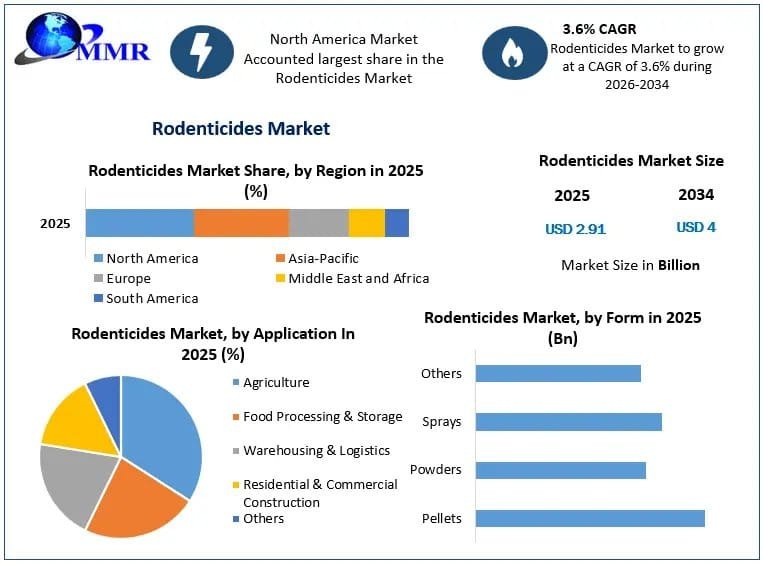
The Global Rodenticides Market was valued at USD 2.91 billion in 2025. The market is projected to expand at a CAGR of 3.6% from 2026 to 2034, reaching approximately USD 4 billion by 2034. The growth outlook is supported by increasing rodent infestations, rising awareness of rodent-borne diseases, urbanization, food-storage expansion, and the growing need for effective pest-management solutions.
The market is also evolving toward safer and more sustainable solutions as demand increases for bio-based, pet-safe, non-toxic, and Integrated Pest Management (IPM)-compatible products.
Understanding the Changing Rodent Control Landscape
Rodenticides are pest-control products designed to manage and control rodent populations across agricultural, residential, commercial, food-processing, storage, and other environments.
Increasing rodent populations are creating concerns related to public health, food contamination, agricultural losses, and property damage. Rodents can transmit diseases including hantavirus, leptospirosis, plague, and salmonellosis, while also damaging electrical wiring, insulation, wooden structures, crops, and stored goods. These risks are strengthening demand for effective rodent-control measures.
Request a Free Sample Report to Access Detailed Market Insights : https://www.maximizemarketresearch.com/request-sample/13268/
Rapid urbanization and population growth can also create favorable conditions for rodent populations through increased waste generation and food availability. At the same time, growing awareness of hygiene and health risks is encouraging households, businesses, and agricultural operators to adopt professional pest-control solutions.
A major industry trend is the transition toward Integrated Pest Management (IPM). IPM combines prevention, monitoring, physical barriers, cultural practices, biological controls, and targeted chemical interventions to reduce reliance on conventional pesticides and address resistance concerns.
Environmental impact remains a major challenge. Rodenticides can unintentionally affect non-target wildlife, including birds of prey, mammals, reptiles, and amphibians. Concerns related to secondary poisoning, bioaccumulation, ecosystem disruption, and contamination are increasing pressure for safer formulations and responsible application practices.
Research Boundaries and Analytical Approach
The study uses 2025 as the base year, with historical information covering 2020–2025 and a forecast period extending from 2026 to 2034. The report evaluates the global market in terms of market value, volume, product categories, applications, distribution channels, rodent types, regional performance, pricing, consumption, production, trade, competitive positioning, and regulatory developments.
The market is analyzed across the following major dimensions:
- By Type: Anticoagulant Rodenticides and Non-anticoagulant Rodenticides
- By Form: Pellets, Powders, Sprays, and Others
- By Rodent Type: Rats, Mice, Chipmunks, Nutria, and Others
- By Distribution: Pest Control Operators (PCOs), Retail/DIY Channels, and Others
- By Application: Agriculture, Food Processing & Storage, Warehousing & Logistics, Residential & Commercial Construction, and Others
- By Region: North America, Europe, Asia Pacific, Middle East & Africa, and South America
The research framework additionally covers consumer behavior, purchasing drivers, price trends, production, global trade, supply-chain dynamics, ESG considerations, regulatory frameworks, competitive benchmarking, investment activity, and technological developments.
Regional Leadership and Emerging Geographic Opportunities
North America held the largest share of the global Rodenticides Market and is expected to record the highest CAGR during the forecast period. The region’s position is supported by urban rodent infestations, strong food-safety requirements, awareness of rodent-borne diseases, and demand for professional pest-control services.
The United States is identified as a dominant country for anticoagulant rodenticides. Growing urbanization, climate-related changes, agricultural practices, and increasing rodent populations are supporting demand for effective control products. Regulatory requirements concerning product safety, effectiveness, and environmental impact also encourage the use of approved formulations.
The regional scope also includes Europe, Asia Pacific, Middle East & Africa, and South America, with country-level coverage including major markets such as China, India, Japan, Germany, France, Brazil, Australia, and others.
Product Categories, Applications and Distribution Dynamics
Type-Based Market Structure
Anticoagulant Rodenticides are expected to dominate the market in 2025. Their leading position is attributed to widespread use, cost-effectiveness, established efficacy, and established supply chains serving agricultural, commercial, and residential applications.
Non-anticoagulant rodenticides represent a smaller market share but are experiencing faster growth as demand increases for eco-friendly, pet-safe, and less-toxic alternatives. Concerns about secondary poisoning, sustainability, and the adoption of IPM practices are contributing to their increasing relevance.
The anticoagulant category includes products such as bromethalin, cholecalciferol, zinc phosphide, and others, while non-anticoagulant categories include first-generation and second-generation products with subsegments such as warfarin, chlorophacinone, diphacinone, difenacoum, brodifacoum, and flocoumafen.
Distribution Channel Performance
Pest Control Operators (PCOs) are expected to represent the leading distribution channel in 2025. Their professional expertise, bulk purchasing capabilities, established customer relationships, and deployment across commercial, industrial, and agricultural applications support their dominant position.
Retail and DIY channels are growing as urban consumers increasingly seek convenient, ready-to-use, and environmentally conscious pest-control products. Online marketplaces and institutional procurement represent additional emerging channels.
Application Landscape
The market serves a broad range of applications, including:
- Agriculture
- Food processing and storage
- Warehousing and logistics
- Residential and commercial construction
- Other pest-control applications
These applications reflect the need to protect crops, stored food, commercial facilities, residential properties, warehouses, and supply-chain infrastructure from rodent-related damage and contamination.
Competitive Positioning and Leading Industry Participants
The global Rodenticides Market features established agrochemical, pest-control, and specialty product companies competing through product development, geographic expansion, innovative formulations, regulatory compliance, and strategic partnerships.
Key companies identified in the MMR report include:
- BASF
- Bayer AG
- Syngenta
- UPL
- Liphatech Inc.
- JT Eaton
- Neogen Corporation
- PelGar International
- SenesTech, Inc.
- Bell Laboratories
Recent developments highlighted by the report include new non-lethal and non-anticoagulant solutions, formulation improvements, distribution partnerships, regulatory clearances, and manufacturing-capacity expansion. These developments indicate increasing industry emphasis on sustainability, resistance management, supply-chain resilience, and specialized pest-control applications.
Request a Sample Copy of the Full Market Research Report : https://www.maximizemarketresearch.com/request-sample/13268/
Essential Questions Addressed by the Market Study
- What was the size of the Rodenticides Market in 2025?
The global market was valued at USD 2.91 billion in 2025. - What growth rate is expected through 2034?
The market is forecast to grow at a 3.6% CAGR from 2026 to 2034. - What will the market be worth by 2034?
The market is projected to reach approximately USD 4 billion by 2034. - Which region currently leads the market?
North America held the largest market share and is expected to register the highest CAGR during the forecast period. - Which product category is expected to dominate?
Anticoagulant Rodenticides are expected to dominate in 2025 because of their established use, affordability, efficacy, and supply infrastructure.
Intelligence and Strategic Value Delivered by the Report
The Rodenticides Market study provides detailed information intended to support business planning, investment evaluation, product development, and competitive strategy. Key offerings include:
- Global market size and revenue forecasts through 2034
- Historical market analysis from 2020–2025
- CAGR and growth outlook
- Type-based market segmentation
- Form-based analysis
- Rodent-species segmentation
- Distribution-channel assessment
- Application analysis
Overall, the Rodenticides Market is expected to experience steady expansion through 2034, with growth increasingly influenced by urbanization, rodent-related health risks, professional pest-management demand, resistance management, and the transition toward safer and more sustainable pest-control solutions.
Discover More Insights Through Our Additional Reports :
Global Refrigeration Lubricants Market https://www.maximizemarketresearch.com/market-report/global-refrigeration-lubricants-market/72914/
Global Biomedical Textiles Market https://www.maximizemarketresearch.com/market-report/global-biomedical-textiles-market/5970/
About Maximize Market Research :
Maximize Market Research Pvt. Ltd. (MMR) is a global market research and consulting company that provides reliable, data-focused, and practical business insights. The firm serves a wide range of industries, including healthcare, pharmaceuticals, technology, automotive, electronics, chemicals, personal care, and consumer goods. Through market forecasts, competitive analysis, strategic consulting, and industry impact assessments, MMR helps organizations understand changing market conditions, identify growth opportunities, and make informed business decisions for long-term success.
Contact Us :
2nd Floor, Navale IT Park Phase 3
Pune Banglore Highway, Narhe
Pune, Maharashtra 411041, India
+91 9607365656
sales@maximizemarketresearch.com