
Market Overview
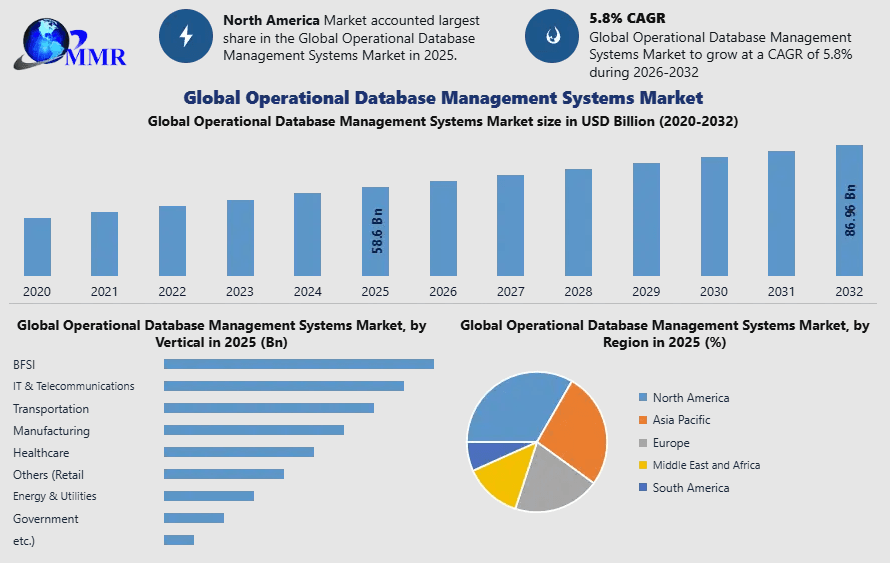
The global Operational Database Management Systems Market is projected to reach nearly USD 86.96 billion by 2032, expanding at a CAGR of 5.8% during the forecast period from 2026 to 2032. The market was valued at approximately USD 58.6 billion in 2025, reflecting the increasing importance of real-time data management, transaction processing, and operational analytics across enterprises.
Intrigued to explore the contents? Secure your hands-on sample copy of the report: https://www.maximizemarketresearch.com/request-sample/62593/
Operational database management systems, commonly associated with Online Transaction Processing (OLTP) databases, are designed to manage data that is continuously created, modified, added, or deleted in real time. These systems support the day-to-day activities of organizations by maintaining transaction data, reference information, system-control data, counters, indicators, and other operational records.
Unlike databases primarily designed for historical analysis, operational database management systems focus on maintaining current and highly detailed information required for routine business processes. They serve as an important data source for data warehouses, analytical platforms, and enterprise applications. As transactions continue to increase across digital platforms, organizations require database environments capable of processing large numbers of concurrent operations while maintaining availability, consistency, and performance.
The rapid expansion of enterprise data is creating both opportunities and challenges for the market. Organizations across banking, financial services, insurance (BFSI), telecommunications, manufacturing, healthcare, transportation, retail, and government are increasingly dependent on database systems to support customer-facing and internal applications. Cloud adoption, digital transformation, connected applications, and the increasing requirement for immediate access to operational information are further contributing to market development.
Market Drivers and Trends
One of the primary factors supporting the growth of the Operational Database Management Systems Market is the rapid increase in enterprise data volumes. Businesses generate substantial quantities of transactional information through websites, mobile applications, enterprise resource planning platforms, customer relationship management systems, payment applications, connected devices, and digital services. Operational database systems allow this information to be captured and updated efficiently as business activities occur.
Intrigued to explore the contents? Secure your hands-on sample copy of the report: https://www.maximizemarketresearch.com/request-sample/62593/
The growing requirement for real-time data processing is another important market driver. Organizations increasingly need immediate access to accurate information for order management, financial transactions, inventory tracking, customer services, logistics, healthcare records, and other operational activities. OLTP-oriented database systems are designed to process frequent transactions while supporting data integrity and availability.
The adoption of cloud-based database infrastructure is also changing the operational database landscape. Cloud deployment allows organizations to access database resources without maintaining all infrastructure on-premise. Scalability, flexible resource allocation, accessibility, and integration with other cloud services are encouraging businesses to consider cloud-based operational database solutions.
Another significant trend is the increasing adoption of Software-as-a-Service (SaaS) and managed database environments. SMEs in particular can benefit from managed database platforms because they can reduce infrastructure management requirements while obtaining access to enterprise-grade database capabilities.
The integration of operational databases with analytics, artificial intelligence, machine learning, and automation technologies is also emerging as an important trend. Businesses increasingly seek to connect transactional information with analytical systems to support faster decision-making. This creates demand for database architectures that can efficiently handle operational workloads while supporting integration with modern data platforms.
Furthermore, the development of distributed databases, NoSQL technologies, in-memory processing, cloud-native architectures, and high-availability database environments is expanding the range of solutions available to organizations with complex workloads.
Primary Market Constraints
Despite strong growth opportunities, the market faces several challenges. One major constraint is the increasing complexity of managing large-scale operational databases. As transaction volumes grow, organizations need appropriate infrastructure, skilled database administrators, monitoring systems, security mechanisms, and performance optimization strategies.
Data security and privacy are also important considerations. Operational databases can contain sensitive financial, customer, healthcare, employee, and business information. Organizations must implement appropriate access controls, encryption, backup mechanisms, authentication procedures, and compliance measures to protect these databases.
The cost of migration and modernization can also limit adoption, particularly for organizations operating legacy database environments. Migrating large volumes of business-critical information to newer database architectures can require significant planning, investment, application changes, testing, and employee training.
Another challenge is maintaining database performance as data volumes and transaction rates increase. Poorly optimized systems can experience slower processing, increased downtime, or operational disruptions. Organizations therefore need continuous monitoring and infrastructure optimization.
The shortage of professionals with specialized database administration, cloud database, distributed systems, and data engineering expertise may further affect implementation and management.
Key Market Segments
The Operational Database Management Systems Market can be segmented based on deployment model, enterprise size, vertical, and geography.
By Deployment Model
The market is divided into Software-as-a-Service and On-premise deployment models. Cloud and SaaS-based solutions are gaining attention because they can provide flexible infrastructure, scalability, and simplified management. On-premise systems continue to be used by organizations that require greater control over infrastructure, data environments, security policies, or legacy applications.
By Enterprise Size
Based on enterprise size, the market is categorized into SMEs and Large Enterprises. Large enterprises represent an important user base because of their extensive transaction volumes, complex application environments, and geographically distributed operations. At the same time, SMEs are increasingly adopting cloud-based database technologies because of their flexible deployment and reduced infrastructure requirements.
By Vertical
Key industry verticals include BFSI, IT and Telecommunications, Transportation, Manufacturing, Healthcare, and Others, including retail, energy and utilities, and government.
The BFSI sector requires reliable and highly available databases for payment processing, account management, transaction recording, fraud monitoring, and customer services. Healthcare organizations use operational databases for managing patient information, administrative processes, scheduling, and other operational workloads. Manufacturing and transportation companies use databases for inventory, logistics, supply chain, production, and asset management.
By Region
The market is geographically segmented into North America, Europe, Asia Pacific, Middle East & Africa, and South America.
North America held the largest market share in 2025, supported by the presence of large enterprises, advanced technology infrastructure, skilled professionals, and strong demand for database management technologies.
Europe accounted for another significant share, with industries including healthcare, manufacturing, hospitality, and transportation increasingly adopting advanced operational data systems.
Asia Pacific is expected to experience significant growth during 2026–2032. Increasing enterprise digitalization, expanding technology infrastructure, growing cloud adoption, and the rising importance of data-driven operations are contributing to demand across countries such as China, Japan, India, South Korea, Australia, Indonesia, Malaysia, and other markets.
Intrigued to explore the contents? Secure your hands-on sample copy of the report: https://www.maximizemarketresearch.com/request-sample/62593/
Major Industry Players
The competitive landscape includes global technology companies, database specialists, cloud service providers, and emerging database technology developers. Major companies covered in the market include:
- International Business Machines Corporation
- SAP SE
- Amazon Web Services
- Google Inc.
- Microsoft Corporation
- Fujitsu
- MarkLogic
- MemSQL
- Oracle Corporation
- MongoDB Inc.
- EnterpriseOB
- ArangoDB
- RavenDB
- DataStax
- Redis Ltd.
- Couchbase Inc.
- MariaDB Corporation
- SQLite
- InterSystems Corporation
- Neo Technologies, Inc.
- Snowflake Inc.
- Databricks
- Cloudera Inc.
- Teradata
- SingleStore
- Aerospike
- Neo4j
- ClickHouse Inc.
- InfluxData Inc.
- PingCAP
- Embarcadero Technologies Inc.
These companies compete through database technology development, cloud integration, product enhancements, partnerships, platform expansion, security capabilities, scalability improvements, and support for emerging data architectures.
Frequently Asked Questions
What is the expected size of the Operational Database Management Systems Market by 2032?
The global Operational Database Management Systems Market is expected to reach approximately USD 86.96 billion by 2032, growing at a CAGR of 5.8% during 2026–2032.
What was the market size in 2025?
The market was valued at approximately USD 58.6 billion in 2025.
What are operational database management systems?
Operational database management systems are databases designed to support day-to-day business operations and real-time transaction processing. They allow organizations to add, modify, retrieve, and delete data as transactions occur.
What are the major market segments?
The major segments include deployment model, enterprise size, and industry vertical. Deployment is divided into SaaS and on-premise, enterprise size includes SMEs and large enterprises, while major verticals include BFSI, IT and telecommunications, transportation, manufacturing, healthcare, and other industries.
Which region held the largest market share?
North America held the largest market share in 2025, supported by large enterprises, technical expertise, advanced infrastructure, and demand for operational database solutions.
Conclusion
The Operational Database Management Systems Market is evolving alongside the broader transformation of enterprise data infrastructure. With the market projected to grow from USD 58.6 billion in 2025 to nearly USD 86.96 billion by 2032, organizations are placing greater emphasis on reliable, scalable, and real-time database environments.
Connect With Us:
MAXIMIZE MARKET RESEARCH PVT. LTD.
2nd Floor, Navale IT park Phase 3,
Pune Banglore Highway, Narhe
Pune, Maharashtra 411041, India.
+91 9607365656
sales@maximizemarketresearch.com
About Maximize Market Research:
Maximize Market Research is one of the fastest-growing market research and business consulting firms serving clients globally. Our revenue impact and focused growth-driven research initiatives make us a proud partner of majority of the Fortune 500 companies. We have a diversified portfolio and serve a variety of industries such as IT & telecom, chemical, food & beverage, aerospace & defense, healthcare and others.