
Air Pollution Control Systems Market to Reach USD 131.36 Billion by 2034, Supported by Industrial Expansion and Stricter Emission Management
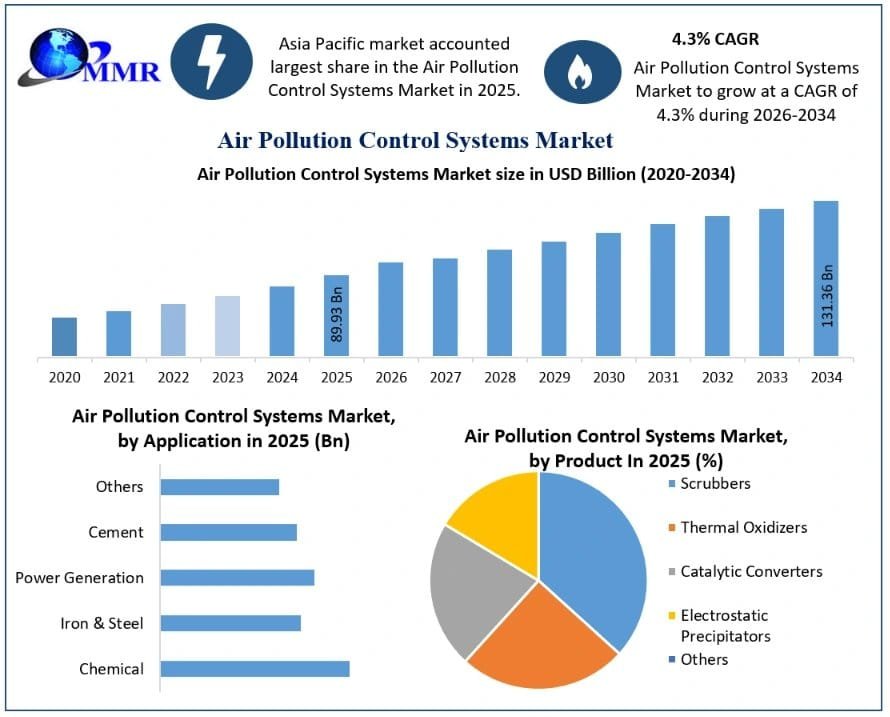
The Air Pollution Control Systems Market was valued at USD 89.93 billion in 2025 and is projected to reach USD 131.36 billion by 2034, expanding at a CAGR of 4.3% from 2026 to 2034. Rapid industrialization, urban populations, respiratory-health concerns, and demand for cleaner environments are shaping the market. Increasing investment in power generation, chemicals, iron and steel, cement, and other pollution-intensive industries is creating sustained demand for emission-control equipment. Manufacturers are focusing on energy-efficient systems, digital monitoring, advanced filtration, and technologies capable of controlling multiple pollutants. Opportunities are emerging from modernization and retrofit projects, particularly where aging plants must improve environmental performance without replacing entire production assets. Developing-economy industrial expansion and cleaner production requirements are creating opportunities for system suppliers and engineering companies.
U.S. Market Trends and Investment
The U.S. market is experiencing a complex transition in 2025 as electricity demand rises alongside changes in federal environmental policy. The U.S. Environmental Protection Agency proposed in June 2025 to repeal federal greenhouse-gas emissions standards for fossil-fuel power plants and amendments to the Mercury and Air Toxics Standards. While the proposals could reduce compliance costs and alter investment timing for some operators, the installed base of pollution-control equipment, state-level requirements, industrial modernization, and demand from data centers continue to support air-quality technologies. U.S. investment is increasingly focused on upgrades, maintenance, monitoring, efficiency improvements, and emissions-control retrofits. Suppliers offering flexible, cost-effective systems can benefit.
Market Segmentation: Largest Shares
By product, the Scrubbers segment held the dominant position in the global Air Pollution Control Systems Market in terms of revenue. Scrubbers remove particulate matter and gases using liquid-based treatment and are widely applied for contaminant control. By application, power generation is expected to witness the fastest growth through the forecast period, while iron and steel is the highest-growth application. By region, Asia Pacific held the highest market share and is projected to maintain its leadership, supported by industrial expansion and investment in power generation, chemicals, mining, and heavy industry.
Access a Free Sample Report Copy : https://www.maximizemarketresearch.com/request-sample/20592/
Competitive Analysis
The competitive landscape includes established engineering and environmental technology companies. Mitsubishi Power Systems Americas supplies air-quality control systems combining selective catalytic reduction, electrostatic precipitation, and flue-gas desulfurization. Its portfolio includes particulate, SOx, NOx, and mercury-control solutions.
Thermax Limited is expanding its air-pollution-control capabilities, particularly scrubbers for semiconductor and electronics industries. Its 2024-25 activities emphasized sustainable energy and environmental solutions, while product innovation and international expansion can broaden its market.
Babcock & Wilcox Enterprises strengthened its environmental business in 2025. In December, it announced a $40 million contract for advanced low-pressure wet gas scrubbing technology at a Canadian petroleum refinery. The technology controls sulfur dioxide and can integrate NOx and particulate controls, highlighting demand for multi-pollutant systems.
CECO Environmental advanced its industrial environmental portfolio through the January 2025 acquisition of Profire Energy, adding intelligent combustion-control capabilities. CECO also develops scrubbers, regenerative thermal oxidizers, VOC concentrators, dust collectors, and filtration technologies, supporting integrated solutions.
GE Company, now represented through GE Vernova businesses, continues investing in air-quality-control upgrades, particulate solutions, wet and dry FGD, and NOx technologies. In 2025, GE Vernova also advanced direct-air-capture technology using solid sorbents, expanding the broader emissions-control opportunity.
Regional Analysis
Asia Pacific is the leading region in coming years. China is a major contributor because of its large manufacturing base, power-generation capacity, urbanization, and need to reduce industrial emissions. Japan remains an important technology-driven market, supported by advanced industrial processes and environmental standards. Germany, France, and the UK contribute through industrial modernization, emissions compliance, and cleaner manufacturing. In the United States, established environmental-control infrastructure, industrial activity, and modernization of power and manufacturing assets sustain demand. Environmental policies and emissions standards encourage investment in filtration, scrubbing, catalytic treatment, monitoring, and retrofit technologies.
Key Players
Key players identified in the market include Ionisation Filtration Industries PVT LTD, Joriki Engineering, Alfa Enterprises, Rieco Industries Limited, Horizon Services, Mitsubishi Power Systems Americas, Thermax Limited, Amec Foster Wheeler, Monroe Environmental Corp., Anguil Environmental Systems, Inc., Babcock & Wilcox Enterprises, Inc., CECO Environmental Corp., CTP Chemisch Thermische Prozesstechnik GmbH, Durr AG, GE Company, Honeywell International Inc., The Fives Group, Zeeco Inc., CODEL International Ltd, and AMETEK Land.
Why This Market Matters Now
Air pollution control is moving from a compliance-driven purchase to a strategic industrial investment. Companies must balance production growth, energy costs, environmental performance, and reliability. Rising electricity demand, industrial expansion, public-health concerns, and aging facilities are increasing the need for technologies that capture pollutants efficiently and economically. The market also benefits from the convergence of pollution control with digital monitoring, advanced materials, energy optimization, carbon management, and retrofit engineering. These trends create opportunities for technology developers and investors while supporting cleaner industrial growth worldwide.
Explore More Related Reports:
Global Unmanned Sea System Market https://www.maximizemarketresearch.com/market-report/global-unmanned-sea-system-market/54488/
Positive Displacement Pumps Market https://www.maximizemarketresearch.com/market-report/global-positive-displacement-pd-pumps-market/82937/
About Maximize Market Research
Maximize Market Research Pvt. Ltd. (MMR) is a global market research and consulting company that provides reliable, data-focused, and practical business insights. The firm serves industries including healthcare, pharmaceuticals, technology, automotive, electronics, chemicals, personal care, and consumer goods. Through market forecasts, competitive analysis, strategic consulting, and industry impact assessments, MMR helps organizations understand changing market conditions, identify growth opportunities, and make informed business decisions for long-term success.
Contact Us
2nd Floor, Navale IT Park Phase 3
Pune Banglore Highway, Narhe
Pune, Maharashtra 411041, India
+91 9607365656
sales@maximizemarketresearch.com