
Urea Market to Reach USD 56.72 Billion by 2032, Driven by Rising Agricultural Demand and Sustainable Fertilizer Production
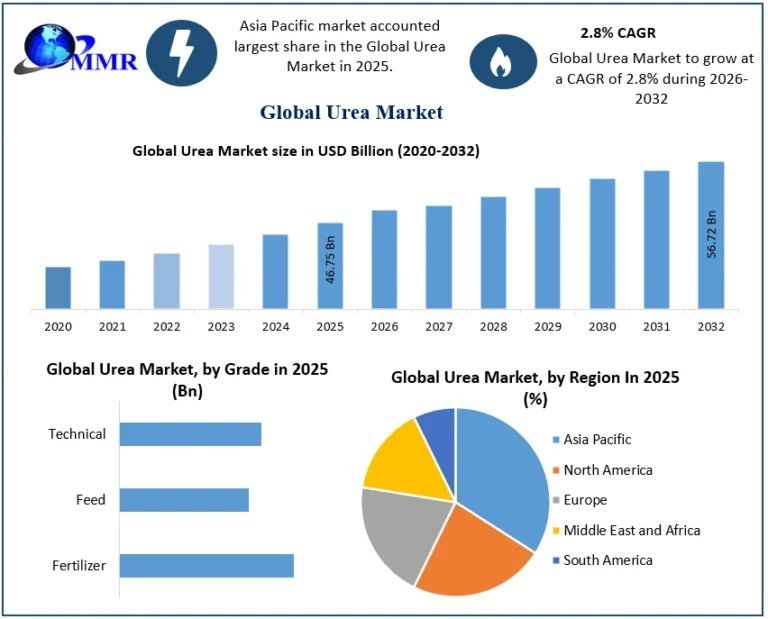
The Urea Market was valued at USD 46.75 billion in 2025 and is projected to reach nearly USD 56.72 billion by 2032, growing at a compound annual growth rate (CAGR) of 2.8% during the forecast period from 2026 to 2032. According to Maximize Market Research, increasing demand for nitrogen-based fertilizers, growing agricultural productivity requirements, expanding industrial applications, and advancements in sustainable fertilizer manufacturing are expected to support market expansion. Urea remains an essential agricultural input because of its high nitrogen content, affordability, and effectiveness in supporting crop growth. Additionally, increasing applications in chemical manufacturing, industrial resins, and automotive emission-control technologies are creating opportunities for manufacturers worldwide.
Urea Market Estimation, Growth Drivers, and Opportunities
The Urea Market is experiencing steady growth as agricultural producers seek to improve crop yields and meet rising global food requirements. With a nitrogen content of approximately 46%, urea is widely used to support the growth of cereals, grains, vegetables, fruits, and other agricultural crops. Population growth, limited arable land, and the increasing need for food security are encouraging farmers to adopt effective fertilizer solutions.
Government fertilizer subsidies, agricultural modernization programs, and precision farming practices are further supporting demand. Developing economies continue to offer substantial opportunities because of their large agricultural sectors and growing fertilizer consumption.
Industrial applications are also creating new growth opportunities. Urea is used in urea-formaldehyde resins, adhesives, plastics, and diesel exhaust fluid (DEF), which helps reduce nitrogen oxide emissions from diesel-powered vehicles. Manufacturers investing in energy-efficient production, enhanced-efficiency fertilizers, carbon capture, and low-carbon ammonia technologies can strengthen their competitiveness. However, natural gas price fluctuations, environmental concerns, and international supply-chain disruptions remain important challenges for the industry.
Request Your Sample Market Report PDF : https://www.maximizemarketresearch.com/request-sample/26788/
United States Market Trends and Investment Outlook
The United States represents an important market for urea because of its extensive commercial agriculture sector, established fertilizer distribution networks, and demand for nitrogen nutrients across major crop-producing regions. In 2025, fertilizer market conditions continued to highlight the importance of domestic production capacity, reliable imports, and efficient supply-chain management. Investment interest also remained focused on improving nitrogen fertilizer production efficiency and reducing the carbon intensity of ammonia manufacturing, a key intermediate in urea production. Federal incentives supporting eligible carbon capture projects have helped strengthen the business case for certain low-carbon industrial investments. Furthermore, demand from corn and other nitrogen-intensive crops supports fertilizer consumption, while precision agriculture technologies encourage more targeted nutrient application. These trends create opportunities for established producers to improve operational performance and explore lower-emission manufacturing pathways.
Urea Market Segmentation: Largest Market Share
By Grade: Agricultural-grade urea holds the largest market share because of its extensive use in crop fertilization. Its high nitrogen concentration, cost-effectiveness, and widespread availability make it a preferred nutrient source for farmers. Increasing agricultural productivity requirements and government support for fertilizer accessibility continue to reinforce the segment’s dominance.
By Application: The fertilizer segment accounts for the largest market share. Urea is widely applied to improve plant growth and agricultural productivity across diverse cropping systems. Its established distribution infrastructure, compatibility with conventional farming practices, and importance in food production support its leading position. Growing fertilizer consumption in major agricultural economies is expected to sustain demand throughout the forecast period.
Competitive Analysis: Five Major Urea Industry Participants
Competition in the global urea industry is influenced by manufacturing capacity, access to natural gas, production efficiency, distribution networks, and sustainability investments. The following companies are prominent industry participants identified in the market landscape; their individual global urea market shares are not quantified in the supplied market information.
- Nutrien Ltd.
Nutrien benefits from integrated fertilizer production and an extensive agricultural retail network. Its strategic priorities include operational optimization, digital agriculture, and improved nutrient management. Connecting fertilizer supply with agricultural advisory services enables the company to support efficient fertilizer use and strengthen relationships with growers.
- CF Industries Holdings, Inc.
CF Industries is a major nitrogen fertilizer producer with substantial manufacturing capabilities. Its strategic focus includes low-carbon ammonia, carbon capture and storage, and manufacturing efficiency. These initiatives can help reduce production-related emissions while supporting future demand for nitrogen fertilizers and lower-carbon industrial feedstocks.
- BASF SE
BASF participates in the broader chemicals and industrial materials landscape, including applications associated with urea-based products. Its emphasis on process efficiency, chemical innovation, and sustainability creates opportunities across industrial value chains. Continued demand for engineered materials, resins, and chemical intermediates supports the wider industrial relevance of urea.
- OCI Global
OCI Global has an established presence in nitrogen fertilizers and industrial chemicals. Its strategic focus on ammonia, hydrogen, and lower-carbon production pathways positions it to participate in the transition toward more sustainable fertilizer manufacturing. Cleaner production technologies could help address increasing environmental expectations across agricultural supply chains.
- Acron Group
Acron Group is an international mineral fertilizer producer serving agricultural markets. Its manufacturing and distribution capabilities support fertilizer availability across multiple markets. Improvements in production efficiency, product quality, and logistics can strengthen its competitive position as farmers and distributors respond to changing fertilizer requirements.
These companies operate in a competitive environment where technological improvements, production economics, and reliable product availability are increasingly important. Their broader strategic priorities offer potential opportunities, although individual investment announcements and product-specific policy changes should be assessed separately.
Regional Analysis: United States, United Kingdom, Germany, France, Japan, and China
United States: The US market benefits from large-scale farming, demand for corn and other major crops, and established fertilizer infrastructure. Domestic nitrogen production and investment in lower-carbon ammonia technologies support long-term industry development.
United Kingdom: Agricultural nutrient management requirements and environmental policies encourage efficient fertilizer application. Demand is influenced by crop production needs, fertilizer affordability, and the adoption of sustainable farming practices.
Germany: Germany’s established chemical industry and agricultural sector support demand for urea and related products. Industrial decarbonization objectives and energy-efficiency initiatives encourage manufacturers to evaluate lower-emission production technologies.
France: France’s extensive agricultural industry supports fertilizer consumption across cereal production and other farming activities. Agricultural sustainability initiatives and efforts to improve nutrient efficiency influence purchasing and application practices.
Japan: Japan’s agricultural modernization, focus on resource efficiency, and interest in reducing industrial emissions create opportunities for efficient fertilizer use and advanced manufacturing technologies.
China: China is a major global urea producer and consumer. Its extensive agricultural base, domestic fertilizer manufacturing capacity, and food-security priorities support market development. Agricultural policies and investments in production efficiency influence supply and demand. Asia-Pacific remains the leading regional market, supported by substantial fertilizer consumption across China, India, and other agricultural economies. Individual country market shares are not specified in the supplied report information.
Key Players in the Urea Market
Other notable participants include Acron Group, Agrofert, Achema, Chambal Fertilisers and Chemicals, Coromandel International, Gujarat Narmada Valley Fertilizers & Chemicals, Zuari Agro Chemicals, National Fertilizers Limited, Indorama Corporation, China BlueChemical, PETRONAS Chemicals Group, SABIC, EuroChem Group AG, Qatar Fertiliser Company, and Saudi Arabian Fertilizer Company.
Why This Market Matters Now
The Urea Market is strategically important because fertilizer availability directly influences agricultural productivity, food affordability, and farming economics. Growing food requirements are reinforcing demand, while industrial applications are expanding urea’s role beyond conventional agriculture. At the same time, volatile energy costs, environmental regulations, and supply-chain uncertainties are encouraging manufacturers to improve production efficiency and explore lower-carbon technologies. Companies that combine reliable supply, competitive pricing, technological innovation, and sustainable manufacturing practices will be better positioned to capture emerging opportunities through 2032.
Explore More Related Reports
Air Pollution Control Systems Market https://www.maximizemarketresearch.com/market-report/global-air-pollution-control-systems-market/20592/
Global Cytokinins Market https://www.maximizemarketresearch.com/market-report/global-cytokinins-market/91394/
About Maximize Market Research
Maximize Market Research Pvt. Ltd. (MMR) is a global market research and consulting company providing reliable, data-focused, and practical business insights. The company serves industries including healthcare, pharmaceuticals, technology, automotive, electronics, chemicals, personal care, and consumer goods. Through market forecasts, competitive analysis, and strategic consulting, MMR helps organizations understand changing market conditions, identify growth opportunities, and make informed business decisions.
Contact Us
Maximize Market Research Pvt. Ltd.
2nd Floor, Navale IT Park Phase 3
Pune Bangalore Highway, Narhe
Pune, Maharashtra 411041, India
Phone: +91 9607365656
Email: sales@maximizemarketresearch.com