
Global Insulated Bags Market Overview
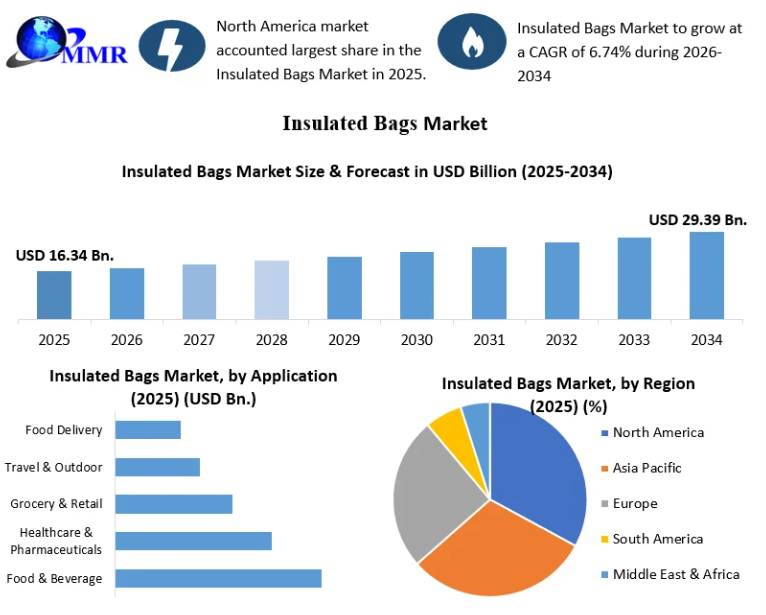
The Global Insulated Bags Market was valued at USD 16.34 billion in 2025 and is projected to reach nearly USD 29.39 billion by 2034, growing at a CAGR of 6.74% during the forecast period from 2026 to 2034. The market is witnessing steady growth due to increasing demand for temperature-controlled packaging solutions across the food and beverage, healthcare, pharmaceutical, grocery retail, travel, and outdoor recreation industries. Rising online food ordering, expanding grocery delivery services, and the growing need to transport temperature-sensitive products are creating significant opportunities for insulated bag manufacturers worldwide.
Download Free Sample & Check the Latest Market Analysis: https://www.maximizemarketresearch.com/request-sample/24944/
Insulated bags are specially designed bags manufactured using thermal insulation materials that help maintain the temperature of their contents while minimizing the impact of external heat, cold, moisture, and other environmental conditions. These bags are commonly used to transport hot meals, chilled beverages, frozen products, fresh groceries, pharmaceutical products, and biological materials. Depending on their intended applications, insulated bags are available in various sizes, designs, materials, and configurations, including lunch bags, cooler bags, insulated tote bags, backpacks, food delivery bags, and medical transport bags.
The report examines the Global Insulated Bags Market through a detailed analysis of market drivers, restraints, opportunities, challenges, major industry players, and emerging trends. It evaluates key market segments by material type, product type, application, distribution channel, end-use industry, and region. The study also analyzes competitive positioning, product innovation, regional demand patterns, and strategic developments shaping the future of the insulated bags industry.
Global Insulated Bags Market Growth, Size, and Share Analysis
The increasing importance of temperature-controlled transportation is creating favorable conditions for the Global Insulated Bags Market. Businesses across food delivery, grocery retail, healthcare, and outdoor recreation are adopting insulated bags to improve product protection, reduce temperature-related quality deterioration, and enhance convenience.
The market’s expansion is also supported by changing consumer lifestyles, increasing disposable incomes, growing demand for portable food storage, and the rising popularity of reusable shopping products. As businesses seek practical packaging solutions that combine functionality with durability, insulated bags are becoming an increasingly important component of modern distribution and consumer packaging systems.
To know more about the research methodology and detailed market estimates, request a free sample report.
Global Insulated Bags Market Dynamics
Market Drivers
Rising Demand for Online Food Delivery and Convenience Foods
The rapid expansion of online food ordering and delivery services is one of the major factors driving the Global Insulated Bags Market. Consumers increasingly prefer convenient meal delivery options, including restaurant meals, ready-to-eat products, frozen foods, and prepared grocery items. Insulated delivery bags help maintain food temperatures during transportation, supporting product quality and customer satisfaction.
Restaurants, cloud kitchens, catering companies, and third-party delivery providers are increasingly investing in durable thermal bags to improve delivery operations. The continued growth of digital ordering platforms is expected to support demand for insulated bags throughout the forecast period.
Download Free Sample & Check the Latest Market Analysis: https://www.maximizemarketresearch.com/request-sample/24944/
Growing Need for Temperature-Sensitive Pharmaceutical Transportation
The pharmaceutical and healthcare industries require reliable solutions for transporting products that may be affected by temperature fluctuations. Insulated medical bags are used to transport certain medicines, vaccines, biological samples, and diagnostic materials under specified temperature conditions.
Growing healthcare distribution networks, increased attention to pharmaceutical logistics, and the need to protect sensitive medical products are creating additional opportunities for manufacturers. However, specialized medical applications may require validated packaging systems, temperature monitoring, and additional cooling components beyond basic insulation.
Increasing Demand for Reusable and Durable Packaging
Environmental awareness and efforts to reduce single-use packaging are encouraging consumers and businesses to consider reusable insulated bags. These products can be used for grocery shopping, food transportation, picnics, travel, and everyday storage.
Manufacturers are introducing products made with recycled fabrics, durable outer materials, reusable liners, and improved insulation systems. These innovations are helping companies differentiate their offerings while addressing demand for practical and longer-lasting packaging alternatives.
Expansion of Grocery Retail and E-Commerce Logistics
The growth of online grocery shopping and home delivery services has increased the importance of maintaining the quality of chilled, frozen, and perishable products. Insulated bags help retailers and logistics providers transport selected products while reducing exposure to ambient temperature changes.
The increasing availability of grocery delivery services, meal kits, and specialty food products is creating opportunities for insulated packaging solutions across developed and emerging markets.
Market Trends
Innovation in Lightweight and High-Performance Insulation Materials
Manufacturers are increasingly focusing on insulation technologies that provide effective thermal retention without making bags excessively heavy or bulky. Developments in foam insulation, multilayer thermal linings, reflective materials, and improved closures are helping enhance performance and convenience.
Lightweight designs are particularly important for delivery personnel, commuters, students, travelers, and outdoor enthusiasts who require products that are easy to carry and store.
Growing Popularity of Multifunctional Insulated Bags
Insulated bags are expanding beyond conventional lunch bags and food delivery applications. Consumers are increasingly purchasing insulated backpacks, cooler totes, convertible travel bags, and compact soft coolers that combine thermal performance with everyday functionality.
These products are gaining attention in outdoor recreation, camping, sports, picnics, road travel, and family activities. Multifunctional designs allow manufacturers to reach new customer segments and expand their product portfolios.
Increasing Focus on Sustainable Product Development
Sustainability is becoming an important consideration in product design and material selection. Manufacturers are exploring recycled fabrics, durable reusable components, and packaging designs intended to extend product life.
However, the overall environmental impact depends on the materials used, manufacturing processes, product durability, and frequency of reuse. Companies that balance insulation performance, affordability, and material efficiency may gain a competitive advantage.
Market Restraints and Challenges
The relatively high cost of premium insulated bags can limit adoption among price-sensitive consumers and small businesses. Advanced insulation materials, specialized liners, durable construction, and additional cooling components may increase manufacturing costs.
Furthermore, competition from low-cost alternatives, fluctuations in raw material prices, and the need to meet different temperature requirements across applications can create operational challenges. Standard insulated bags may also be insufficient for certain pharmaceutical products that require tightly controlled temperature ranges and documented cold-chain compliance.
Manufacturers must therefore focus on cost optimization, material innovation, product differentiation, and quality improvements to maintain competitiveness.
Global Insulated Bags Market Segment Analysis
The Global Insulated Bags Market is segmented by material type, product type, application, distribution channel, end-use industry, and region.
By Material Type
The market includes PET, fabric, nonwovens, polyethylene, polyurethane, and gel packs used in selected insulated bag systems.
The fabric segment is an important category because fabrics can support a wide range of bag designs, including lunch bags, grocery totes, cooler bags, and delivery carriers. Fabric-based products can incorporate thermal linings, insulation layers, and protective outer materials to improve usability and temperature retention.
Polyethylene and polyurethane materials are also relevant to insulation and protective packaging applications because of their potential to provide lightweight construction and thermal resistance. Gel packs are commonly used as supplementary cooling components in suitable applications rather than as standalone bag materials.
Demand across material categories depends on thermal performance, durability, flexibility, cost, ease of cleaning, and the intended end use.
By Product Type
The product type segment includes lunch bags, cooler bags, insulated tote bags, insulated backpacks, insulated delivery bags, and insulated medical bags.
Insulated lunch bags are widely used by students, office employees, and consumers who carry meals from home. Cooler bags are popular for outdoor recreation, travel, picnics, and transporting chilled beverages or food products.
Insulated delivery bags are essential for restaurants, catering companies, and food delivery operators. These products are generally designed for repeated handling and transportation, with features such as reinforced construction, convenient access, and easy-to-clean interiors.
Insulated medical bags serve specialized transportation requirements for temperature-sensitive healthcare products. Demand for these products depends on pharmaceutical logistics requirements and the degree of temperature control needed.
By Application
The application segment covers food and beverage, healthcare and pharmaceuticals, grocery and retail, travel and outdoor activities, and food delivery.
The food and beverage application represents a significant source of demand due to the growing consumption of packaged foods, takeaway meals, chilled beverages, and perishable products. Insulated bags help support food transportation and temporary temperature maintenance.
Healthcare and pharmaceutical applications create opportunities for specialized thermal packaging products. Grocery and retail businesses use insulated bags to support the transportation of frozen and chilled purchases, while travel and outdoor applications benefit from portable food and beverage storage.
Food delivery remains an important application as restaurants and delivery providers seek practical ways to maintain food quality throughout the last-mile delivery process.
By Distribution Channel
The market is distributed through online platforms, supermarkets, specialty stores, convenience stores, and other retail outlets.
Online distribution channels are becoming increasingly important because consumers can compare product designs, insulation features, capacities, prices, and customer reviews before making purchasing decisions. E-commerce platforms also allow manufacturers and brands to reach customers across multiple geographic markets.
Supermarkets and convenience stores support purchases of reusable grocery bags and everyday insulated products. Specialty stores are important for premium cooler bags, outdoor products, and specialized insulated solutions.
By End-Use Industry
The end-use industry segment includes industrial applications, pharmaceuticals, food and beverages, and other sectors.
The food and beverage industry is a major demand center because insulated bags are used in restaurant delivery, catering, grocery distribution, food storage, and takeaway services.
The pharmaceutical sector uses specialized insulated bags to transport selected temperature-sensitive products. Industrial applications may include the transportation of materials that require temporary thermal protection, depending on their specific characteristics.
The expansion of food delivery networks, healthcare logistics, and consumer retail distribution is expected to support demand across these end-use industries.
Download Free Sample & Check the Latest Market Analysis: https://www.maximizemarketresearch.com/request-sample/24944/
Global Insulated Bags Market Regional Insights
Asia Pacific
Asia Pacific is an important regional market for insulated bags, supported by urbanization, expanding food delivery services, growing e-commerce penetration, and increasing demand for convenience products. Countries such as China, India, Japan, South Korea, and Australia offer opportunities for manufacturers serving food delivery, retail, healthcare, and outdoor recreation markets.
The region’s large consumer base and expanding digital commerce ecosystem support demand for affordable, durable, and reusable insulated bags. Growth in organized retail and pharmaceutical distribution also contributes to the region’s market potential.
North America
North America represents an important market because of established outdoor recreation brands, widespread online grocery services, food delivery demand, and consumer interest in premium cooler bags. The United States and Canada provide opportunities for products designed for camping, travel, sports, meal transportation, and everyday use.
Manufacturers are increasingly emphasizing insulation efficiency, product durability, convenient carrying systems, and recycled materials to differentiate their offerings in a competitive market.
Europe
Europe is expected to remain a significant market, supported by established retail infrastructure, growing interest in reusable packaging, and demand for convenient food transportation solutions. Countries such as Germany, France, the United Kingdom, Italy, and Spain offer opportunities across food delivery, grocery retail, travel, and outdoor applications.
Sustainability considerations and consumer preference for durable products are encouraging manufacturers to explore recycled materials and reusable designs. Compliance with relevant packaging, product safety, and environmental requirements also influences product development.
Middle East and Africa
The Middle East and Africa market is supported by expanding foodservice operations, urban development, retail modernization, and growing demand for convenient transportation of food and beverages. Hot climatic conditions in many locations increase the practical importance of thermal protection for selected products.
Opportunities are emerging in food delivery, catering, hospitality, grocery retail, and healthcare distribution. Market development will depend on product affordability, distribution networks, and the ability to meet specific customer requirements.
South America
South America presents opportunities for insulated bag manufacturers as food delivery services, organized retail, tourism, and outdoor recreation continue to develop. Brazil and Argentina are among the important markets in the region.
Demand is supported by the need to transport food and beverages conveniently, alongside interest in reusable grocery bags and portable coolers. Product pricing, consumer purchasing power, and local distribution capabilities remain important factors influencing regional adoption.
Global Insulated Bags Market Competitive Landscape
The Global Insulated Bags Market is characterized by competition among manufacturers offering a wide range of products for food delivery, grocery retail, healthcare transportation, outdoor recreation, and everyday consumer use. Companies compete through product quality, thermal performance, durability, design innovation, pricing, distribution reach, and brand recognition.
Major industry participants include Novolex, Hotpack Packaging Industries LLC, Coleman, Dometic Group, YETI Holdings, Inc., Igloo Products Corp., PackIt LLC, Thermos L.L.C., Arctic Zone, Engel Coolers, Mammoth Coolers, Wildkin, Everest, Green Bag America, and Hood Packaging Corporation.
Coleman, YETI, Igloo, Dometic, and Engel Coolers focus substantially on cooler products and outdoor applications, while PackIt is associated with freezable insulated bags and portable food storage solutions. Thermos and Arctic Zone serve consumer markets with insulated lunch bags and related thermal products. Novolex, Hotpack Packaging Industries, and Hood Packaging participate in broader packaging markets, including foodservice and specialty packaging solutions.
Competition is increasingly influenced by changing consumer expectations and the need to develop products that combine performance with convenience. Companies are introducing new shapes, improved carrying systems, enhanced insulation, multiple storage compartments, and materials designed for repeated use.
Product diversification is allowing manufacturers to target several customer groups, including students, working professionals, outdoor enthusiasts, delivery personnel, retailers, and healthcare providers. Businesses that develop application-specific products while maintaining competitive pricing may be better positioned to benefit from market expansion.
The competitive environment also creates opportunities for partnerships with retailers, food delivery companies, logistics providers, and distributors. Regional expansion, e-commerce development, product customization, and investment in sustainable materials are additional strategies that may support long-term growth.
Global Insulated Bags Market Recent Developments
Product development across the insulated bags and soft cooler industry increasingly emphasizes versatility, portability, and material improvements. Brands are expanding beyond traditional lunch bags and hard-sided coolers into soft coolers, insulated backpacks, multifunctional totes, and everyday carrying products.
Recent product strategies across the broader category have included the development of freezable bags, recycled-material soft coolers, lifestyle-oriented cooler collections, and insulated backpacks designed for outdoor recreation and daily transportation.
These developments illustrate how manufacturers are seeking to increase their addressable markets by combining thermal functionality with contemporary design and convenience. Individual launch dates and product specifications should be verified against official company announcements before publication.
Global Insulated Bags Market Scope
The Global Insulated Bags Market report provides an overview of historical market performance, current industry conditions, forecast growth, competitive positioning, and emerging opportunities.
Report Coverage:
- Base year: 2025
- Forecast period: 2026–2034
- Historical data: 2020–2025
- Market size in 2025: USD 16.34 billion
- Projected market size by 2034: USD 29.39 billion
- Forecast CAGR: 6.74%
Segments Covered:
- By Material Type: PET, Fabric, Nonwovens, Polyethylene, Polyurethane, and Gel Packs
- By Product Type: Lunch Bags, Cooler Bags, Insulated Tote Bags, Insulated Backpacks, Insulated Delivery Bags, and Insulated Medical Bags
- By Application: Food and Beverage, Healthcare and Pharmaceuticals, Grocery and Retail, Travel and Outdoor, and Food Delivery
- By Distribution Channel: Online, Supermarkets, Specialty Stores, Convenience Stores, and Other Retail Stores
- By End-Use Industry: Industrial, Pharmaceutical, Food and Beverages, and Others
Regions Covered:
- North America: United States, Canada, and Mexico
- Europe: United Kingdom, France, Germany, Italy, Spain, Sweden, Austria, and Rest of Europe
- Asia Pacific: China, South Korea, Japan, India, Australia, Indonesia, Malaysia, Vietnam, Taiwan, Bangladesh, Pakistan, and Rest of Asia Pacific
- Middle East and Africa: South Africa, GCC countries, Egypt, Nigeria, and Rest of the Middle East and Africa
- South America: Brazil, Argentina, and Rest of South America
The report also examines the competitive environment using strategic analytical frameworks, including SWOT, PESTEL, and Porter’s Five Forces, where applicable. These frameworks help evaluate the impact of competitive pressures, regulatory conditions, economic developments, technological progress, and changing consumer preferences on the market.
The study aims to provide businesses, investors, manufacturers, distributors, and other stakeholders with insights into market opportunities, product development priorities, regional growth patterns, and competitive strategies.
Frequently Asked Questions (FAQs)
1. What was the Global Insulated Bags Market size in 2025?
The Global Insulated Bags Market was valued at USD 16.34 billion in 2025.
2. What is the projected size of the Global Insulated Bags Market by 2034?
The market is projected to reach nearly USD 29.39 billion by 2034.
3. What is the expected CAGR of the Global Insulated Bags Market during 2026–2034?
The market is expected to grow at a CAGR of 6.74% during the forecast period from 2026 to 2034.
4. What are the major factors driving the Global Insulated Bags Market?
The key drivers include increasing online food delivery, rising demand for convenience foods, expansion of grocery e-commerce, growing pharmaceutical transportation requirements, and increasing consumer interest in reusable and durable packaging products.
5. What are the major restraints affecting the Global Insulated Bags Market?
The relatively high cost of premium insulated bags, raw material price fluctuations, competition from lower-cost alternatives, and the technical requirements of specialized temperature-controlled applications may constrain market growth.
Conclusion
The Global Insulated Bags Market is expected to experience steady growth through 2034, supported by expanding food delivery services, rising demand for convenience foods, growth in grocery e-commerce, and the increasing importance of temperature-sensitive product transportation. Advancements in insulation materials, improvements in reusable designs, and growing interest in multifunctional consumer products are creating new opportunities for manufacturers.
Connect With Us:
MAXIMIZE MARKET RESEARCH PVT. LTD.
2nd Floor, Navale IT park Phase 3,
Pune Banglore Highway, Narhe
Pune, Maharashtra 411041, India.
+91 9607365656
sales@maximizemarketresearch.com
About Maximize Market Research:
Maximize Market Research is one of the fastest-growing market research and business consulting firms serving clients globally. Our revenue impact and focused growth-driven research initiatives make us a proud partner of majority of the Fortune 500 companies. We have a diversified portfolio and serve a variety of industries such as IT & telecom, chemical, food & beverage, aerospace & defense, healthcare and others.