
Market Overview
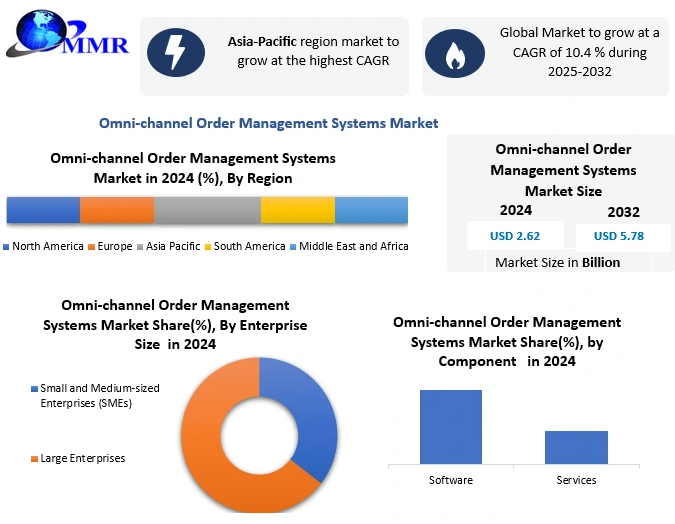
The global Omni-channel Order Management Systems Market was valued at USD 2.62 billion in 2024 and is projected to reach nearly USD 5.78 billion by 2032, growing at a compound annual growth rate (CAGR) of 10.41% during the forecast period from 2025 to 2032. The market is witnessing significant growth as businesses increasingly adopt advanced digital technologies to streamline order processing, improve inventory visibility, and deliver seamless shopping experiences across multiple sales channels.
Dive deeper into market insights, trends, segmentation, and competitive landscape here: https://www.maximizemarketresearch.com/request-sample/94596/
Omni-channel order management systems (OMS) enable organizations to manage and coordinate order-related activities across various customer touchpoints, including e-commerce websites, physical retail stores, mobile applications, marketplaces, and social commerce platforms. These solutions integrate order capture, inventory allocation, payment processing, sourcing, shipping, and fulfillment into a centralized system. By providing real-time visibility into inventory and order status, OMS platforms help businesses optimize operational efficiency, minimize fulfillment delays, and improve customer satisfaction.
The market research report evaluates historical and current industry developments, market dynamics, competitive strategies, and regional growth opportunities. It also examines the potential effects of economic conditions, technological developments, and changing consumer behavior on the market. The analysis is designed to help businesses, investors, technology providers, and industry stakeholders understand market opportunities and make informed strategic decisions.
Market Drivers and Trends
Growing E-commerce and Omni-channel Retail Adoption
The continued expansion of online shopping is one of the major factors driving the global omni-channel order management systems market. Consumers increasingly interact with brands through multiple channels before completing a purchase. A customer may discover a product through social media, compare prices online, inspect the item in a physical store, and complete the transaction through a mobile application.
Managing these interconnected purchasing journeys requires a centralized order management platform capable of coordinating inventory, order processing, and fulfillment across multiple channels. OMS solutions allow retailers to respond to changing customer preferences while maintaining a consistent shopping experience.
Dive deeper into market insights, trends, segmentation, and competitive landscape here: https://www.maximizemarketresearch.com/request-sample/94596/
Increasing Demand for Real-Time Inventory Visibility
Inventory accuracy is becoming increasingly important as businesses manage products across warehouses, distribution centers, retail stores, and online marketplaces. Limited inventory visibility can lead to stockouts, overselling, delayed deliveries, and unnecessary operational expenses.
Omni-channel order management systems provide centralized inventory information, allowing businesses to identify available stock and determine the most appropriate fulfillment location. Real-time inventory visibility also supports improved demand planning, inventory allocation, and replenishment decisions. These capabilities are encouraging retailers and distributors to modernize their order management infrastructure.
Rising Customer Expectations for Flexible Fulfillment
Consumers increasingly expect convenient delivery and collection options, transparent order tracking, and simplified return processes. Retailers are responding by implementing fulfillment strategies that connect online and offline operations.
Features such as buy online, pick up in-store, ship-from-store, same-day delivery, and cross-channel returns are increasing the need for integrated order management solutions. These systems help businesses coordinate fulfillment activities across locations while improving order accuracy and reducing unnecessary transportation costs.
Technological Advancements in Cloud Computing, AI, and Automation
Cloud-based platforms, artificial intelligence, machine learning, and automation are influencing the development of modern OMS solutions. Cloud deployment can provide scalability, centralized access, and integration flexibility, while AI-enabled capabilities can support demand forecasting, intelligent order routing, and inventory optimization.
Automation can also reduce manual intervention in order processing, improve operational consistency, and help businesses manage growing transaction volumes. As companies pursue digital transformation initiatives, demand for scalable and intelligent order management platforms is expected to create additional market opportunities.
Integration Challenges and Implementation Costs
Despite the market’s growth potential, implementation complexity remains a challenge. Many organizations continue to operate legacy enterprise resource planning systems, warehouse management platforms, and retail applications that were not originally designed for integrated omni-channel commerce.
Connecting these systems can require substantial investment, technical expertise, employee training, and process redesign. Small and medium-sized enterprises may face particular challenges when evaluating implementation costs and long-term maintenance requirements. These factors can slow adoption among businesses with limited technology budgets or complex existing infrastructure.
Key Market Segments Covered
The global omni-channel order management systems market is segmented by component, enterprise size, application, and region.
By Component
The market is divided into software and services.
Software: The software segment dominated the market in 2024. OMS software provides the core capabilities required for order processing, inventory management, order orchestration, fulfillment coordination, and returns management. Organizations generally require a foundational software platform before implementing additional omni-channel capabilities, supporting demand for integrated and specialized solutions.
Services: The services segment includes implementation, integration, consulting, support, maintenance, and related professional services. As organizations connect OMS platforms with existing business applications and fulfillment networks, demand for deployment expertise and ongoing technical support continues to create opportunities for service providers.
By Enterprise Size
Based on enterprise size, the market is categorized into small and medium-sized enterprises (SMEs) and large enterprises.
Small and Medium-sized Enterprises: SMEs are increasingly exploring OMS solutions to improve order accuracy, manage inventory across sales channels, and compete with larger retailers. Cloud-based deployment models can help reduce the need for extensive on-premises infrastructure and provide flexible access to advanced order management capabilities.
Large Enterprises: Large enterprises require sophisticated order orchestration capabilities to manage high transaction volumes, geographically distributed inventories, complex fulfillment networks, and multiple brands. Their need for scalability, integration, and centralized operational visibility supports the adoption of enterprise-grade OMS platforms.
By Application
The application segment includes retail and e-commerce, wholesale and distribution, manufacturing, and others.
Retail and E-commerce: Retail and e-commerce represented the dominant application segment in 2024. Businesses in this category must coordinate orders from websites, mobile applications, marketplaces, and physical stores while meeting consumer expectations for accurate inventory information and flexible fulfillment. OMS platforms help retailers manage BOPIS, ship-from-store, online returns, and other interconnected shopping experiences.
Wholesale and Distribution: Wholesalers and distributors use OMS platforms to coordinate customer orders, inventory availability, warehouse operations, and deliveries. Integrated order management can improve order visibility and support more efficient coordination between suppliers, distributors, and business customers.
Manufacturing: Manufacturers are adopting order management technologies to connect customer demand with production schedules, inventory availability, distribution operations, and delivery commitments. These capabilities can support improved order tracking and coordination across manufacturing and fulfillment processes.
Others: Other applications include businesses that require centralized order processing and fulfillment across multiple sales or service channels.
Dive deeper into market insights, trends, segmentation, and competitive landscape here: https://www.maximizemarketresearch.com/request-sample/94596/
Regional Market Insights
The global omni-channel order management systems market covers North America, Europe, Asia Pacific, the Middle East and Africa, and South America.
Asia Pacific is expected to represent a significant growth opportunity during the forecast period, supported by the expansion of e-commerce, increasing digital adoption, and investments in supply chain modernization. Countries such as China and India are experiencing continued development in online retail, digital payments, logistics infrastructure, and technology-enabled business operations.
The region’s large consumer base and expanding digital commerce ecosystem are increasing the need for solutions that can manage high order volumes and provide real-time inventory visibility. Businesses are also investing in automation and integrated supply chain technologies to improve productivity and fulfillment efficiency.
North America remains an important market due to the presence of established technology providers, mature e-commerce infrastructure, and growing investment in digital retail operations. Europe is also contributing to market development as businesses focus on supply chain integration, operational efficiency, and consistent customer experiences across sales channels.
In the Middle East and Africa and South America, the expansion of online retail, digital transformation initiatives, and gradual modernization of logistics networks may support further adoption of omni-channel order management solutions.
Major Industry Players
The global omni-channel order management systems market includes established enterprise software providers and specialized technology companies competing through product innovation, integration capabilities, customer support, and strategic partnerships.
Key industry participants include:
- Aptos
- enVista
- Fluent Commerce
- IBM
- Infor
- Kibo
- Manhattan Associates
- Mi9 Retail
- OneView Commerce
- Oracle
- Radial
- Softeon
- Symphony RetailAI
- Tecsy
These companies participate in the market through solutions designed to improve order orchestration, inventory management, fulfillment coordination, and operational visibility. Competitive strategies may include cloud platform development, automation capabilities, system integration, product enhancements, and partnerships with retail and supply chain technology providers.
The competitive landscape is shaped by the ability of vendors to support complex fulfillment requirements, integrate with existing enterprise applications, and provide scalable solutions for businesses operating across multiple channels and geographic markets.
Market Research Scope and Methodology
The market research report provides a comprehensive assessment of the global omni-channel order management systems market, including historical industry developments, current market conditions, forecast estimates, and competitive analysis.
The study covers the 2025–2032 forecast period and includes historical data from 2019 to 2024. It evaluates market performance by component, enterprise size, application, and region, offering insights into demand patterns and emerging growth opportunities.
The report also examines the competitive environment through company profiles, product portfolios, strategic initiatives, and regional presence. Analytical frameworks, including SWOT/SVOR, Porter’s Five Forces, and PESTEL analysis, are used to assess competitive pressures and relevant macroeconomic, technological, regulatory, and industry factors.
The findings are intended to assist technology providers, retailers, distributors, manufacturers, investors, and business decision-makers in evaluating market developments and identifying potential areas for investment and expansion.
Frequently Asked Questions (FAQs)
1. What was the global omni-channel order management systems market size in 2024?
The global omni-channel order management systems market was valued at USD 2.62 billion in 2024.
2. What is the projected market size by 2032?
The market is expected to reach nearly USD 5.78 billion by 2032.
3. What is the expected CAGR of the omni-channel order management systems market?
The market is projected to grow at a CAGR of 10.41% during the forecast period from 2025 to 2032.
4. Which component dominated the market in 2024?
The software segment dominated the market in 2024, supported by demand for core order processing, inventory management, and fulfillment orchestration capabilities.
5. Which application segment held the leading position in 2024?
Retail and e-commerce represented the dominant application segment in 2024, driven by the need to coordinate customer orders across online and offline sales channels.
Conclusion
The global omni-channel order management systems market is positioned for continued expansion as businesses prioritize connected commerce, efficient inventory utilization, and flexible order fulfillment. With market revenue projected to increase from USD 2.62 billion in 2024 to nearly USD 5.78 billion by 2032, technology providers have opportunities to address the evolving requirements of retailers, manufacturers, wholesalers, and e-commerce businesses.
As digital commerce and supply chain networks become increasingly interconnected, omni-channel order management systems are expected to remain an important technology category for businesses pursuing scalable, customer-focused, and data-driven operations.
Connect With Us:
MAXIMIZE MARKET RESEARCH PVT. LTD.
2nd Floor, Navale IT park Phase 3,
Pune Banglore Highway, Narhe
Pune, Maharashtra 411041, India.
+91 9607365656
sales@maximizemarketresearch.com
About Maximize Market Research:
Maximize Market Research is one of the fastest-growing market research and business consulting firms serving clients globally. Our revenue impact and focused growth-driven research initiatives make us a proud partner of majority of the Fortune 500 companies. We have a diversified portfolio and serve a variety of industries such as IT & telecom, chemical, food & beverage, aerospace & defense, healthcare and others.