
Market Overview
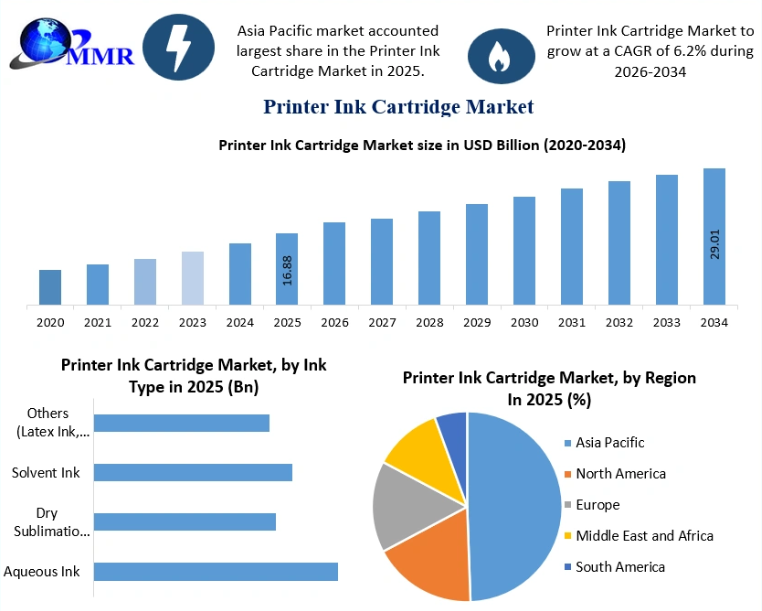
The global Printer Ink Cartridge Market was valued at USD 16.88 billion in 2025 and is projected to reach nearly USD 29.01 billion by 2034, growing at a compound annual growth rate (CAGR) of 6.2% during the forecast period from 2026 to 2034. Market growth is supported by the continued use of inkjet printers across residential, educational, commercial, and institutional settings, alongside advancements in ink formulation, cartridge design, and printing efficiency.
Feel free to request a complimentary sample copy or view a summary of the report: https://www.maximizemarketresearch.com/request-sample/68567/
Printer ink cartridges are essential components of inkjet printing systems. They store and deliver ink to the printhead, which deposits ink onto paper or other printing surfaces to produce text, images, graphics, and documents. Depending on the printer model and application, cartridges may contain individual ink reservoirs or multiple colors within a single unit. Common ink colors include cyan, magenta, yellow, and black, which are combined to reproduce a wide range of colors and shades.
The market report examines historical developments, current market conditions, future growth opportunities, competitive strategies, and regional trends. It also evaluates market segments by ink type, application, and distribution channel to provide a comprehensive understanding of the industry’s evolving structure.
Market Drivers and Trends
Increasing Demand for Printing Across Educational and Commercial Institutions
The expanding use of printers in educational institutions, offices, healthcare facilities, and government organizations remains an important driver of the Printer Ink Cartridge Market. Schools and colleges require printed textbooks, assignments, examination papers, learning materials, certificates, and administrative documents. Similarly, businesses depend on printers for contracts, invoices, reports, customer communications, and internal records.
Growing investment in education and the expansion of educational infrastructure in developing economies are supporting demand for printing equipment and consumables. As printer installations increase, the need for replacement ink cartridges also rises, creating recurring revenue opportunities for manufacturers and distributors.
Feel free to request a complimentary sample copy or view a summary of the report: https://www.maximizemarketresearch.com/request-sample/68567/
Technological Advancements in Ink and Cartridge Design
Continuous innovation in ink formulation and cartridge engineering is influencing market development. Manufacturers are working to improve color accuracy, print resolution, drying time, durability, and ink utilization. These improvements are particularly important for customers who require professional-quality photographs, promotional materials, graphics, and business documents.
Smart cartridges equipped with electronic chips and monitoring capabilities can communicate with compatible printers to provide ink-level information and cartridge authentication. Such technologies help users monitor consumable levels, reduce unexpected interruptions, and simplify maintenance.
High-capacity cartridges are another emerging trend, particularly among businesses and institutions with substantial printing requirements. These products can reduce the frequency of cartridge replacement and improve operational convenience for customers with high-volume workloads.
Growing Focus on Sustainable Printing Solutions
Environmental sustainability is becoming increasingly relevant to the printer consumables industry. Used ink cartridges contribute to waste generation when they are discarded without appropriate collection, reuse, or recycling. In response, manufacturers and specialized recycling companies are developing cartridge recovery programs and exploring recycled plastics and other materials.
Remanufactured cartridges, refill services, and take-back initiatives offer alternatives to purchasing new cartridges for every replacement cycle. These solutions may help reduce material consumption and provide cost-conscious consumers with additional purchasing options.
However, the environmental benefits of individual products depend on factors such as cartridge design, collection efficiency, remanufacturing quality, transportation, and end-of-life processing. Manufacturers must therefore balance sustainability objectives with product reliability and printing performance.
Expansion of E-Commerce and Online Distribution
The growth of online retail platforms has changed how consumers and businesses purchase printer ink cartridges. Online channels provide access to original equipment manufacturer (OEM) cartridges, compatible products, remanufactured cartridges, and multi-cartridge packages. Customers can compare prices, review product specifications, and identify cartridges compatible with specific printer models.
Online distribution is particularly valuable for small businesses and households seeking convenient replacement options. Subscription services and automatic replenishment programs can further simplify purchasing by helping customers obtain replacement cartridges before existing supplies run out.
Meanwhile, offline channels, including electronics retailers, office supply stores, authorized distributors, and specialized printing shops, remain important for customers who prefer immediate availability and in-person assistance.
Competition from Alternative Printing Technologies
Despite favorable growth prospects, the market faces challenges from laser printers and refillable ink-tank systems. Laser printers use toner rather than liquid ink and are often preferred for high-volume document printing. Ink-tank printers, meanwhile, can reduce the cost per page by allowing users to refill integrated ink reservoirs instead of frequently replacing conventional cartridges.
The increasing availability of these alternatives may constrain demand for traditional ink cartridges in certain applications. Manufacturers are responding by improving cartridge efficiency, developing specialized inks, offering higher-yield products, and strengthening compatibility with modern printing systems.
The shift toward digital documentation also remains a long-term challenge. Businesses adopting electronic signatures, digital records, cloud-based collaboration, and paperless workflows may reduce their overall printing requirements. Consequently, manufacturers must continue developing products and business models that address changing customer needs.
Key Market Segments Covered
The Printer Ink Cartridge Market is segmented by ink type, application, distribution channel, and region. These categories help explain differences in customer requirements, product performance, purchasing behavior, and regional demand.
By Ink Type
Aqueous Ink: Aqueous ink uses water as its primary liquid carrier and is widely associated with inkjet printing applications. It is commonly used for documents, photographs, graphics, and other printed materials. Its performance characteristics make it suitable for many residential, office, and professional printing requirements.
Dry Sublimation Ink: Sublimation printing uses specialized inks that transfer dye onto compatible substrates through heat. It is used in applications such as customized apparel, promotional products, decorative materials, and selected specialty printing operations. Demand is influenced by personalized product manufacturing and the expansion of small-scale customization businesses.
Solvent Ink: Solvent-based inks are used in selected inkjet applications where adhesion and durability on suitable substrates are important. They are commonly associated with signage, graphics, and certain industrial printing applications. Product selection depends on substrate compatibility, required durability, and the intended printing environment.
Others: This category includes other ink formulations, such as latex-based inks and specialized solutions, depending on the classification adopted in the market report. These products serve specific printing requirements and may offer particular performance, durability, or environmental characteristics.
By Application
Residential: Residential demand comes from households using printers for school assignments, personal documents, photographs, travel records, and occasional administrative tasks. Purchasing decisions are often influenced by cartridge price, printer compatibility, print quality, and ease of replacement.
Commercial: The commercial segment includes offices, educational institutions, healthcare organizations, government departments, retailers, and businesses with regular printing requirements. Recurring document production and the need for dependable printing supplies support demand in this segment. Commercial buyers often evaluate total printing costs, cartridge yield, reliability, and supply availability when selecting products.
By Distribution Channel
Online: Online distribution includes e-commerce marketplaces, manufacturer websites, authorized digital retailers, and specialized printer-supply platforms. Convenient ordering, broad product availability, and price comparison support this channel’s development.
Offline: Offline distribution includes electronics stores, office supply retailers, wholesalers, authorized resellers, and local printer-supply outlets. These channels provide direct access to products and can help customers identify compatible cartridges or obtain urgent replacements.
Feel free to request a complimentary sample copy or view a summary of the report: https://www.maximizemarketresearch.com/request-sample/68567/
Regional Analysis
The market is analyzed across North America, Europe, Asia Pacific, the Middle East and Africa, and South America.
North America benefits from established business infrastructure, widespread printer adoption, and demand for office and home printing supplies. Europe represents another important market, supported by commercial printing requirements, institutional demand, and growing attention to recycling and resource efficiency.
Asia Pacific offers substantial growth opportunities because of its large population, expanding educational infrastructure, business development, and increasing adoption of printing equipment. China, India, Japan, South Korea, and other regional economies contribute to demand across consumer and commercial applications. The region’s manufacturing capabilities and developing distribution networks also support market expansion.
The Middle East and Africa market is influenced by increasing institutional, commercial, and administrative printing requirements. South America presents opportunities associated with business activity, education, and the replacement of installed printing equipment.
Regional performance varies according to disposable income, printer ownership, the adoption of alternative technologies, product pricing, distribution infrastructure, and the availability of compatible consumables.
Major Industry Players
The global Printer Ink Cartridge Market includes established printer manufacturers, technology companies, cartridge suppliers, and specialized consumables businesses. Competition is shaped by product quality, printer compatibility, pricing, brand recognition, distribution networks, innovation, and sustainability initiatives.
Major companies operating in the market include:
- HP Development Company, L.P.
- Seiko Epson Corporation
- Ricoh Company, Ltd.
- Brother Industries, Ltd.
- Canon Inc.
- Samsung
- Fuji Xerox Co., Ltd.
- Lexmark International, Inc.
- Dell Technologies
- Casio Computer Co., Ltd.
- Ritter Cartridges
- Xerox Corporation
- Static Control Components, Inc.
- Dynamic Cassette International
- Panasonic Corporation
- LD Products
- Easy Inks GmbH
Market participants pursue different competitive strategies, including product development, manufacturing automation, distribution expansion, cartridge recycling, and improvements in ink efficiency. Original equipment manufacturers generally emphasize compatibility and performance within their printing ecosystems, while independent cartridge suppliers compete through pricing, availability, and alternative consumable options.
Innovation is expected to remain an important factor in the competitive landscape. Manufacturers that can balance consistent print quality, reliable performance, competitive operating costs, and responsible resource use will be better positioned to address evolving customer requirements.
The market report evaluates key companies in terms of their product portfolios, strategic initiatives, regional presence, competitive positioning, and business developments. It also uses industry analysis frameworks, including PORTER’s Five Forces, PESTEL, and SWOT/SVOR analysis, to assess competitive conditions and factors influencing future market performance.
Frequently Asked Questions
1. What is the global Printer Ink Cartridge Market size in 2025?
The global Printer Ink Cartridge Market was valued at USD 16.88 billion in 2025.
2. What is the expected market size by 2034?
The market is projected to reach nearly USD 29.01 billion by 2034.
3. What is the expected CAGR of the Printer Ink Cartridge Market during 2026–2034?
The market is expected to grow at a CAGR of 6.2% during the forecast period from 2026 to 2034.
4. What are the major factors driving the Printer Ink Cartridge Market?
Key growth drivers include demand from educational institutions and commercial offices, increasing printer usage, technological advancements in ink formulations and cartridge design, e-commerce expansion, and the need for replacement consumables.
5. Which are the key segments covered in the Printer Ink Cartridge Market report?
The report covers the market by ink type, including aqueous ink, dry sublimation ink, solvent ink, and others; by application, including residential and commercial; and by distribution channel, including online and offline.
Conclusion
The Printer Ink Cartridge Market is expected to maintain steady growth through 2034, supported by recurring consumable demand, continued printing requirements across educational and commercial institutions, and ongoing product innovation. The projected increase from USD 16.88 billion in 2025 to nearly USD 29.01 billion by 2034 reflects the continuing importance of printing supplies across a wide range of applications.
As customer requirements evolve, opportunities will emerge for companies that deliver reliable, cost-effective, and application-specific products. A combination of technological advancement, regional expansion, and sustainability-focused strategies is expected to influence the industry’s competitive direction over the forecast period.
Connect With Us:
MAXIMIZE MARKET RESEARCH PVT. LTD.
2nd Floor, Navale IT park Phase 3,
Pune Banglore Highway, Narhe
Pune, Maharashtra 411041, India.
+91 9607365656
sales@maximizemarketresearch.com
About Maximize Market Research:
Maximize Market Research is one of the fastest-growing market research and business consulting firms serving clients globally. Our revenue impact and focused growth-driven research initiatives make us a proud partner of majority of the Fortune 500 companies. We have a diversified portfolio and serve a variety of industries such as IT & telecom, chemical, food & beverage, aerospace & defense, healthcare and others.