
Anticipated Growth in Revenue
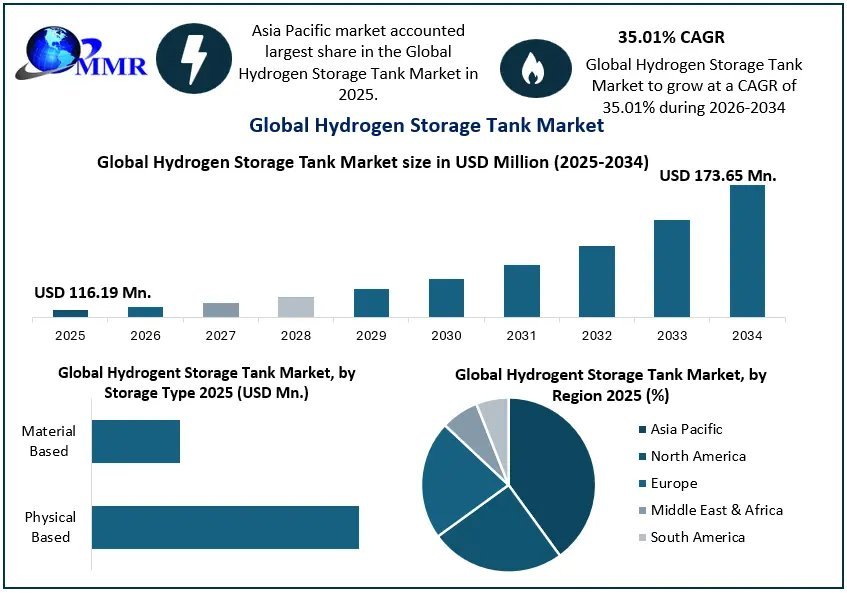
The Global Hydrogen Storage Tank Market was valued at US$ 116.19 million in 2025 and is expected to reach approximately US$ 1,731.65 million by 2034, growing at a remarkable CAGR of 35.01% during the forecast period 2026–2034.
Market Overview
Hydrogen storage tanks are specialized containers designed to store hydrogen safely under high pressure or in other controlled storage conditions. These tanks play an important role in the hydrogen value chain by enabling the storage, transportation, distribution, and utilization of hydrogen across various industries.
The growing global focus on decarbonization and clean energy transition is creating significant opportunities for the hydrogen storage tank industry. Hydrogen is increasingly being considered an alternative energy carrier for reducing carbon emissions in sectors such as transportation, power generation, chemicals, steel manufacturing, and industrial processing.
One of the major factors driving market growth is the increasing adoption of hydrogen-powered vehicles, including fuel-cell electric vehicles, buses, trucks, and material-handling equipment. These vehicles require advanced storage tanks capable of holding hydrogen at high pressure while maintaining safety, durability, and lightweight characteristics.
Request Free Access to the Sample Report : https://www.maximizemarketresearch.com/request-sample/220242/
Technological advancements in composite materials are also supporting market development. Type III and Type IV hydrogen storage tanks are gaining attention because of their high strength-to-weight ratios and suitability for high-pressure hydrogen storage. Type IV tanks, which generally use polymer liners reinforced with carbon-fibre composites, are particularly relevant to automotive and mobility applications.
Government initiatives, investments in hydrogen refuelling infrastructure, and the development of green hydrogen production facilities are further strengthening market opportunities. Countries are increasingly investing in hydrogen ecosystems to support energy security and achieve long-term emissions-reduction targets.
However, high manufacturing costs, expensive composite materials, hydrogen leakage risks, infrastructure limitations, and stringent safety requirements remain important challenges. Continued research into advanced materials, tank designs, and storage technologies is expected to improve performance and support wider commercial adoption.
Scope and Methodology
The Hydrogen Storage Tank Market report provides a detailed assessment of industry trends, market dynamics, technological developments, competitive positioning, and regional growth opportunities through 2034.
The study evaluates the market across product type, material type, storage type, application, end-use industry, and region. It examines the factors influencing hydrogen storage tank adoption, including clean energy investments, hydrogen infrastructure development, fuel-cell vehicle production, and industrial decarbonization.
The research methodology combines primary and secondary research to estimate market size, validate industry developments, and evaluate competitive conditions. It considers industry publications, company information, technology developments, government initiatives, and market data.
The report also uses analytical frameworks such as PORTER’s Five Forces, PESTEL analysis, SWOT analysis, value-chain analysis, and competitive benchmarking to assess industry competition, investment opportunities, supply-chain conditions, and strategic developments.
Regional Insights
Asia Pacific
Asia Pacific is expected to remain a leading regional market, supported by hydrogen infrastructure investments, industrial demand, fuel-cell vehicle adoption, and government initiatives. China, Japan, and South Korea are important contributors to regional development.
China is expanding hydrogen production, storage, transportation, and refuelling infrastructure. Japan is investing in hydrogen supply chains and fuel-cell technologies, while South Korea is promoting hydrogen mobility and clean hydrogen applications. These developments are increasing demand for high-pressure composite tanks and industrial hydrogen storage systems.
North America
North America represents an important market due to investments in clean hydrogen production, industrial applications, and advanced storage technologies. The United States is supporting hydrogen infrastructure development across transportation, refining, chemicals, and energy storage. Canada is also developing clean hydrogen projects and industrial decarbonization initiatives.
Research into Type III and Type IV composite tanks, lightweight storage systems, and high-pressure cylinders is creating opportunities for manufacturers.
Europe
Europe is strengthening its hydrogen ecosystem through decarbonization policies, renewable energy investments, and hydrogen infrastructure development. Germany, France, the Netherlands, and Spain are important markets.
Growing hydrogen adoption in steel production, chemicals, refining, heavy transportation, and renewable energy storage is supporting demand for advanced storage tanks. Investment in hydrogen transportation and distribution networks is also creating opportunities for storage technology providers.
Middle East & Africa
The Middle East & Africa region offers emerging opportunities through investments in green hydrogen production, industrial diversification, and hydrogen export projects. Saudi Arabia, the UAE, and Oman are developing large-scale hydrogen initiatives supported by renewable energy resources.
Egypt, Morocco, and South Africa are also exploring hydrogen production and industrial applications. These projects are expected to increase demand for industrial storage tanks, composite cylinders, and hydrogen transportation infrastructure.
Unlock Your Free Sample Report : https://www.maximizemarketresearch.com/request-sample/220242/
South America
South America is developing its hydrogen market through renewable energy investments and green hydrogen initiatives. Brazil, Chile, and Argentina are exploring hydrogen production for industrial consumption and international exports.
The region’s solar and wind energy resources provide opportunities for renewable hydrogen production, creating potential demand for storage and distribution infrastructure. However, financing requirements and infrastructure development remain important considerations.
Market Segmentation
The Global Hydrogen Storage Tank Market is segmented based on product type, material type, storage type, application, and region.
By Product Type
- Type 1
- Type 2
- Type 3
- Type 4
Type 1 tanks use an all-metal construction and are commonly associated with industrial and stationary storage applications. Type 2 tanks combine a metal liner with partial composite reinforcement.
Type 3 tanks feature a metal liner with full composite wrapping, offering improved strength and reduced weight. Type 4 tanks use a polymer liner with full composite reinforcement and are particularly suitable for high-pressure hydrogen storage in fuel-cell vehicles.
By Material Type
- Metal
- Carbon Fibre
- Glass Fibre
Metal materials provide strength and durability for hydrogen storage applications. Carbon fibre is increasingly used in lightweight composite tanks because of its high tensile strength and favourable strength-to-weight ratio. Glass fibre offers an alternative reinforcement material for composite storage systems.
By Storage Type
- Physical-Based
- Material-Based
Physical-based storage includes compressed gaseous hydrogen and liquid hydrogen storage technologies. Material-based storage involves hydrogen absorption or storage through specialised materials, including metal hydrides and other hydrogen-storage substances.
By Application
- Chemical
- Refinery
- Transportation
- Others
The chemical industry uses hydrogen in ammonia production, methanol manufacturing, and other industrial processes. Refineries require hydrogen for hydroprocessing and desulfurization operations.
Transportation is an important growth application because fuel-cell vehicles, buses, trucks, and other hydrogen-powered mobility solutions require reliable onboard storage systems. Other applications include power generation, industrial processing, and renewable energy storage.
By Region
- North America
- United States
- Canada
- Mexico
- Europe
- Germany
- France
- United Kingdom
- Italy
- Spain
- Rest of Europe
- Asia Pacific
- China
- Japan
- India
- South Korea
- Rest of Asia Pacific
- Middle East & Africa
- Saudi Arabia
- UAE
- South Africa
- Rest of Middle East & Africa
- South America
- Brazil
- Argentina
- Rest of South America
Market Segmentation
The Global Hydrogen Storage Tank Market is segmented based on product, material type, storage type, application, end-use, and region.
By Product
- Type 1
- Type 2
- Type 3
- Type 4
Type 1 tanks feature an all-metal construction and are used in industrial and stationary storage applications. Type 2 tanks combine a metal liner with composite reinforcement.
Type 3 tanks use a metal liner with full composite wrapping, providing improved strength and reduced weight. Type 4 tanks feature a polymer liner with full composite reinforcement, making them suitable for lightweight, high-pressure hydrogen storage, particularly in transportation applications.
By Material Type
- Metal
- Carbon
- Glass
Metal provides structural strength and durability for hydrogen storage applications. Carbon fibre is increasingly used in advanced composite tanks because of its high tensile strength and lightweight characteristics. Glass fibre offers an alternative reinforcement material for composite storage systems.
By Storage Type
- Physical Based
- Material Based
Physical-based storage includes compressed gaseous hydrogen and liquid hydrogen storage. Material-based storage uses specialised materials, including metal hydrides, to store hydrogen through absorption or other material-based processes.
By Application
- Chemical
- Refinery
- Transportation
- Others
The chemical industry uses hydrogen in ammonia production, methanol manufacturing, and other industrial processes. Refineries require hydrogen for hydroprocessing and desulfurization operations.
Transportation is an important growth application because fuel-cell vehicles, buses, trucks, and other hydrogen-powered mobility solutions require reliable onboard storage systems. Other applications include power generation, industrial processing, and renewable energy storage.
By End-Use
- Automotive
- Industrial
- Aerospace & Defence
- Medical
- Other
The automotive sector is creating significant opportunities through the adoption of hydrogen fuel-cell vehicles and commercial transportation. Industrial applications require storage systems for manufacturing, chemical processing, and energy operations.
Aerospace and defence applications include specialised hydrogen storage requirements, while medical applications involve hydrogen storage for relevant healthcare and research purposes.
Explore the Report Sample Before You Buy : https://www.maximizemarketresearch.com/request-sample/220242/
Key Players
The global Hydrogen Storage Tank Market includes established industrial gas suppliers, composite cylinder manufacturers, engineering companies, and hydrogen technology providers. Companies are focusing on advanced storage technologies, lightweight materials, manufacturing efficiency, and strategic collaborations.
Key players operating in the market include:
- Air Products and Chemicals, Inc.
- Linde plc
- Hexagon Composites ASA
- McPhy Energy S.A.
- Praxair, Inc.
- NEL ASA
- Plug Power Inc.
- Hydrogenics Corporation
- Cryostar SAS
- Quantum Fuel Systems LLC
- Luxfer Holdings PLC
- Worthington Industries, Inc.
- INOXCVA
- VRV S.p.A.
- Chart Industries, Inc.
View More Reports :
Global Aliphatic Amines Market https://www.maximizemarketresearch.com/market-report/global-aliphatic-amines-market/69637/
Global Rust Preventive Oil Market https://www.maximizemarketresearch.com/market-report/global-rust-preventive-oil-market/79161/
About Maximize Market Research
Maximize Market Research Pvt. Ltd. (MMR) is a global market research and consulting company that provides reliable, data-focused, and practical business insights. The firm serves a wide range of industries, including healthcare, pharmaceuticals, technology, automotive, electronics, chemicals, personal care, and consumer goods. Through market forecasts, competitive analysis, strategic consulting, and industry impact assessments, MMR helps organizations understand changing market conditions, identify growth opportunities, and make informed business decisions for long-term success.
Contact Us :
2nd Floor, Navale IT Park Phase 3
Pune Banglore Highway, Narhe
Pune, Maharashtra 411041, India
+91 9607365656
sales@maximizemarketresearch.com