

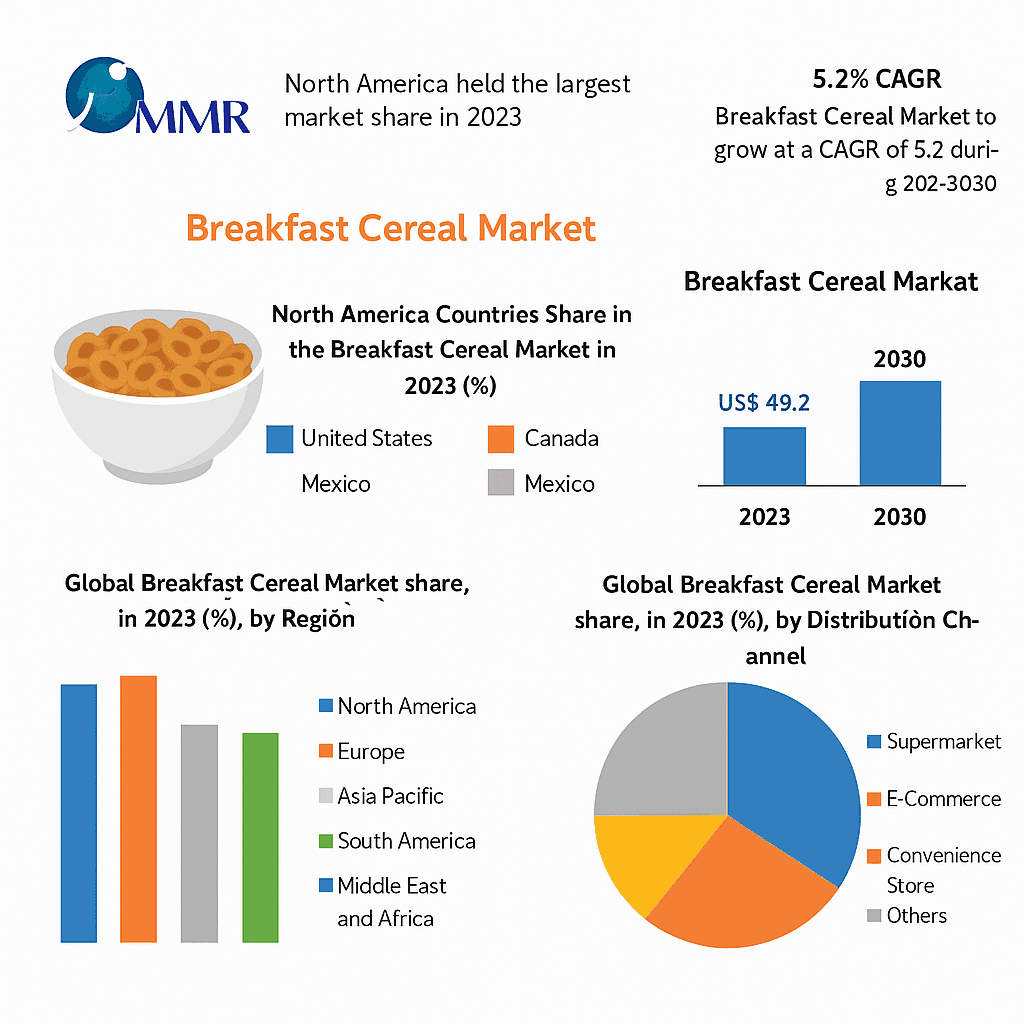
The global breakfast cereal market size is projected to grow from USD 49.2 billion in 2023 to approximately USD 70.16 billion by 2030, registering a compound annual growth rate (CAGR) of 5.2%. This growth is fueled by increasing health consciousness, demand for convenient meal options, and continuous product innovation.
Market Estimation & Definition
Breakfast cereals are processed grain-based food products consumed primarily as a morning meal. They are available in various forms, including ready-to-eat (RTE) cereals like flakes and puffed grains, as well as hot cereals such as oatmeal. The market encompasses a wide range of products tailored to diverse consumer preferences, dietary needs, and cultural tastes.
Market Growth Drivers & Opportunities
Health and Wellness Trends
Consumers are increasingly seeking nutritious breakfast options that align with health and wellness goals. This shift has led to a surge in demand for cereals rich in whole grains, fiber, and protein, as well as those catering to specific dietary requirements like gluten-free, organic, and low-sugar options.
Convenience and On-the-Go Consumption
Busy lifestyles have amplified the need for quick and easy meal solutions. Breakfast cereals, particularly RTE variants, offer a convenient option for consumers seeking time-efficient meals without compromising on nutrition. The rise of single-serve packaging and portable formats has further enhanced the appeal of cereals for on-the-go consumption.
Product Innovation and Diversification
To stay competitive, manufacturers are investing in product innovation, introducing new flavors, ingredients, and functional benefits. The incorporation of superfoods, plant-based proteins, and fortified nutrients has expanded the market’s reach to health-conscious consumers. Additionally, the development of cereals targeting specific demographics, such as children and athletes, presents new growth opportunities.
Segmentation Analysis
By Product Type
Ready-to-Eat (RTE) Cereals: Dominating the market due to their convenience, RTE cereals are favored by consumers seeking quick meal options. The segment has witnessed significant innovation, including the introduction of health-focused variants with added vitamins, minerals, and fiber.
Hot Cereals: Including products like oatmeal and porridge, hot cereals are gaining popularity for their perceived health benefits and comfort appeal. The segment is experiencing growth driven by the introduction of multigrain and fortified options.
By Packaging Type
Boxes: Traditional packaging offering ease of storage and brand visibility.
Pouches: Flexible packaging catering to on-the-go consumption and portion control.
Others: Innovative packaging formats designed for convenience and sustainability.
By Source
Wheat, Rice, Oat, Corn, Barley, Others: Diverse grain sources catering to varying taste preferences and dietary needs.
By Distribution Channel
Supermarkets/Hypermarkets: Primary retail outlets offering a wide variety of cereal brands and products.
E-Commerce: Rapidly growing segment attributed to the convenience of online shopping and the availability of a broader product range.
Convenience Stores: Accessible retail points for quick purchases, often featuring single-serve options.
Others: Specialty health stores and other retail formats catering to niche markets.
Country-Level Analysis
United States
The U.S. maintains its position as the largest market for breakfast cereals, driven by a strong cereal consumption culture and the presence of major players like Kellogg’s, General Mills, and Post Consumer Brands. The market is characterized by a diverse product range, continuous innovation, and effective marketing strategies targeting both children and adults.
Germany
Germany is witnessing robust growth in the breakfast cereal market, fueled by increasing health awareness and a preference for organic and clean-label products. Consumers are gravitating towards cereals with minimal additives and natural ingredients. Collaborations with social media influencers and fitness experts have further propelled market growth.
Competitor Analysis
The breakfast cereal market is highly competitive, with key players focusing on innovation, marketing, and distribution to maintain market share. Major companies include:
Kellogg Co.: Known for its extensive product portfolio and global presence, Kellogg’s continues to innovate with health-focused cereals and strategic partnerships.
General Mills Inc.: With popular brands like Cheerios and Wheaties, General Mills emphasizes product diversification and nutritional enhancements.
Post Holdings, Inc.: Offers a wide range of cereals catering to various consumer preferences, including organic and gluten-free options.
Nestlé S.A.: Expanding its footprint through product innovation and adaptation to local tastes, particularly in emerging markets.
PepsiCo.: Through its Quaker brand, PepsiCo delivers a variety of hot and cold cereal products, focusing on health and convenience.
to get full Report : https://www.maximizemarketresearch.com/market-report/global-breakfast-cereal-market/28323/
The global breakfast cereal market is poised for significant growth, underpinned by evolving consumer preferences towards health and convenience. Continuous product innovation, strategic marketing, and expansion into emerging markets will be critical for companies aiming to capitalize on this growth trajectory. Stakeholders are encouraged to align their offerings with consumer demands and leverage digital platforms to enhance market reach

