

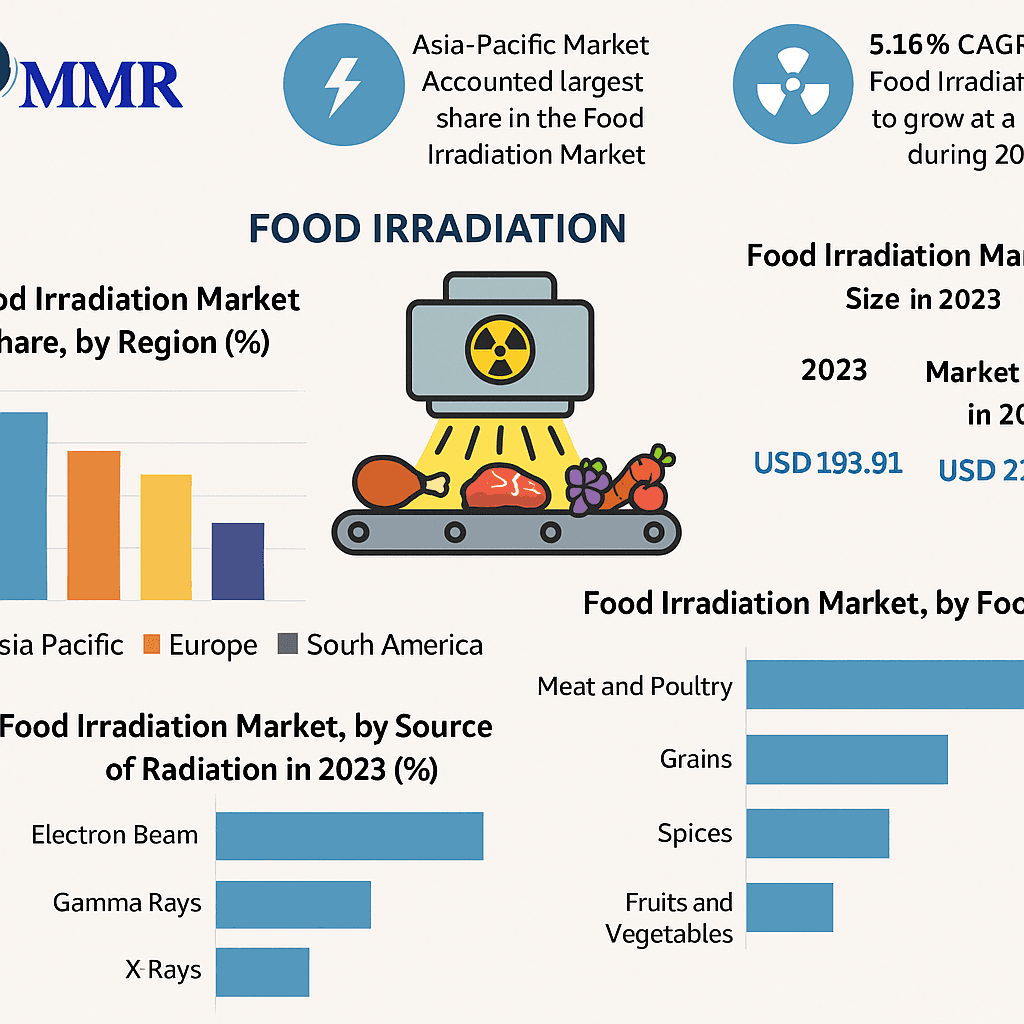
The global food irradiation market size is projected to grow significantly from USD 193.91 million in 2023 to USD 275.78 million by 2030, at a CAGR of 5.16%. This expansion is primarily attributed to growing consumer awareness about food safety, increasing demand for perishable goods, and the need to reduce foodborne illnesses and waste.
1. Market Estimation and Definition
Food irradiation refers to the process of exposing food to a controlled amount of ionizing radiation to eliminate pathogens, pests, and spoilage organisms. The technology extends the shelf life of food and ensures its safety without compromising nutritional value or taste.
This process is applicable to various food categories including meat, poultry, seafood, spices, fruits, and vegetables. It is recognized as a safe and effective method for preserving food quality, especially in the face of global challenges like supply chain inefficiencies and rising food spoilage rates.
2. Market Growth Drivers and Opportunities
a. Rising Incidence of Foodborne Illnesses
Foodborne pathogens continue to pose significant public health concerns. Irradiation helps eliminate microorganisms such as E. coli, Salmonella, and Listeria from food items, ensuring a safer supply chain from farm to table. As awareness of food hygiene grows, food irradiation becomes a preferred solution among producers and consumers alike.
b. Growth in Packaged and Processed Food Demand
The increasing global population, urbanization, and a shift toward convenience foods have led to a surge in demand for packaged and processed food. Food irradiation supports this trend by enhancing shelf life and ensuring microbial stability in pre-packaged meals, spices, and dried products.
c. Regulatory Encouragement and Harmonization
Many regions are streamlining food irradiation standards and regulations to support safer global trade. Efforts to harmonize national laws across countries are enabling easier export and import of irradiated food products, fostering market growth.
d. Technological Advancements
Emerging technologies such as X-ray and electron beam irradiation systems are becoming more efficient and cost-effective compared to traditional gamma rays. These developments make food irradiation scalable and environmentally friendly by avoiding radioactive isotopes.
e. Sustainability and Waste Reduction
Food irradiation contributes to reducing spoilage and post-harvest losses, supporting environmental sustainability goals. By improving the longevity of food, especially perishable items, it plays a vital role in minimizing global food waste.
3. Segmentation Analysis
a. By Source of Radiation
Gamma Radiation
Gamma radiation dominated the market in 2023 and is expected to continue leading through 2030. This method is widely used for sterilizing spices, meats, and dried products, due to its high penetration capability and effectiveness.Electron Beam and X-ray
While still emerging, these technologies are gaining popularity for their faster processing times and lower safety risks during operation. They are particularly useful in treating thin or small food items efficiently.
b. By Food Type
Meat and Poultry
This segment holds the largest share, driven by the rising consumption of meat products and the need to eliminate harmful microbes. Irradiation ensures extended shelf life and safer distribution of meats in both domestic and international markets.Spices and Herbs
Irradiation of spices helps prevent contamination from molds, bacteria, and insects. It is especially popular in regions with high spice consumption and export activity.Fruits and Vegetables
Increasing demand for fresh, clean produce is fueling the adoption of irradiation in this segment. It delays ripening and reduces microbial load, maintaining freshness during transit.
4. Country-Level Analysis
United States
The U.S. represents one of the most mature markets for food irradiation. The country has implemented clear regulations and approvals for multiple food categories. High consumer awareness and demand for safer processed foods continue to support widespread adoption of irradiation technologies.
In addition, the presence of advanced food processing industries and investment in innovation makes the U.S. a leader in the global market. The country’s emphasis on minimizing food waste and improving food export quality further strengthens its position.
Germany
Germany is emerging as a progressive European market for food irradiation, driven by both regulatory acceptance and sustainability objectives. With rising concerns around foodborne diseases and the push for eco-friendly preservation methods, Germany is investing in research and innovation to boost adoption.
Moreover, German food exporters are increasingly turning to irradiation as a tool to meet international food safety requirements and reduce spoilage across long supply chains.
Competitive Landscape Analysis
The global food irradiation market is moderately consolidated with several key players focusing on capacity expansion, technological innovation, and service diversification to maintain their competitive edge.
Company Commentary
Sterigenics U.S., LLC
A leader in irradiation services, the company offers extensive gamma, e-beam, and X-ray capabilities. Its wide network of service centers enables scalable food processing for global distribution.Food Technology Service, Inc.
Known for its consistent focus on high-quality gamma irradiation, this company supports a wide range of food processing clients with regulatory-compliant solutions.Ionisos
A European specialist in sterilization technologies, Ionisos provides tailor-made food irradiation services to meet regional standards and consumer preferences.GrayStar
Specializing in electron beam and X-ray technologies, GrayStar is gaining traction for its sustainable and efficient irradiation systems tailored to high-throughput food environments.
These players are investing in automation, AI-driven quality control, and cloud-based tracking systems to offer enhanced traceability and operational efficiency, solidifying their leadership in the market.
To view Full report : https://www.maximizemarketresearch.com/market-report/global-food-irradiation-market/23590/
The food irradiation market is on a strong upward trajectory, driven by the global push for food safety, increasing demand for processed food, and technological innovation. As regulatory frameworks become more unified and consumer acceptance rises, irradiation will become a cornerstone of modern food preservation.
Countries like the United States and Germany are setting examples in both adoption and innovation, highlighting the importance of public-private collaboration. Meanwhile, evolving irradiation technologies and sustainability goals continue to open new opportunities for companies to expand their footprint and make food safer and more resilient worldwide.
The coming years will see greater automation, integration with smart food systems, and broader geographic penetration, making food irradiation not just a technological tool but a standard in global food processing.

