

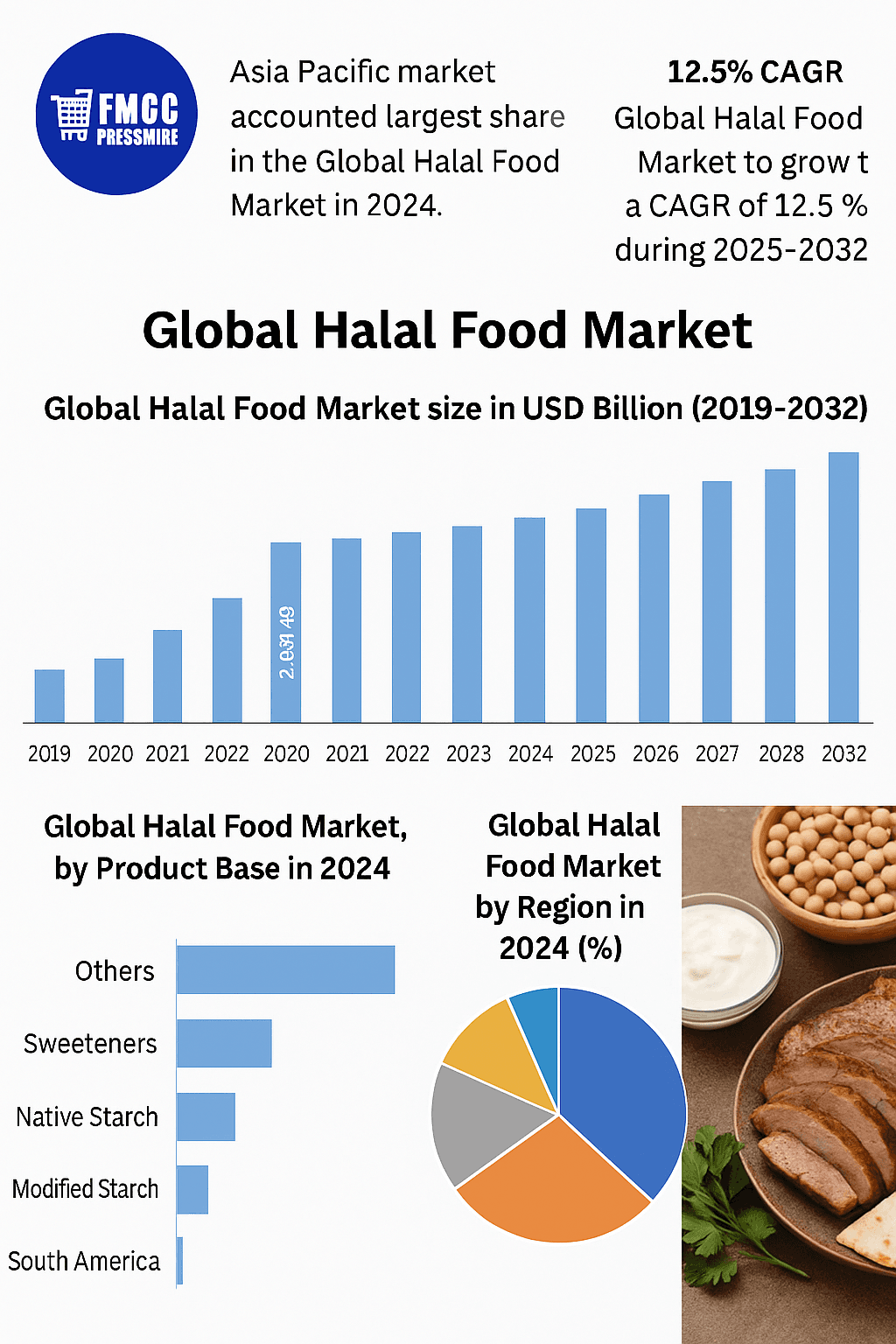
The global halal food market Size is experiencing unprecedented growth, with its valuation projected to soar from USD 2,631.48 billion in 2024 to nearly USD 6,751.83 billion by 2032, reflecting a robust CAGR of 12.5% over the forecast period.
Market Estimation & Definition
Halal food refers to consumables that comply with Islamic dietary laws, emphasizing cleanliness, ethical sourcing, and the exclusion of prohibited substances like pork and alcohol. This market segment has evolved from serving primarily Muslim consumers to attracting a broader demographic interested in food safety, ethical consumption, and quality assurance.
Market Growth Drivers & Opportunities
Several factors are propelling the halal food market’s expansion:
Demographic Shifts: The global Muslim population is expected to reach approximately 2.9 billion by 2030, significantly increasing the demand for halal-certified products.
Health and Safety Concerns: Consumers are increasingly seeking products that are free from harmful additives and contaminants, positioning halal food as a preferred choice due to its stringent preparation standards.
Ethical Consumption Trends: The emphasis on humane animal treatment and ethical sourcing in halal food production resonates with a growing segment of ethically conscious consumers.
Government Initiatives: Countries like Malaysia and Indonesia have implemented policies to promote halal certification, enhancing consumer trust and market growth.
Segmentation Analysis
The halal food market is categorized based on product type and distribution channels:
By Product Type:
Meat and Poultry: Dominates the market, accounting for over 50% of the share in 2021, driven by the demand for hygienic and ethically sourced meat products.
Dairy Products: Experiencing significant growth due to increased consumer awareness about halal-certified dairy offerings.
Cereals and Grains, Fruits and Vegetables: Gaining traction as consumers diversify their halal food consumption.
By Distribution Channel:
Supermarkets & Hypermarkets: Held a 56% market share in 2024, benefiting from urbanization and consumer preference for one-stop shopping experiences.
E-Commerce: Captured 21% of the market in 2024, reflecting the rising trend of online shopping and the availability of diverse halal products.
Country-Level Analysis: USA and Germany
United States: The U.S. halal food market is expanding beyond the Muslim population, with non-Muslim consumers increasingly opting for halal products due to perceptions of higher quality and ethical standards. States like New York and California, with significant Muslim populations, are leading this growth.
Germany: Germany represents a significant market in Europe, driven by its substantial Muslim population and the growing demand for halal-certified products. The country’s emphasis on food safety and quality aligns with the principles of halal food production, fostering market growth.
Competitive Landscape
The halal food market is characterized by the presence of both multinational corporations and regional players:
Nestlé: A leading player, with halal products accounting for approximately 35% of its global sales.
Al Islami Foods Co.: Based in Dubai, the company has expanded its premium halal offerings in Qatar, emphasizing its commitment to high halal standards.
Crescent Foods: A U.S.-based company providing hand-cut halal meat and poultry products, recently launched programs targeting college and university dining services.
Other notable companies include Kawan Foods, Cargill, BRF, and Tahira Food, each contributing to the market’s diversity and innovation.
To View Full Report : https://www.maximizemarketresearch.com/market-report/global-halal-food-market/28343/
The global halal food market is poised for significant growth, driven by demographic trends, health and ethical considerations, and supportive government policies. As consumer awareness and demand continue to rise, the market offers substantial opportunities for businesses to innovate and cater to a diverse and expanding customer base.

