

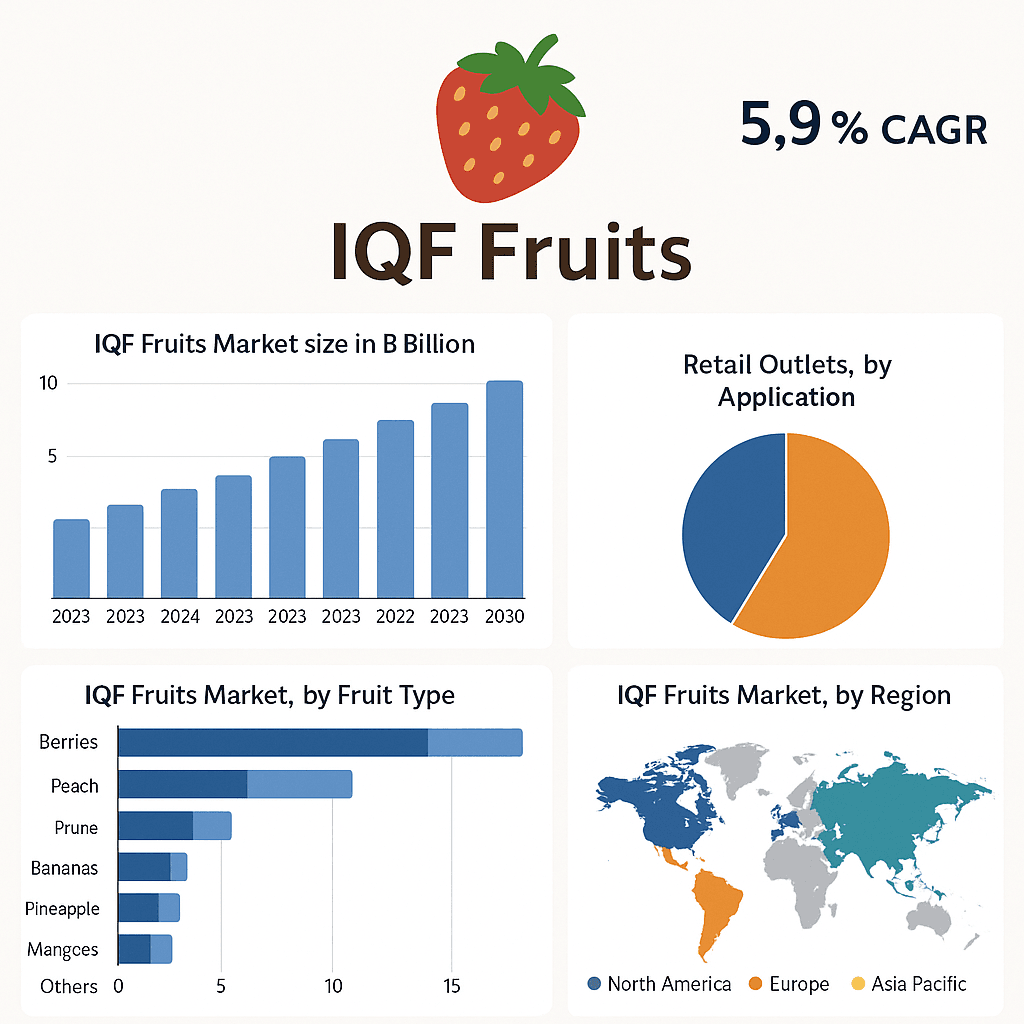
The global Individually Quick Frozen (IQF) Fruits Market size is set for robust growth, projected to reach USD 10.70 billion by 2030 from USD 7.16 billion in 2023, expanding at a CAGR of 5.9% during the forecast period. This upward trajectory is driven by rising health consciousness, the growing preference for convenient food formats, and the rapid adoption of freezing technology innovations.
Market Estimation & Definition
Individually Quick Frozen (IQF) fruits are frozen at extremely low temperatures in such a way that each fruit piece is frozen separately. This process preserves the flavor, color, and nutritional value of fruits more effectively than traditional freezing methods. IQF technology prevents clumping, allowing only the required portion to be used, improving efficiency for both consumers and businesses. These frozen fruits are especially popular among industries such as dairy, confectionery, and bakery as well as for direct consumer consumption.
The market, valued at USD 7.16 billion in 2023, is witnessing significant growth and is estimated to reach USD 10.70 billion by the end of 2030. Increasing availability through retail and e-commerce platforms is also making IQF fruits more accessible to end-users worldwide.
Market Growth Drivers & Opportunity
1. Health Awareness and Nutritional Value:
Consumers are becoming more health-conscious, driving demand for foods that retain essential vitamins and minerals. IQF fruits retain most of their nutritional integrity and freshness due to the rapid freezing process, making them a desirable alternative to canned or dried fruits.
2. Rising Urbanization and Lifestyle Changes:
Busy urban lifestyles are increasing the demand for convenient, ready-to-use food ingredients. IQF fruits require no cleaning or peeling and are ready to use right out of the package, appealing to time-constrained consumers.
3. Advancements in Freezing Technology:
The development of more efficient and cost-effective freezing technologies is enhancing product quality, allowing for large-scale adoption in food processing and foodservice industries.
4. Expansion of E-commerce and Cold Chain Logistics:
The rapid expansion of online food retail and cold storage logistics is making IQF fruits more widely available across various regions, helping suppliers reach more customers while maintaining freshness and quality.
5. Demand from the Foodservice Industry:
Hotels, restaurants, cafes, and catering services are increasingly integrating IQF fruits into their operations due to their extended shelf life and consistent availability, regardless of seasonality.
Segmentation Analysis
Based on the original market report, the IQF Fruits Market is segmented as follows:
By Fruit Type:
Berries
Peaches
Prunes
Bananas
Pineapples
Mangoes
Oranges
Others
Among these, berries hold a dominant share, owing to their widespread use in baking, desserts, yogurts, and smoothies.
By Application:
Retail Outlets
Online Stores
Online platforms are rapidly gaining traction, especially post-pandemic, due to their convenience and broad product selection.
By Sales Channel:
Direct Sales (Manufacturers)
Indirect Sales:
Hypermarkets/Supermarkets
Convenience Stores
Specialty Retail Stores
Traditional Grocery Stores
Online Retailers
By End Use:
Food Industry
Bakery and Confectionery
Dairy
Fruit-Based Beverages
Breakfast Cereals
Retail (Households)
HoReCa (Hotels, Restaurants, Cafes)
Retail (households) and foodservice applications together represent the largest share of end-use, owing to consumer preference for freshness and reliability.
Country-Level Analysis
United States:
The U.S. represents the largest market in North America, fueled by high consumer demand for natural and preservative-free foods. A well-developed cold chain infrastructure and a robust foodservice industry support sustained growth in the IQF sector.
Germany:
Germany dominates the European market due to a strong preference for high-quality food products, especially in organic and natural categories. German consumers are highly aware of nutrition labels, and IQF fruits meet the criteria for clean label products. Germany is also home to numerous food processing companies that rely on high-quality frozen ingredients.
Commutator Analysis
The IQF fruits market features a competitive and fragmented landscape, with both multinational and regional players focusing on innovation, quality, and global expansion. Key strategic moves include new product launches, mergers, distribution partnerships, and investments in technology.
Notable trends across competitors include:
Investment in sustainable packaging to align with environmental concerns.
Focus on premium, organic, and non-GMO product lines.
Development of mixed-fruit offerings to cater to smoothie and breakfast segments.
Strengthening cold-chain logistics for better product delivery and reach.
Competitors are also increasingly using digital platforms to reach customers directly, bypassing traditional retail constraints and enabling personalized marketing campaigns.
Conclusion
The global IQF Fruits Market is positioned for healthy growth through 2030, driven by rising consumer awareness around health and nutrition, as well as the increasing need for convenience. Technological innovation, expansion in e-commerce, and supportive government policies regarding food safety and processing are also contributing factors.
As demand continues to surge in both developed and emerging markets, companies in the IQF fruits industry are expected to focus on sustainability, customer-centric offerings, and distribution network enhancements to maintain competitiveness.
With steady innovation and rising global adoption, IQF fruits are likely to remain a cornerstone of the frozen food segment, meeting the needs of health-conscious and time-pressed consumers alike.

