
Agricultural Films Market to Reach USD 25.15 Billion by 2032, Driven by Sustainable Farming and Protected Agriculture
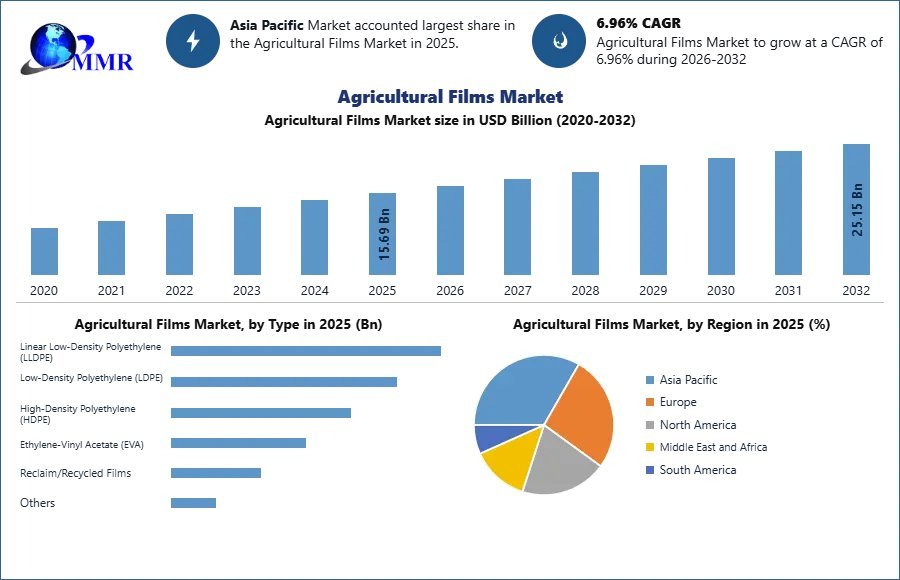
The Agricultural Films Market was valued at USD 15.7 billion in 2025 and is expected to expand at a CAGR of 6.96% during the forecast period, according to Maximize Market Research. The market is projected to reach approximately USD 25.15 billion by 2032, reflecting the increasing adoption of plasticulture technologies for improving crop productivity, conserving water, controlling weeds and protecting crops from increasingly unpredictable weather conditions.
Market Estimation, Growth Drivers and Opportunities
Agricultural films are becoming an important component of modern farming as growers seek higher yields from limited arable land while managing water, temperature, pests and soil conditions. Greenhouse films, mulching films, silage films and crop-protection films enable farmers to create more controlled growing environments, reduce crop losses and improve resource efficiency.
The growing global population, increasing demand for fruits and vegetables, expansion of protected cultivation and adoption of sustainable farming practices are expected to remain major market drivers. Government initiatives encouraging efficient agricultural practices and restrictions on certain chemical-based pesticides and weed-control products are also creating opportunities for agricultural film technologies.
A particularly important opportunity is the development of biodegradable, compostable, recyclable and lightweight films. Manufacturers are investing in films that provide high mechanical strength and UV resistance while reducing material consumption and end-of-life environmental impacts. Advanced films incorporating light diffusion, thermal regulation, UV management and moisture-control properties are also creating new opportunities in commercial horticulture.
Request a Sample of the Full Market Report : https://www.maximizemarketresearch.com/request-sample/42869/
U.S. Market Trends and Investment
The United States is emerging as an important market for protected cultivation and controlled-environment agriculture. In 2025, USDA-backed research highlighted the potential of greenhouses and indoor farms to expand domestic production of fresh herbs, reduce import dependence and bring food production closer to population centers.
Private investment is also supporting greenhouse development. In March 2025, UK-based Oasthouse Ventures announced plans to invest USD 104.8 million in a 65-acre controlled-environment agriculture facility in Virginia, designed to produce approximately 45 million pounds of tomatoes annually. The project demonstrates growing investor interest in large-scale greenhouse production, where durable and high-performance agricultural films are essential for crop protection and climate management.
U.S. agricultural policy is simultaneously emphasizing conservation and climate-smart farming. USDA programs have provided substantial funding for conservation practices and technologies designed to improve resilience, resource efficiency and environmental performance.
Market Segmentation: Largest Segments
Based on type, Linear Low-Density Polyethylene (LLDPE) represents the key high-growth material segment in the MMR analysis. LLDPE offers high tensile strength, chemical resistance, flexibility, moisture-barrier performance and UV resistance, making it suitable for demanding agricultural applications.
Based on application, Greenhouse Films represent the leading growth opportunity. Greenhouse films help regulate temperature, humidity and light while protecting crops from wind, rain and frost. Their ability to support multiple crop cycles and improve productivity makes them increasingly valuable as growers respond to limited arable land and rising food demand.
Competitive Analysis
The competitive landscape includes major polymer, film and agricultural-material manufacturers competing through product innovation, sustainability initiatives and advanced film technologies. Among the leading companies identified in the MMR market assessment are Berry Global Group Inc., Dow Inc., RKW Group, Kuraray Co. Ltd. and BASF SE.
Berry Global Group Inc. continues to focus on high-performance and circular agricultural films. Its Silotite portfolio includes lightweight films, recycled-content solutions and Film&Film technology designed to improve silage protection while supporting easier recycling. In 2025, the integration of Berry Global with Amcor further strengthened technical capabilities and supply-chain scale for agricultural film innovation.
Dow Inc. maintains a broad agricultural-film portfolio covering greenhouse and tunnel films, mulch and fumigation films, bale wraps, silo bags and silage applications. Its polyethylene resin technologies focus on durability, puncture resistance, moisture and oxygen barriers, crop protection and resource efficiency.
RKW Group is strengthening its greenhouse-film portfolio through advanced solutions such as Hytilux, Hytifite and Grafeno. Hytilux technology is designed to improve thermal performance and manage light transmission, potentially reducing temperature stress and energy requirements in protected cultivation.
Kuraray Co. Ltd. brings specialty polymer and film technologies to agricultural applications, including water-soluble PVOH films for seed tapes and agricultural applications. Such technologies can simplify sowing operations while reducing post-use processing requirements.
BASF SE is advancing sustainable agricultural materials through its ecovio portfolio. In 2025, BASF highlighted certified industrial-compostable biopolymer solutions for greenhouse clips and twines, while its soil-biodegradable ecovio M 2351 is designed for agricultural mulch films. These developments support the industry’s transition toward more circular agricultural plastics.
Regional Analysis
United States: Demand is supported by greenhouse agriculture, specialty-crop production, controlled-environment farming and investment in climate-resilient agriculture. New greenhouse projects and USDA-supported research are creating opportunities for advanced films that manage light, temperature and crop protection.
China: China remains a major agricultural-film market because of its extensive protected cultivation sector and strong adoption of greenhouse and mulching technologies. Increasing investment in high-value fruits and vegetables, together with the modernization of protected agriculture, supports demand for high-performance films.
Japan: Japan’s limited agricultural land, advanced horticulture sector and emphasis on efficient crop production support the adoption of greenhouse and specialty agricultural films. Agricultural-film technologies that improve productivity and resource efficiency are particularly relevant to the country’s high-value horticulture sector.
Germany: Germany is an important European market for sustainable agricultural materials and protected cultivation technologies. Demand is supported by innovation in recyclable and biodegradable materials, while companies such as BASF and RKW are developing technologies focused on reducing agricultural plastic impacts and improving greenhouse performance.
Key Players
Key companies operating in the Agricultural Films Market include Berry Global Group Inc., Dow Inc., RKW Group, Kuraray Co. Ltd., BASF SE, Coveris, Rani Group, Armando Alvarez Group, Trioworld, Exxon Mobil Corporation, Plastika Kritis S.A., Ginegar Plastic Products Ltd., Novamont S.p.A., Groupe Barbier, Polifilm Group, Agriplast Tech India Private Limited, Anhui Guofeng Plastic Industry Co. Ltd., Achilles Corporation, Tilak Polypack Private Limited, Megaplast India Pvt Ltd., Agripolyane, FKuR, BioBag International AS and Kaveri Agriculture Products.
Why This Market Matters Now
The Agricultural Films Market matters now because agriculture is under simultaneous pressure to produce more food, use fewer resources and withstand climate variability. Agricultural films can improve crop productivity, conserve water, reduce weed pressure, protect crops and extend growing seasons. At the same time, sustainability requirements are accelerating innovation in biodegradable, recyclable, lightweight and resource-efficient film technologies.
As protected cultivation expands and investment moves toward controlled-environment agriculture, agricultural films are shifting from basic crop coverings to sophisticated materials engineered for light management, thermal regulation, durability and circularity. This transition is expected to create attractive opportunities for polymer producers, film manufacturers, technology developers, investors and agricultural businesses through 2032.
Explore More Related Reports
Global Oxygen-Free Copper Market https://www.maximizemarketresearch.com/market-report/oxygen-free-copper-market/122196/
2D Materials Market https://www.maximizemarketresearch.com/market-report/global-2d-materials-market/74941/
About Maximize Market Research
Maximize Market Research Pvt. Ltd. (MMR) is a global market research and consulting company that provides reliable, data-focused, and practical business insights. The firm serves a wide range of industries, including healthcare, pharmaceuticals, technology, automotive, electronics, chemicals, personal care, and consumer goods. Through market forecasts, competitive analysis, strategic consulting, and industry impact assessments, MMR helps organizations understand changing market conditions, identify growth opportunities, and make informed business decisions for long-term success.
Contact Us
Maximize Market Research Pvt. Ltd.
2nd Floor, Navale IT Park Phase 3
Pune Banglore Highway, Narhe
Pune, Maharashtra 411041, India
Phone: +91 9607365656
Email: sales@maximizemarketresearch.com