
Market Overview
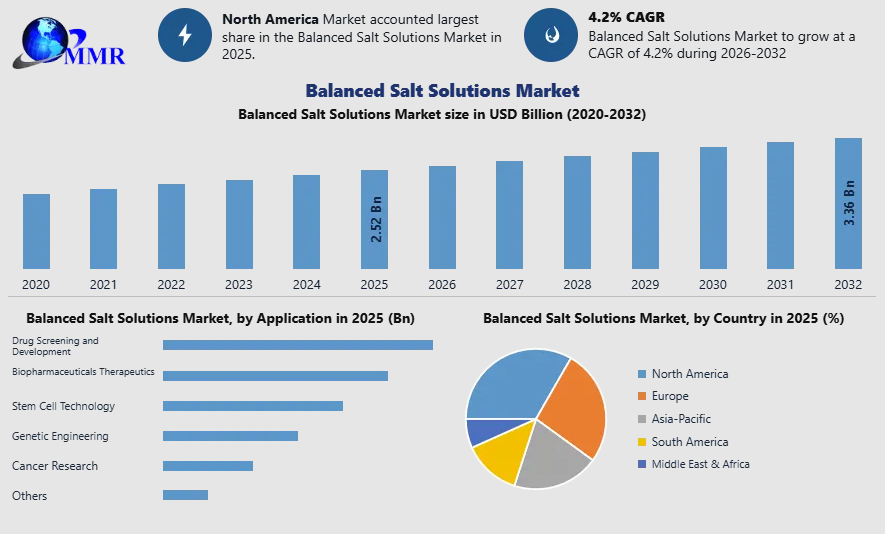
The global Balanced Salt Solutions Market was valued at USD 2.52 billion in 2025 and is projected to reach USD 3.36 billion by 2032, growing at a compound annual growth rate (CAGR) of 4.2% during the forecast period from 2026 to 2032. The market is experiencing steady growth as pharmaceutical companies, biotechnology organizations, and academic research institutions increasingly rely on cell culture technologies, drug discovery processes, and advanced biomedical research.
Download Sample Pages of Research Overview: https://www.maximizemarketresearch.com/request-sample/37281/
Balanced salt solutions (BSS) are specialized aqueous solutions formulated with essential inorganic salts, including sodium, potassium, calcium, magnesium, and chloride. These solutions help maintain physiological pH, osmotic pressure, and cellular integrity under laboratory conditions. Depending on their intended applications, balanced salt solutions may also contain glucose as an energy source and phenol red as a pH indicator. They are widely used in cell washing, tissue preparation, cell isolation, laboratory experimentation, and other procedures that require a controlled cellular environment.
The growing importance of cell-based research has increased the demand for reliable and high-quality laboratory reagents. Balanced salt solutions play an important role in the development of monoclonal antibodies, therapeutic proteins, vaccines, and other biopharmaceutical products. They are also used in drug screening, genetic engineering, cancer research, and stem cell technology, where maintaining suitable cellular conditions is essential for experimental consistency.
The market includes various product types, such as Hanks’ Balanced Salt Solution, Gey’s Balanced Salt Solution, Earle’s Balanced Salt Solution, and Dulbecco’s Phosphate Buffered Saline (DPBS). These formulations serve different laboratory requirements depending on the cell type, experimental conditions, and intended application. Manufacturers are increasingly focusing on product quality, formulation consistency, sterile manufacturing, and convenient packaging to meet the requirements of modern research laboratories.
North America held a leading position in the Balanced Salt Solutions Market in 2025, supported by advanced biotechnology infrastructure, substantial pharmaceutical research expenditure, and the presence of established life sciences companies. Meanwhile, Asia-Pacific is emerging as an important growth region due to expanding biotechnology industries, increasing investments in healthcare research, and the development of pharmaceutical manufacturing capabilities in countries such as China and India.
Market Drivers and Trends
Increasing Demand for Biopharmaceuticals and Therapeutic Products
The expansion of the biopharmaceutical industry is a major factor supporting the growth of the Balanced Salt Solutions Market. Pharmaceutical and biotechnology companies use cell culture techniques to develop monoclonal antibodies, recombinant proteins, vaccines, and other biologically derived therapies. Balanced salt solutions help maintain appropriate cellular conditions during several laboratory procedures associated with these development activities.
Download Sample Pages of Research Overview: https://www.maximizemarketresearch.com/request-sample/37281/
As research organizations expand their bioprocessing capabilities, demand for dependable laboratory reagents is expected to increase. The growing adoption of cell-based manufacturing methods and the development of complex biological medicines are creating opportunities for suppliers of balanced salt solutions.
Growth in Drug Discovery and Development Activities
The increasing emphasis on discovering new medicines is another important market driver. Drug discovery programs require extensive laboratory testing, cell-based assays, and experimental procedures to evaluate potential therapeutic candidates. Balanced salt solutions are used in these workflows to support cellular integrity and provide suitable conditions for conducting experiments.
Pharmaceutical companies are also investing in research technologies that improve experimental reproducibility and laboratory efficiency. As drug pipelines become more diversified, the need for standardized laboratory reagents is expected to remain an important source of demand.
Rising Investment in Cell Culture and Vaccine Research
Government funding, academic research programs, and private-sector investment are supporting developments in cell biology, vaccine research, and regenerative medicine. Balanced salt solutions are widely used in cell culture laboratories and in procedures involving the preparation, washing, and handling of biological samples.
The expansion of research infrastructure and the development of cell-based vaccine technologies can create additional opportunities for manufacturers. Laboratories increasingly require solutions that meet defined specifications for sterility, pH, osmolarity, and compatibility with particular experimental protocols.
Technological Improvements and Product Innovation
Manufacturers are focusing on improving formulation consistency, manufacturing efficiency, packaging, and quality control. Ready-to-use liquid formulations can reduce preparation time and help laboratories maintain consistency, while powder formulations may offer storage and transportation advantages in appropriate applications.
The adoption of improved production systems and quality assurance procedures is also important for suppliers serving pharmaceutical and biotechnology customers. As laboratory requirements become more specialized, manufacturers may expand their product portfolios to address different cell types, experimental conditions, and research applications.
Strategic Partnerships and Competitive Expansion
The competitive environment encourages companies to strengthen their market positions through product development, distribution agreements, acquisitions, and collaborations. Established life sciences suppliers benefit from broad product portfolios and established relationships with research laboratories and pharmaceutical manufacturers.
Companies are also competing through pricing, product availability, technical support, and quality assurance. These factors are particularly important for research institutions and commercial laboratories that require consistent reagent supplies over extended research programs.
Primary Market Constraints
High Research and Development Costs
Research and development expenditure can limit market expansion, particularly for smaller manufacturers and emerging biotechnology suppliers. Developing specialized formulations, validating production processes, and maintaining appropriate quality systems require financial and technical resources.
Research organizations also face substantial costs associated with advanced cell biology experiments, specialized laboratory equipment, and skilled personnel. These expenses may restrict research activity in institutions operating with limited budgets, indirectly affecting demand for laboratory reagents.
Limited Research Infrastructure in Emerging Markets
Although biotechnology research is expanding globally, access to advanced laboratory infrastructure remains uneven. Some institutions face limitations in equipment availability, technical expertise, funding, and laboratory facilities. These challenges can slow the adoption of advanced cell culture methods and reduce demand for specialized balanced salt solutions.
Improving laboratory infrastructure, strengthening scientific training, and expanding public and private research funding will be important for addressing these limitations.
Quality Control and Regulatory Requirements
Balanced salt solutions intended for sensitive research and biopharmaceutical applications must meet appropriate quality specifications. Variations in composition, contamination, pH, or osmolarity can affect experimental results and compromise reproducibility.
Manufacturers must maintain robust quality control procedures and comply with applicable requirements for their intended markets and product classifications. Sterile products and solutions used in regulated manufacturing environments may require additional validation, documentation, and handling controls. These requirements can increase production costs and create barriers for new market participants.
Pricing Pressure and Supply Chain Challenges
Competition among established suppliers can create pressure on selling prices, particularly for commonly used formulations. Laboratories often seek a balance between cost, quality, product availability, and technical support.
Manufacturers may also face challenges related to raw material sourcing, packaging costs, transportation, and maintaining consistent inventory. Supply disruptions can affect laboratory schedules and pharmaceutical research programs, making reliable distribution networks an important competitive advantage.
Key Market Segments
The Balanced Salt Solutions Market is segmented by product, form, sterility, packaging, application, end user, and region. These categories reflect differences in formulation requirements, storage preferences, research objectives, and purchasing behavior.
By Product
The market includes Hanks’ Balanced Salt Solution, Gey’s Balanced Salt Solution, Earle’s Balanced Salt Solution, and Dulbecco’s Phosphate Buffered Saline (DPBS).
Dulbecco’s Phosphate Buffered Saline is a widely used formulation in biological research because it helps maintain suitable pH and osmotic conditions during routine laboratory procedures. It is commonly used for washing cells, preparing samples, and supporting various cell culture workflows. Its versatility across laboratory applications supported the DPBS segment’s leading position in 2025.
Hanks’ Balanced Salt Solution is used in applications that require a balanced ionic environment, including certain cell handling and tissue preparation procedures. Earle’s Balanced Salt Solution is used in selected cell culture applications, while Gey’s Balanced Salt Solution serves specialized laboratory requirements. Demand across these product categories depends on experimental protocols, cell types, and research objectives.
By Form
The market is divided into liquid and powder formulations.
Liquid balanced salt solutions are convenient for laboratories that require ready-to-use products and standardized preparation. They can help reduce preparation time and minimize errors associated with manual mixing. These benefits make liquid formulations suitable for laboratories conducting frequent or high-volume experiments.
Powder formulations can provide advantages in storage, transportation, and preparation flexibility when appropriate handling procedures are followed. Their suitability depends on laboratory requirements, available preparation facilities, and the need for specific solution volumes.
By Sterility
The market includes sterile and non-sterile balanced salt solutions.
Sterile formulations are important for applications in which microbial contamination could compromise cell culture experiments or other sensitive biological procedures. Pharmaceutical and biotechnology companies may require sterile products for workflows that demand stringent contamination controls.
Non-sterile formulations may be appropriate for selected applications where sterility is not required by the relevant protocol. Demand for each category depends on the intended use, laboratory procedures, and quality specifications.
By Packaging
The market is categorized into bottles, bags, and vials.
Bottles are widely used for laboratory storage and routine dispensing. Bags can be suitable for applications requiring larger volumes or specific fluid-handling arrangements, while vials may serve smaller-volume and specialized laboratory needs.
Packaging selection depends on volume requirements, storage conditions, ease of handling, transportation, and contamination prevention. Manufacturers are working to improve packaging convenience and product integrity throughout distribution and use.
By Application
Applications include drug screening and development, biopharmaceutical therapeutics, stem cell technology, genetic engineering, cancer research, and other uses.
Drug screening and development represented the leading application segment in 2025, supported by the extensive use of balanced salt solutions in laboratory testing, cell-based assays, and experimental procedures. Increasing investment in drug discovery and the development of new therapeutic candidates continue to support demand in this category.
Biopharmaceutical therapeutics represent another important application area because cell culture processes are central to the development of many biological medicines. Stem cell technology and genetic engineering also create demand for solutions that maintain appropriate cellular conditions during research procedures.
Cancer research contributes to market demand through cell-based experiments and investigations into disease mechanisms and potential treatments. Other applications include broader life sciences research and laboratory sample preparation.
By End User
The market is segmented into research institutes and pharmaceutical and biotechnology companies.
Pharmaceutical and biotechnology companies held the largest end-user share in 2025. Their demand is supported by drug discovery programs, biologics development, laboratory testing, and biopharmaceutical manufacturing activities. These organizations often require consistent reagent quality and dependable supply arrangements.
Research institutes also represent an important customer group. Universities, public research organizations, and independent laboratories use balanced salt solutions in cell biology, molecular biology, tissue studies, and other experimental activities. Increasing investment in academic research and biotechnology innovation can support future demand from this segment.
Download Sample Pages of Research Overview: https://www.maximizemarketresearch.com/request-sample/37281/
Regional Performance
North America
North America dominated the Balanced Salt Solutions Market in 2025. The region benefits from an established biotechnology ecosystem, advanced laboratory infrastructure, leading pharmaceutical companies, and substantial investment in life sciences research.
The United States is a major contributor because of its pharmaceutical research capabilities, biotechnology clusters, academic institutions, and drug development activities. Demand for balanced salt solutions is supported by research involving biologics, stem cells, cancer therapies, and cell-based testing. Established reagent suppliers and developed distribution networks further strengthen the regional market.
Europe
Europe holds a significant position in the market due to its established pharmaceutical industry, academic research capabilities, and biotechnology development activities. Countries such as Germany, the United Kingdom, France, and Italy support demand through pharmaceutical research, laboratory testing, and life sciences innovation.
The region’s research infrastructure and emphasis on quality standards create opportunities for suppliers offering reliable and consistently manufactured laboratory reagents. Collaboration between universities, biotechnology companies, and pharmaceutical manufacturers also supports the use of balanced salt solutions.
Asia-Pacific
Asia-Pacific is expected to experience strong growth during the forecast period as biotechnology industries expand and research investments increase. China, India, Japan, South Korea, and Australia are important markets due to their pharmaceutical manufacturing capabilities, research institutions, and developing life sciences sectors.
India’s expanding pharmaceutical industry and increasing emphasis on biotechnology research offer opportunities for manufacturers and distributors. China’s investments in biopharmaceutical development and laboratory infrastructure also support regional demand. The availability of skilled scientific personnel and the expansion of research facilities may further strengthen market development.
South America
South America offers growth opportunities as pharmaceutical production, academic research, and healthcare-related investments expand. Brazil and Argentina are important markets in the region. Market development will depend on research funding, access to laboratory infrastructure, product availability, and the ability of suppliers to maintain competitive pricing.
Middle East and Africa
The Middle East and Africa market is supported by gradual investment in healthcare infrastructure, scientific research, and pharmaceutical capabilities. The GCC countries and South Africa represent important areas of development. However, differences in research funding, laboratory access, and distribution infrastructure may influence the pace of adoption across individual countries.
Major Industry Players
The Balanced Salt Solutions Market includes established life sciences companies, laboratory reagent manufacturers, biotechnology suppliers, and specialized cell culture product providers. Competition is shaped by product quality, formulation range, pricing, distribution reach, technical support, and the ability to serve research and commercial customers.
Key companies operating in the market include:
- Thermo Fisher Scientific Inc.
- Lonza Group Ltd.
- Becton, Dickinson and Company (BD)
- Merck KGaA (EMD Millipore)
- Corning Incorporated
- Sartorius AG
- GE Healthcare (Cytiva)
- Sigma-Aldrich Co. LLC
- PromoCell GmbH
- Biological Industries (BI)
- VWR International, LLC (Avantor)
- Ajinomoto Co., Inc.
- HiMedia Laboratories
- Irvine Scientific (Fujifilm)
- Atlanta Biologicals (R&D Systems)
- Biowest
- AllCells, LLC
- Wheaton Industries Inc.
- Caisson Laboratories, Inc.
- Cell Culture Technologies LLC
- Takara Bio Inc.
- STEMCELL Technologies Inc.
- Pan-Biotech GmbH
- ZenBio, Inc.
- CCT (Cell Culture Technologies)
These companies participate in broader laboratory reagents, cell culture, biotechnology, and life sciences markets, although their individual product portfolios and levels of participation in the balanced salt solutions category vary. Their competitive strategies may include expanding reagent offerings, improving production capabilities, strengthening distribution channels, and developing products for specialized laboratory applications.
Large suppliers can benefit from established customer relationships and broad life sciences portfolios, while specialized manufacturers can compete through application-specific products, flexibility, and technical expertise. Product consistency, dependable supply, and compatibility with laboratory protocols are likely to remain important factors influencing purchasing decisions throughout the forecast period.
Recent Industry Developments
The broader life sciences sector continues to experience investment in manufacturing capacity, laboratory technologies, and portfolio expansion. These developments are relevant to the supply ecosystem supporting cell culture reagents and balanced salt solutions.
Lonza Group AG and Thermo Fisher Scientific Inc. are among the major companies active in the wider biopharmaceutical and life sciences industries. Investments in biologics manufacturing, laboratory solutions, filtration technologies, and research infrastructure can influence the availability and development of products used in cell-based research.
However, corporate announcements and financial performance do not necessarily establish a direct increase in balanced salt solution sales. Specific product launches, acquisitions, or capacity expansions should be verified against official company announcements before being attributed to this market.
Frequently Asked Questions (FAQs)
1. What is the size of the Balanced Salt Solutions Market?
The Balanced Salt Solutions Market was valued at USD 2.52 billion in 2025 and is projected to reach USD 3.36 billion by 2032.
2. What is the expected CAGR of the Balanced Salt Solutions Market?
The market is expected to grow at a CAGR of 4.2% during the forecast period from 2026 to 2032.
3. What are balanced salt solutions used for?
Balanced salt solutions help maintain physiological pH, osmotic pressure, and cellular integrity. They are used in cell culture, tissue preparation, cell washing, drug screening, genetic engineering, cancer research, and biopharmaceutical development.
4. Which product segment dominated the market in 2025?
Dulbecco’s Phosphate Buffered Saline (DPBS) dominated the market in 2025, according to the supplied market overview, owing to its broad use in cell culture and biological research.
5. Which application segment held the largest market share in 2025?
Drug screening and development was the leading application segment in 2025, supported by demand for laboratory testing, cell-based assays, and pharmaceutical discovery activities.
Conclusion
The Balanced Salt Solutions Market is positioned for steady growth as cell culture technologies, biopharmaceutical research, and drug discovery activities continue to expand. The market’s projected increase from USD 2.52 billion in 2025 to USD 3.36 billion by 2032 reflects the ongoing importance of reliable laboratory reagents in modern life sciences research.
Connect With Us:
MAXIMIZE MARKET RESEARCH PVT. LTD.
2nd Floor, Navale IT park Phase 3,
Pune Banglore Highway, Narhe
Pune, Maharashtra 411041, India.
+91 9607365656
sales@maximizemarketresearch.com
About Maximize Market Research:
Maximize Market Research is one of the fastest-growing market research and business consulting firms serving clients globally. Our revenue impact and focused growth-driven research initiatives make us a proud partner of majority of the Fortune 500 companies. We have a diversified portfolio and serve a variety of industries such as IT & telecom, chemical, food & beverage, aerospace & defense, healthcare and others.