
Anticipated Growth in Revenue
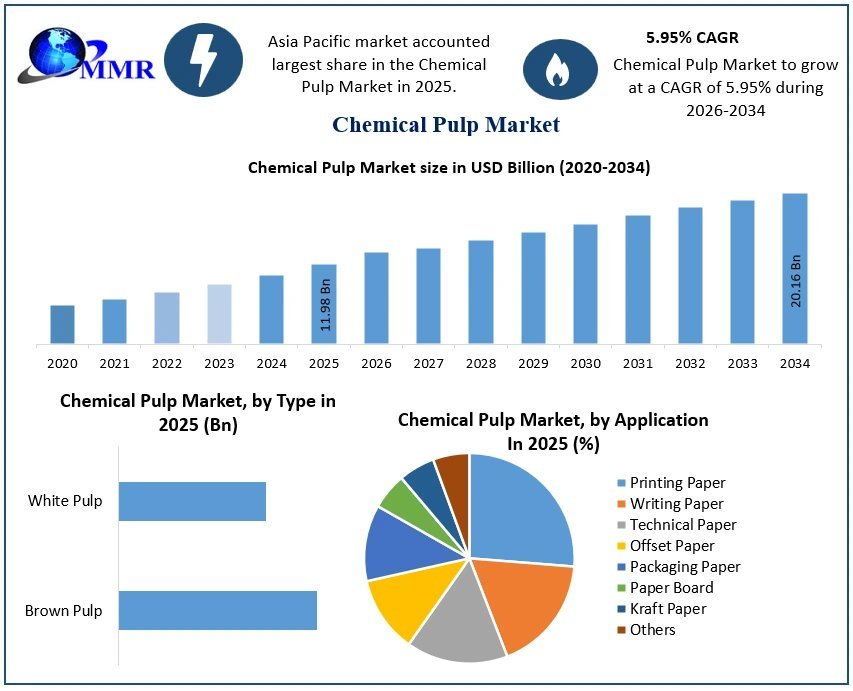
The Chemical Pulp Market was valued at USD 11.98 billion in 2025 and is expected to reach USD 20.16 billion by 2034, growing at a compound annual growth rate (CAGR) of 5.95% during the forecast period. Market growth is supported by rising demand for paper-based packaging, tissue products, printing paper, and other cellulose-based materials. Increasing attention to recyclable packaging and renewable raw materials is also creating opportunities for chemical pulp manufacturers worldwide.
Market Overview
Chemical pulp is produced through chemical processes that separate cellulose fibers from wood and other lignocellulosic raw materials. These processes remove a substantial portion of the lignin that binds fibers together, helping produce pulp with properties suitable for manufacturing a wide range of paper and paperboard products.
Chemical pulp is an important raw material for packaging materials, printing and writing paper, tissue paper, specialty paper, and selected industrial applications. Its strength, quality, and versatility make it valuable across several end-use industries. Manufacturers continue to improve production processes to enhance fiber quality, optimize resource consumption, and reduce environmental impacts.
The market is evolving alongside changes in packaging preferences, consumer purchasing habits, and sustainability objectives. Businesses are exploring paper-based solutions for different packaging applications, while consumers continue to purchase tissue and hygiene products. These developments contribute to demand for pulp and create opportunities for manufacturers to improve their product offerings.
Get Your Complimentary Report Preview : https://www.maximizemarketresearch.com/request-sample/127017/
Key Market Growth Drivers
One of the major factors supporting the Chemical Pulp Market is the increasing use of paper-based packaging. E-commerce, food and beverage distribution, retail, and consumer goods industries require packaging materials that protect products during storage and transportation. Chemical pulp supports the production of various paper and paperboard grades used in cartons, boxes, wrapping materials, and other packaging formats.
Growing awareness of recycling and waste reduction is another important factor influencing market development. Businesses are reviewing packaging designs and material choices to meet sustainability objectives and changing customer expectations. Paper-based materials can offer advantages in suitable applications, although their overall environmental performance depends on sourcing, manufacturing, collection, and recycling practices.
Demand from the tissue and hygiene sector also contributes to market growth. Tissue products, household paper products, and hygiene-related applications require pulp with appropriate softness, absorbency, and strength characteristics. As consumption patterns evolve across residential, commercial, and institutional settings, manufacturers have opportunities to serve different product categories.
Technological advancements are further influencing the market. Improvements in chemical recovery, process control, water management, and energy efficiency can help pulp producers optimize operations, manage costs, and improve resource utilization.
Scope and Research Methodology
The Chemical Pulp Market assessment examines market trends, growth drivers, challenges, competitive developments, and future opportunities. The analysis considers demand across major applications and evaluates the influence of production technologies, raw material availability, regional manufacturing capacity, and changing end-user requirements.
Market research generally incorporates primary and secondary research, industry information, company-level assessments, and competitive analysis. These methods help evaluate the factors influencing demand and identify potential developments throughout the forecast period. Market performance can vary according to economic conditions, production costs, environmental policies, and regional consumption patterns.
Explore the Report Sample Before You Buy : https://www.maximizemarketresearch.com/request-sample/127017/
Regional Insights
Regional market performance is influenced by forestry resources, pulp and paper manufacturing infrastructure, packaging demand, and environmental regulations. Regions with established pulp production facilities benefit from manufacturing expertise, developed supply chains, and access to downstream paper industries.
Meanwhile, developing economies may offer opportunities as e-commerce, packaged consumer goods, hygiene product consumption, and industrial activity expand. Investments in modern manufacturing facilities and improved production technologies can also influence regional competitiveness.
However, regional growth depends on factors such as access to suitable raw materials, transportation infrastructure, energy availability, and compliance with environmental standards. Producers must evaluate these conditions when making investment and expansion decisions.
Market Segmentation
The Chemical Pulp Market can be analyzed across several key categories:
By Pulping Process: Kraft pulp, sulfite pulp, and other chemical pulping processes serve different production requirements. The selection of a process depends on the desired fiber characteristics, manufacturing economics, and intended end use.
By Application: Major applications include packaging paper, printing and writing paper, tissue paper, specialty paper, and other paper products. Demand across these categories depends on consumer preferences, commercial activity, and the development of alternative materials.
By End-Use Industry: Packaging, healthcare and hygiene, consumer goods, printing and publishing, and industrial sectors contribute to demand for chemical pulp. The importance of each segment varies according to product specifications and regional market conditions.
These segments help manufacturers understand changing customer requirements and identify areas where product quality, operational efficiency, and specialized pulp grades may create competitive advantages.
Key Players and Competitive Landscape
Competition in the Chemical Pulp Market is influenced by production capacity, raw material sourcing, operational efficiency, product consistency, and sustainability initiatives. Market participants seek to improve manufacturing performance, strengthen supply chains, and respond to customer requirements across packaging, tissue, and specialty paper applications.
Innovation in production processes and resource management can help companies manage costs and improve their environmental performance. Companies with reliable supply networks and the ability to deliver consistent product quality may be better positioned to respond to changing demand. The competitive landscape also reflects differences in regional production costs, access to forestry resources, and investment in modern facilities.
Request Free Access to the Sample Report : https://www.maximizemarketresearch.com/request-sample/127017/
Challenges and Future Opportunities
Despite its growth potential, the industry faces challenges related to wood availability, energy prices, chemical costs, transportation expenses, and environmental compliance. Fluctuations in raw material prices can affect production economics, while manufacturers must manage water consumption, emissions, and waste generated during processing.
Future opportunities include increasing demand for fiber-based packaging, improvements in pulp production efficiency, and the development of products tailored to specific paper and board applications. Continued investment in responsible forestry, recycling systems, and resource-efficient technologies may also support the industry’s long-term development.
Key Questions Answered
- What is the projected value of the Chemical Pulp Market by 2034?
- What CAGR is expected during the forecast period?
- Which factors are driving demand for chemical pulp?
- How does paper-based packaging contribute to market growth?
- What are the major applications of chemical pulp?
- Which challenges affect pulp manufacturers?
- How are technological advancements influencing production?
- What opportunities could support future market expansion?
View More Reports :
Global Canned Coffee Market : https://www.maximizemarketresearch.com/market-report/global-canned-coffee-market/71674/
Electronic Data Interchange (EDI) Market : https://www.maximizemarketresearch.com/market-report/global-electronic-data-interchange-edi-market/90413/
About Maximize Market Research
Maximize Market Research Pvt. Ltd. (MMR) is a global market research and consulting company that provides reliable, data-focused, and practical business insights. The firm serves a wide range of industries, including healthcare, pharmaceuticals, technology, automotive, electronics, chemicals, personal care, and consumer goods. Through market forecasts, competitive analysis, strategic consulting, and industry impact assessments, MMR helps organizations understand changing market conditions, identify growth opportunities, and make informed business decisions for long-term success.
Contact Us :
2nd Floor, Navale IT Park Phase 3
Pune Banglore Highway, Narhe
Pune, Maharashtra 411041, India
+91 9607365656
sales@maximizemarketresearch.com