
Revenue Outlook and Future Market Potential
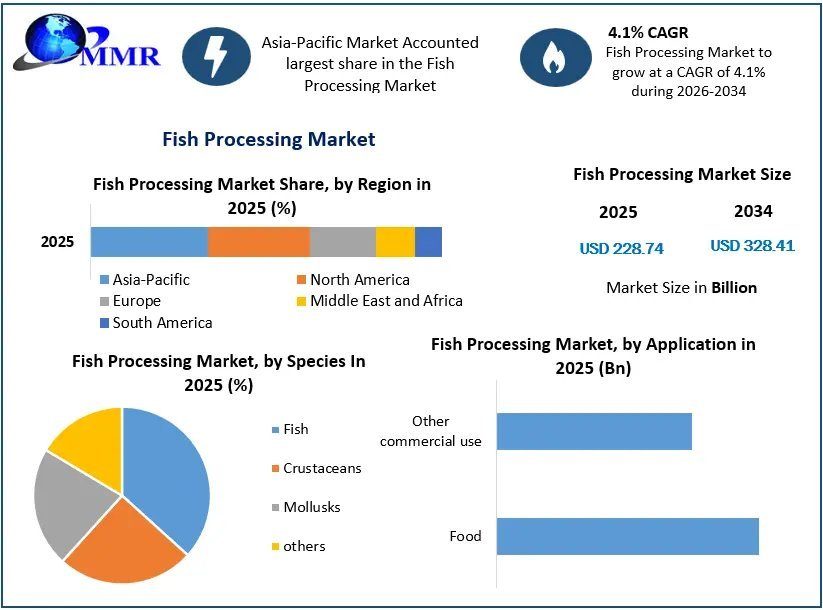
The Fish Processing Market was valued at USD 228.74 billion in 2025 and is projected to reach approximately USD 328.41 billion by 2034, growing at a CAGR of 4.1% from 2026 to 2034. Market expansion is supported by increasing seafood consumption, rising demand for convenient food products, the need for extended shelf life, and advancements in seafood preservation and processing technologies.
Fish processing plays a vital role in maintaining the quality, nutritional value, and safety of seafood between harvesting and final consumption. Freezing, preservation, packaging, and other processing techniques help reduce spoilage and make seafood products available across domestic and international markets. Growing aquaculture production and expanding seafood distribution networks are also creating opportunities for processors and equipment manufacturers.
Industry Transformation and Emerging Seafood Trends
Fish processing encompasses the handling and transformation of fish and other commercially harvested aquatic organisms into products suitable for consumption or other commercial applications. Common processes include freezing, preservation, packaging, and value-added product preparation.
Explore the Report Sample Before You Buy : https://www.maximizemarketresearch.com/request-sample/147841/
The market is influenced by rising demand for frozen seafood, increasing preference for convenient food options, and the expansion of international seafood trade. Processed fish products offer longer storage periods and improved distribution flexibility, allowing suppliers to serve markets beyond their immediate geographic areas.
Technological developments are also changing seafood processing operations. Automated processing equipment, advanced freezing systems, and high-pressure processing technologies can help improve operational efficiency, product consistency, and shelf-life management. Value-added seafood products provide additional opportunities for companies seeking to diversify their product portfolios.
However, the industry must manage challenges associated with seafood perishability, raw-material availability, food safety, cold-chain logistics, and changing regulatory requirements. Maintaining product quality throughout processing, storage, and transportation remains essential for market participants.
Study Coverage and Research Methodology
The MMR report uses 2025 as the base year, with the forecast period extending from 2026 to 2034. Historical market data covers 2020–2025. The analysis evaluates market size, revenue forecasts, segment performance, regional demand, competitive positioning, and developments across the fish processing industry.
The market is classified by Type, Species, Application, and Region.
- Type: Frozen, Preserved, and Others
- Species: Fish, Crustaceans, Mollusks, and Others
- Application: Food and Other Commercial Use
- Region: North America, Europe, Asia Pacific, Middle East and Africa, and South America
The study incorporates market estimation, competitive benchmarking, industry dynamics, regional assessments, and analysis of supply and demand. Additional coverage includes Porter’s Five Forces, PESTLE analysis, the technology roadmap, regulatory developments, trade analysis, and value-chain evaluation.
Regional Market Distribution and Growth Opportunities
Asia Pacific dominated the Fish Processing Market in 2025, accounting for 44% of the global market. Its leading position is supported by substantial seafood production, established processing operations, and the presence of major industry participants. China and India contribute to regional seafood supply, while companies such as Charoen Pokphand Foods strengthen the region’s industry presence.
North America is an important market supported by established seafood processors, distribution networks, and demand for frozen and preserved seafood. Europe also represents a significant market, with seafood consumption and international trade supporting processing activities.
The Middle East and Africa and South America offer additional opportunities as seafood production, processing infrastructure, and distribution capabilities develop. Market prospects across these regions depend on access to raw materials, cold-chain facilities, consumer demand, and the ability to meet food safety and export requirements.
Product Formats, Aquatic Species and End-Use Demand
The market’s segmentation reflects the different ways seafood is processed and the types of aquatic products supplied to consumers and commercial customers.
By Type: The market includes Frozen, Preserved, and Others. The Frozen segment held the largest market share in 2025 and is expected to maintain its leading position during the forecast period. Freezing helps preserve seafood quality, reduce deterioration, and extend product availability without relying solely on chemical preservatives.
By Species: The market covers Fish, Crustaceans, Mollusks, and Others. Fish represented the dominant species segment in the report. Demand is supported by the widespread consumption of fish as a source of protein and other nutrients. Meanwhile, the Crustaceans segment is projected to grow at a CAGR of 4.8%, supported by demand for shrimp, crab, and other crustacean products.
By Application: The market is divided into Food and Other Commercial Use. Food represents the principal application because fish and seafood are widely consumed across global markets. Processed seafood products serve households, retailers, restaurants, and foodservice operators.
Other commercial uses contribute to demand for processing capabilities suited to specific industrial and commercial requirements.
Request Free Access to the Sample Report : https://www.maximizemarketresearch.com/request-sample/147841/
Competitive Landscape and Leading Industry Participants
Competition in the Fish Processing Market involves seafood producers, processors, preservation technology providers, and manufacturers of processing equipment. Companies compete through processing capacity, product quality, operational efficiency, distribution reach, product innovation, and expansion into value-added seafood categories.
Major companies identified in the MMR report include Charoen Pokphand Foods PCL, High Liner Foods Incorporated, Lerøy Seafood Group ASA, Mowi ASA, Maruha Nichiro Corporation, Nissui Corporation, Pelagic ASA, Pescanova S.A., Royal Greenland A/S, Thai Union Group PCL, Norway Pelagic ASA, Optimar AS, JBT Corporation, Skaginn 3X, Arenco AB, KROMA A/S, Marel hf., The Middleby Corporation, BAADER Group, TriVision A/S, Pisces Microjet, Vartdal Plast, SEAC AB, Yanagiya Machinery Co., Ltd., Rybord LLC, Steen F.P.M. International, Pacific Seafood Group, Ocean Beauty Seafoods LLC, Trident Seafoods Corporation, and Hiperbaric S.A.
Recent developments demonstrate the industry’s focus on consolidation, capacity expansion, and advanced processing technology. In July 2026, Pacific Seafood merged its distribution operations with Ocean Beauty Seafoods to consolidate supply chains. In March 2026, High Liner Foods implemented organizational restructuring aimed at long-term cost optimization.
Earlier developments included Nissui Corporation’s subsidiary Cite Marine acquiring a seafood processing facility in August 2025, and Hiperbaric partnering with East Coast Seafood in March 2025 to deploy high-pressure processing technology. JBT Corporation completed its strategic combination with Marel in January 2025, strengthening its position in automated food and fish processing solutions.
Important Questions for Market Participants
- What was the global Fish Processing Market size in 2025?
The market was valued at USD 228.74 billion. - What is the projected market value by 2034?
The market is expected to reach approximately USD 328.41 billion. - What is the expected CAGR during 2026–2034?
The market is projected to grow at a CAGR of 4.1%. - Which region dominated the market in 2025?
Asia Pacific led the market with a 44% share. - Which processing type held the largest share?
Frozen fish products represented the leading type segment.
Strategic Insights and Scope of Report Deliverables
The MMR report provides a detailed assessment of the Fish Processing Market through 2034, covering market valuation, growth forecasts, segment-level analysis, regional opportunities, competitive developments, and industry dynamics.
Key report deliverables include:
- Global market size and revenue forecast for 2025–2034
- Historical market assessment for 2020–2025
- Type analysis covering frozen, preserved, and other products
- Species-level analysis of fish, crustaceans, mollusks, and others
- Application assessment across food and other commercial uses
- Regional and country-level market analysis
- Competitive landscape and company profiling
- Market drivers, restraints, opportunities, and challenges
- Processing technology and innovation assessment
- Supply-chain and value-chain analysis
View More Reports :
Global Low Alcohol Beverage Market https://www.maximizemarketresearch.com/market-report/low-alcohol-beverage-market/112935/
Reverse Osmosis Membrane Market https://www.maximizemarketresearch.com/market-report/reverse-osmosis-membrane-market/221749/
About Maximize Market Research
Maximize Market Research Pvt. Ltd. (MMR) is a global market research and consulting company that provides reliable, data-focused, and practical business insights. The firm serves a wide range of industries, including healthcare, pharmaceuticals, technology, automotive, electronics, chemicals, personal care, and consumer goods. Through market forecasts, competitive analysis, strategic consulting, and industry impact assessments, MMR helps organizations understand changing market conditions, identify growth opportunities, and make informed business decisions for long-term success.
Contact Us :
2nd Floor, Navale IT Park Phase 3
Pune Banglore Highway, Narhe
Pune, Maharashtra 411041, India
+91 9607365656
sales@maximizemarketresearch.com