
Glass Filled Nylon Market to Reach USD 11.69 Billion by 2034 as Lightweighting and EV Demand Accelerate
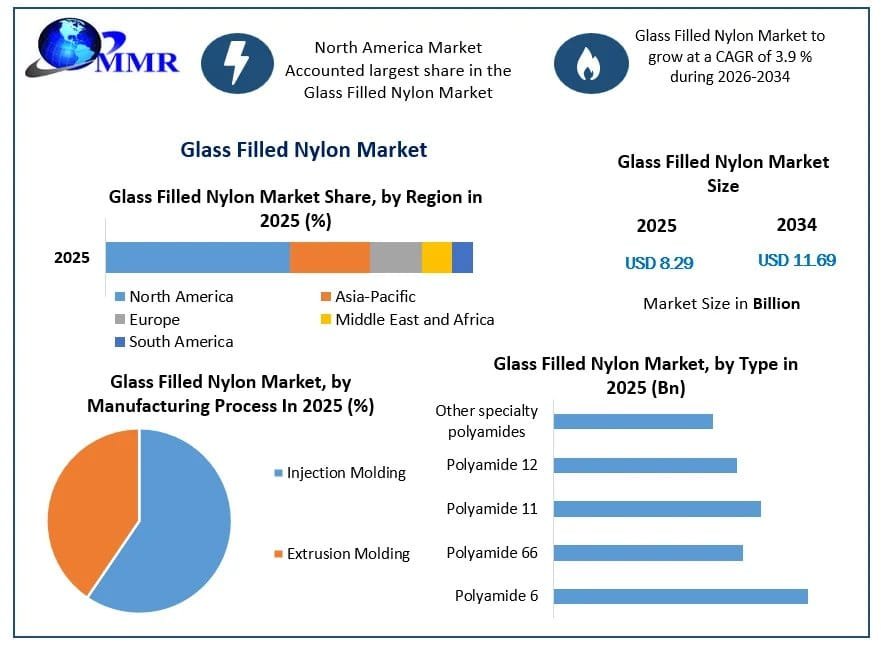
The Glass Filled Nylon Market is entering a period of steady expansion as automotive manufacturers, electrical and electronics producers, and industrial companies increasingly adopt lightweight, high-strength engineering plastics. According to the latest market outlook, the Glass Filled Nylon Market is expected to grow at a CAGR of 3.9% during the forecast period and reach USD 11.69 billion by 2034. The market is supported by the material’s high stiffness, tensile strength, dimensional stability, chemical resistance, durability, and ability to replace heavier metal components in demanding applications.
Market Estimation, Growth Drivers and Opportunities
Glass-filled nylon combines nylon resin with glass fibers to improve mechanical and thermal performance. Growing demand for lightweight automotive components is one of the strongest growth drivers because manufacturers are seeking materials that can reduce component weight while maintaining strength and dimensional accuracy. Increasing vehicle electrification is also creating opportunities for reinforced polyamides in battery-related components, electrical housings, connectors, thermal-management systems, brackets, and under-the-hood applications.
The market is additionally benefiting from the expansion of electrical and electronics manufacturing, industrial automation, consumer products, and advanced machinery. Injection molding enables manufacturers to produce complex components with fewer secondary operations, supporting productivity and design flexibility. Opportunities are emerging around recycled-content compounds, bio-based feedstocks, long-glass-fiber technologies, flame-retardant grades, hydrolysis-resistant materials, and specialized formulations designed for high-temperature and high-voltage environments.
Get Your Free Sample Report Link : https://www.maximizemarketresearch.com/request-sample/33342/
U.S. Market Trends and Investment
The United States remains an important market because of its established automotive, aerospace, electrical, electronics, and advanced manufacturing industries. In January 2025, the U.S. Department of Energy announced up to USD 88 million in Fiscal Year 2025 Vehicle Technologies Office funding for innovative transportation technologies, supporting research, development, demonstration, and deployment across advanced mobility. Lightweight materials remain strategically relevant to vehicle efficiency because reducing vehicle weight can improve fuel economy and help offset battery weight in electrified vehicles.
In 2025, BASF expanded its North American sustainable polyamide portfolio with Ultramid LowPCF and Ultramid BMB, designed to lower product carbon footprints while maintaining established processing and performance characteristics. BASF also introduced new polyamide solutions for high-voltage automotive connectors, demonstrating the industry’s movement toward materials combining electrical safety, dimensional stability, flame resistance, and lightweighting.
Market Segmentation: Largest-Share Segments
According to the Maximize Market Research report, automotive represented the dominant end-use industry in 2023, supported by demand for lightweight vehicle components, improved fuel economy, and applications in engine compartments, engine covers, and under-bonnet components. By glass filling, 30% glass-filled nylon held the prominent share in 2023 because of its suitability for automotive components requiring enhanced stiffness and strength. By type, Polyamide 6 (PA6) accounted for a significant share due to its design flexibility, tensile strength, chemical resistance, and widespread use across automotive and electrical and electronics applications.
Competitive Analysis
The competitive landscape includes major global material producers and engineering-plastics specialists. The leading companies identified in the Maximize Market Research report include BASF SE, Asahi Kasei Corporation, DowDuPont Inc., LANXESS, and Celanese Corporation.
BASF SE continues to strengthen its engineering-plastics portfolio through high-performance and sustainable polyamide development. In 2025, its new Ultramid solutions addressed hydrolysis resistance, high-voltage connectors, flame retardancy, and e-mobility requirements, supporting broader use of reinforced polyamides in next-generation vehicles.
Asahi Kasei Corporation focused on material innovation and circularity in 2025. The company announced PFAS-free polyamide development and showcased recycling technologies, bio-based materials, and cellulose-nanofiber-reinforced polyamide solutions at K 2025. These developments support demand for sustainable, high-performance engineering plastics.
DowDuPont Inc. remains associated with advanced engineering materials and high-performance polymer technologies used across demanding industrial and automotive applications. DuPont also received three 2025 R&D 100 Awards for material and technology innovations, highlighting continued emphasis on advanced materials development.
LANXESS maintains a broad portfolio of Durethan glass-fiber-reinforced polyamide compounds for automotive, electrical, electronics, and industrial applications. Its material development has emphasized high-strength, flame-retardant, low-warpage, and sustainable compounds, supporting lightweighting and electrification applications.
Celanese Corporation is another significant participant in engineered polyamides, supplying materials for automotive, electrical, and industrial applications. Its engineered-materials strategy continues to focus on strengthening nylon capabilities, manufacturing efficiency, supply resilience, and application-focused innovation.
Regional Analysis
United States: North America held the highest regional share in 2023 according to Maximize Market Research, with the United States identified as a leading contributor. Strong automotive production, advanced manufacturing, engineering-plastics expertise, and investment in lightweight vehicle technologies support market demand.
Germany: Germany represents an important European market because of its automotive manufacturing base and demand for lightweight, high-performance materials. Glass-filled nylon is increasingly relevant to vehicle electrification, connectors, housings, structural components, and thermal-management applications.
China: China provides significant growth opportunities through its large automotive, electronics, EV, and industrial manufacturing ecosystem. Increasing domestic production of electric vehicles and electronic components is creating additional demand for engineered polymers.
Japan: Japan’s advanced automotive and electronics industries support demand for precision engineering plastics. Lightweighting, miniaturization, high-temperature performance, and electrical reliability continue to influence material selection.
France: France benefits from automotive, aerospace, electrical, and industrial manufacturing activities. Investments in advanced materials and vehicle efficiency provide opportunities for reinforced nylon applications.
Key Players
BASF SE; Asahi Kasei Corporation; DowDuPont Inc.; LANXESS; Celanese Corporation; Ensinger; Arkema Group; E. I. du Pont de Nemours and Company; EMS-CHEMIE Holding AG; Evonik Industries; Royal DSM N.V.; RTP Company; SABIC; Ascend Performance Materials; Fukuang Plastic; Nylatech; Akro-Plastic GmbH; Radici Group; SRF Plastics; Steklonit JSC; Emco Industrial Plastics Inc.; DOMO Chemicals; and Quadrant.
Why This Market Matters Now
The Glass Filled Nylon Market matters now because manufacturers are balancing weight reduction, performance, electrification, sustainability, and production efficiency. Glass-filled nylon provides a practical pathway for replacing selected metal components while maintaining mechanical and thermal performance. As electric vehicles, advanced electronics, industrial automation, and lightweight manufacturing expand, demand for application-specific reinforced nylon grades is expected to create new opportunities for material producers, compounders, component manufacturers, and technology developers.
Explore More Related Reports:
Global Automotive Lead Acid Batteries Market https://www.maximizemarketresearch.com/market-report/global-automotive-lead-acid-batteries-market/98248/
Global Dicyandiamide Market https://www.maximizemarketresearch.com/market-report/global-dicyandiamide-market/63986/
About Maximize Market Research
Maximize Market Research Pvt. Ltd. (MMR) is a global market research and consulting company that provides reliable, data-focused, and practical business insights. The firm serves a wide range of industries, including healthcare, pharmaceuticals, technology, automotive, electronics, chemicals, personal care, and consumer goods. Through market forecasts, competitive analysis, strategic consulting, and industry impact assessments, MMR helps organizations understand changing market conditions, identify growth opportunities, and make informed business decisions for long-term success.
Contact Us
2nd Floor, Navale IT Park Phase 3
Pune Banglore Highway, Narhe
Pune, Maharashtra 411041, India
+91 9607365656
sales@maximizemarketresearch.com