
Revenue Projections and Future Market Potential
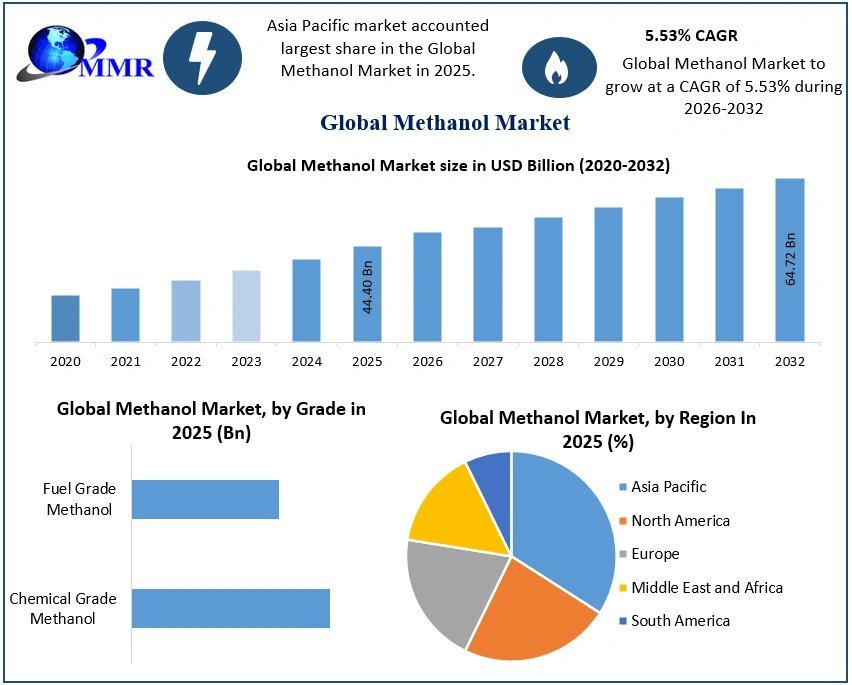
The Methanol Market was valued at USD 44.40 billion in 2025 and is projected to grow at a CAGR of 5.53% from 2025 to 2032, reaching approximately USD 64.72 billion by 2032. This growth outlook reflects increasing methanol consumption across chemical manufacturing, industrial applications, fuel production, and emerging clean-energy technologies.
Methanol continues to serve as an important industrial raw material for producing formaldehyde, acetic acid, plastics, resins, solvents, and other chemical derivatives. Growing petrochemical production, expanding construction activity, and demand for alternative fuels are supporting market development. In addition, investments in bio-methanol, e-methanol, and other low-carbon production pathways are creating new opportunities for producers seeking to meet evolving sustainability requirements.
Industry Structure, Key Trends and Growth Influences
Methanol, chemically represented as CH₃OH, is a colorless, volatile, and flammable alcohol used extensively in chemical manufacturing, fuels, and industrial processes. It is produced primarily from natural gas and coal, while alternative production pathways use biomass, captured carbon dioxide, renewable hydrogen, and waste-derived feedstocks.
Explore the Report Sample Before You Buy : https://www.maximizemarketresearch.com/request-sample/126817/
Emerging Industry Trends
The industry is gradually expanding beyond conventional petrochemical applications into cleaner fuel technologies. Green methanol, including bio-methanol and e-methanol, is attracting investment as shipping companies and industrial producers explore lower-carbon alternatives.
Methanol-powered marine vessels, methanol-to-olefins (MTO) technologies, biomass conversion, and carbon dioxide-to-methanol processes are influencing the industry’s long-term direction. Digital procurement and improved production technologies are also gaining attention as manufacturers seek better supply-chain visibility and operational efficiency.
Principal Growth Drivers
- Increasing demand for methanol derivatives used in plastics, adhesives, resins, and construction materials.
- Expansion of petrochemical and chemical manufacturing, particularly in Asia-Pacific.
- Rising demand for fuel applications, including gasoline blending, marine fuel, and power generation.
- Growing interest in alternative feedstocks and low-carbon chemical production.
- Investments in methanol-to-olefins and methanol-to-propylene facilities.
- Increasing adoption of methanol-based intermediates in automotive, electronics, packaging, and industrial applications.
Market Opportunities and Industry Challenges
Renewable methanol offers opportunities in marine transportation, industrial heating, clean fuels, and sustainable chemical manufacturing. Carbon capture integration, renewable hydrogen, and waste-to-methanol technologies may help producers diversify feedstocks and reduce the carbon intensity of production.
However, the industry faces challenges associated with fossil-fuel feedstock dependence, fluctuating natural gas and coal prices, emissions regulations, and supply-chain disruptions. Green methanol production also remains more expensive than conventional production, which can limit widespread adoption. Differences in production capacity and demand between regions may further affect prices and trade flows.
Research Coverage, Market Boundaries and Analytical Approach
The report evaluates the global methanol industry using 2025 as the base year, a 2026–2032 forecast period, and historical data covering 2020–2025. The source’s overview presents the market’s growth estimate from 2025 to 2032, while its scope table specifies 2026–2032 as the forecast period.
The study covers market size and revenue forecasts, feedstock categories, methanol derivatives, product grades, end-user industries, geographic markets, and the competitive environment. It also examines production capacity, supply and demand, pricing fluctuations, international trade, industry developments, sustainability, and investment opportunities.
The research framework includes competitive benchmarking, company profiles, market dynamics, supply-chain assessment, technology developments, regional demand, and strategic analysis. These elements help businesses evaluate growth opportunities and understand the factors influencing methanol production and consumption.
Geographic Market Performance and Regional Opportunities
The global methanol market is analyzed across Asia-Pacific, North America, Europe, the Middle East and Africa, and South America. These regions differ in feedstock availability, production capacity, industrial consumption, trade activity, and investment in alternative methanol technologies.
Asia-Pacific held the leading regional position in 2025, accounting for more than 55% of global methanol consumption and approximately 60–65% of production capacity, according to the source report. China is the region’s principal market, supported by extensive coal-based methanol production and methanol-to-olefins facilities serving the plastics and petrochemical industries.
Regional demand is supported by industrialization and activity across construction, automotive, paints and coatings, electronics, and chemical manufacturing. China, India, Indonesia, and Japan are also exploring renewable methanol and related low-carbon technologies, creating opportunities for future investment.
North America benefits from established methanol producers and natural gas resources, while the Middle East has an important role in feedstock-based production and export supply. Europe offers opportunities in renewable methanol and e-methanol, particularly as industrial and maritime operators pursue lower-emission alternatives. South America and Africa are included in the report’s geographic assessment, with market prospects influenced by local industrial demand, feedstock availability, and infrastructure development.
Request the Free Sample Report : https://www.maximizemarketresearch.com/request-sample/126817/
Market Breakdown by Feedstock, Derivatives, Grade and End Use
Feedstock-Based Market Structure
The market is divided into Natural Gas-Based Methanol, Coal-Based Methanol, and Others, including biomass, captured carbon dioxide combined with hydrogen, and waste-derived feedstocks.
Natural Gas-Based Methanol was the leading feedstock segment in 2025, supported by cost efficiency, production scalability, and the availability of natural gas in regions such as North America, the Middle East, and Russia. Coal-based production remains significant, particularly in China, although its higher carbon emissions present environmental challenges. Alternative feedstocks are gaining attention as producers explore lower-carbon production methods.
Derivative-Based Market Categories
The report classifies methanol derivatives into:
- Gasoline
- Methanol-to-Olefins and Methanol-to-Propylene (MTO/MTP)
- Formaldehyde
- Methyl Tertiary Butyl Ether (MTBE)
- Acetic Acid
- Dimethyl Ether (DME)
- Methyl Methacrylate (MMA)
- Biodiesel
- Others
These derivatives serve a broad range of industries, including plastics, construction materials, paints, adhesives, fuels, and chemical manufacturing. Demand is influenced by downstream production activity and the development of new methanol-based applications.
Product Grade Classification
Methanol is classified into Chemical Grade Methanol and Fuel Grade Methanol. Chemical-grade methanol supports industrial synthesis and the manufacture of chemical intermediates. Fuel-grade methanol is used in fuel-related applications, including blending, energy generation, and emerging marine-fuel technologies.
End-User Industry Assessment
The report covers the following end-user categories:
- Construction
- Automotive
- Electronics
- Appliances
- Paints and Coatings
- Insulation
- Pharmaceuticals
- Packaging, including PET bottles
- Solvents
- Others
Construction was the leading end-user segment in 2025, reflecting methanol’s role in producing formaldehyde-based resins, adhesives, laminates, plywood, medium-density fiberboard, and insulation materials. Demand is supported by construction activity, infrastructure development, housing, and interior furnishing.
Automotive, paints and coatings, electronics, packaging, and pharmaceutical applications also contribute to demand through their use of methanol-based chemicals and intermediates.
Competitive Landscape and Major Industry Participants
The global methanol market comprises producers and chemical companies operating across feedstock supply, methanol manufacturing, derivatives, distribution, and industrial applications. Competitive positioning is influenced by production capacity, feedstock economics, logistics,
Major companies identified in the report include:
- Methanex Corporation
- Celanese Corporation
- Atlantic Methanol Production Company
- Eastman Chemical Company
- Mitsubishi Gas Chemical Co., Inc.
- Southern Chemical Corporation
- Natgasoline LLC
- BASF SE
- Methanol Holdings Limited
- HELM AG
- Simalin Chemical Industries Pvt. Ltd.
- Metafrax Chemicals
- Zagros Petrochemical Company
- SABIC
- Mitsui & Co., Ltd.
- Yanzhou Coal Mining Company Ltd.
- Shanghai Huayi (Group) Company
- Ningxia Baofeng Energy Group Co., Ltd.
Explore the Report Sample Before You Buy : https://www.maximizemarketresearch.com/request-sample/126817/
Competitive Strategies and Recent Developments
Market participants are investing in production capacity, supply-chain integration, renewable methanol, and technologies intended to reduce carbon emissions. Conventional producers continue to emphasize production scale and feedstock access, while emerging low-carbon projects are creating new opportunities in alternative fuel supply.
The source reports that Methanex completed its acquisition of OCI Global’s international methanol assets in June 2025, strengthening its production and distribution footprint. It also highlights the inauguration of a commercial-scale e-methanol facility in Kassø, Denmark, by Mitsui and European Energy in May 2025. These developments illustrate the industry’s parallel focus on conventional market consolidation and low-carbon production.
Frequently Asked Questions About the Methanol Industry
What was the global methanol market value in 2025?
The market was valued at USD 44.40 billion in 2025.
What is the projected market value by 2032?
The market is expected to reach approximately USD 64.72 billion by 2032.
What is the expected growth rate of the market?
The source projects a CAGR of 5.53% over the stated 2025–2032 growth period.
Which region leads the global methanol market?
Asia-Pacific led the market in 2025, supported by substantial consumption and production capacity, particularly in China.
Which feedstock segment dominates methanol production?
Natural gas-based methanol was the leading feedstock segment in 2025.
Report Coverage and Strategic Deliverables
The Global Methanol Market report provides an integrated assessment of market size, revenue projections, historical performance, and future growth prospects. It examines the industry through feedstock, derivatives, grade, end-user, and regional segmentation.
Its key areas of coverage include:
- Market sizing and forecasts: Revenue estimates, historical data, and projections through 2032.
- Segment analysis: Feedstock categories, methanol derivatives, product grades, and end-user industries.
- Regional intelligence: Geographic demand, production capacity, regional market leadership, and growth opportunities.
- Industry dynamics: Key drivers, restraints, opportunities, challenges, and emerging market trends.
- Competitive assessment: Major companies, market positioning, company profiles, and strategic developments.
- Supply-chain analysis: Feedstock availability, pricing fluctuations, production economics, and international trade.
- Technology developments: Conventional production methods, renewable methanol, carbon dioxide conversion, and alternative feedstocks.
- Sustainability insights: Low-carbon production pathways, emissions-related pressures, and the transition toward cleaner fuels.
- Strategic outlook: Capacity expansion, investment opportunities, changing end-user demand, and competitive developments.
View More Reports :
Bulk Food Ingredients Market https://www.maximizemarketresearch.com/market-report/bulk-food-ingredients-market/124758/
Ice Flaking Machine Market https://www.maximizemarketresearch.com/market-report/ice-flaking-machine-market/122940/
About Maximize Market Research
Maximize Market Research Pvt. Ltd. (MMR) is a global market research and consulting company that provides reliable, data-focused, and practical business insights. The firm serves a wide range of industries, including healthcare, pharmaceuticals, technology, automotive, electronics, chemicals, personal care, and consumer goods. Through market forecasts, competitive analysis, strategic consulting, and industry impact assessments, MMR helps organizations understand changing market conditions, identify growth opportunities, and make informed business decisions for long-term success.
Contact Us :
2nd Floor, Navale IT Park Phase 3
Pune Banglore Highway, Narhe
Pune, Maharashtra 411041, India
+91 9607365656
sales@maximizemarketresearch.com