
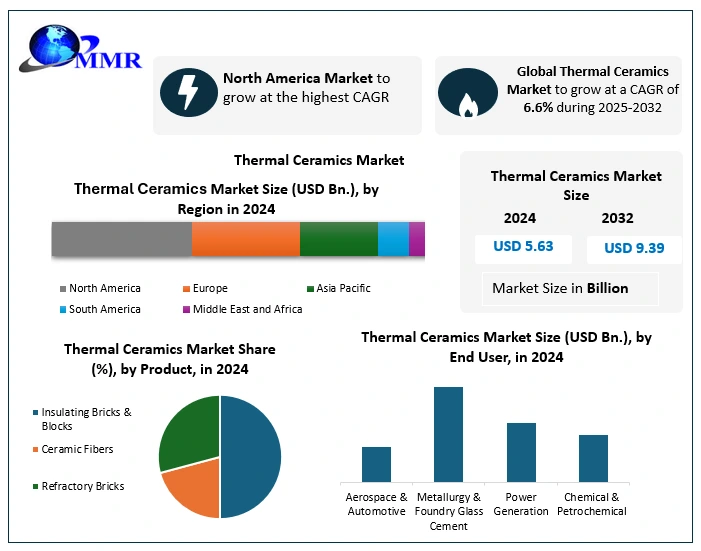
The global Thermal Ceramics Market is gaining strong momentum as industries increasingly demand advanced insulation materials capable of withstanding extreme temperatures. Valued at USD 5.63 billion in 2024, the market is projected to reach USD 9.39 billion by 2032, growing at a CAGR of 6.6% during the forecast period.
Thermal ceramics are essential high-performance materials used in industrial environments where heat control, energy efficiency, and safety are critical.
Market Overview
Thermal ceramics are specialized insulating materials designed to manage extreme heat conditions in industries such as:
- Steel and metallurgy
- Cement and glass manufacturing
- Petrochemical processing
- Power generation
- Aerospace and automotive systems
These materials have evolved from basic heat-resistant products into advanced, lightweight, and energy-efficient insulation solutions with high thermal stability and chemical resistance.
To know the most attractive segments, click here for a free sample of the report:https://www.maximizemarketresearch.com/request-sample/22702/
Key Market Drivers
- Rising Industrialization and Infrastructure Development
Rapid industrial expansion, especially in emerging economies like India and China, is increasing demand for high-temperature insulation in furnaces, kilns, and metal processing units.
- Strong Focus on Energy Efficiency
Governments worldwide are enforcing strict energy efficiency regulations, pushing industries to adopt advanced insulation systems that reduce energy loss and emissions.
- Growth in Heavy Industries
Sectors such as steel, cement, and glass manufacturing rely heavily on thermal ceramics for:
- Furnace linings
- Kiln insulation
- High-temperature processing systems
- Automotive and Aerospace Expansion
The shift toward lightweight, fuel-efficient vehicles and advanced aerospace systems is increasing demand for ceramic-based insulation materials.
- Technological Advancements
Innovation in materials science is enabling:
- Bio-soluble ceramic fibers
- Nanotechnology-based insulation
- Composite thermal barriers
- Digital furnace monitoring systems
These advancements are improving performance while reducing environmental impact.
Market Challenges
High Initial Investment Costs
Advanced thermal ceramic systems require significant capital investment, limiting adoption among small and medium enterprises.
Raw Material Price Volatility
Fluctuations in materials such as alumina impact production costs and profitability.
Environmental and Regulatory Pressure
Manufacturers must comply with strict environmental regulations related to emissions, waste disposal, and workplace safety.
Skilled Labor Shortage
Installation and maintenance require technical expertise, which is limited in certain regions.
Market Segmentation
By Type (Dominant Segment: Insulating Bricks & Blocks)
- Insulating bricks & blocks
- Ceramic fibers
- Refractory bricks
- Modules and boards
Insulating bricks dominate due to their widespread use in high-temperature industrial furnaces and kilns.
By End-Use Industry
- Metallurgy & foundry (largest share)
- Cement & glass
- Power generation
- Chemical & petrochemical
- Aerospace & automotive
Metallurgy remains the largest consumer due to continuous steel production growth worldwide.
To know the most attractive segments, click here for a free sample of the report:https://www.maximizemarketresearch.com/request-sample/22702/
Regional Analysis
Asia Pacific: Fastest-Growing Region
Asia Pacific leads market expansion due to:
- Rapid industrialization in China and India
- Large-scale steel and cement production
- Increasing infrastructure development
North America: Technology Leader
North America remains a key market driven by:
- Advanced aerospace and automotive industries
- Strong focus on energy efficiency
- Adoption of high-performance insulation systems
Europe: Sustainability-Driven Market
Europe is heavily focused on:
- Carbon emission reduction
- Energy-efficient industrial operations
- Adoption of eco-friendly materials like bio-soluble fibers
Competitive Landscape
The thermal ceramics market is moderately consolidated with global players focusing on innovation, sustainability, and high-performance materials.
Key companies include:
- Morgan Advanced Materials
- Unifrax
- Saint-Gobain
- Rath AG
- 3M
- IBIDEN Co., Ltd.
These companies are investing in advanced insulation technologies, bio-soluble fibers, and high-temperature ceramic composites to strengthen their global position.
Key Market Trends
- Shift Toward Sustainable Materials
Bio-soluble fibers are replacing traditional ceramic fibers due to environmental and health safety concerns.
- Expansion in Electric Vehicle Applications
Thermal ceramics are increasingly used in:
- EV battery thermal management
- Fire protection systems
- Growth in Aerospace-Grade Ceramics
Demand is rising for ultra-high-temperature materials capable of withstanding extreme aerospace conditions.
- Smart Manufacturing Integration
Digital furnace monitoring and automated thermal systems are improving efficiency and reducing energy consumption.
Recent Developments
- Germany (2024): Advanced sintering furnace systems improving efficiency in ceramic processing
- China (2025): Modular thermal ceramic systems enhancing furnace insulation performance
- India (2025): Breakthrough thermal barrier coatings for scramjet engines
- USA (2025): Increased adoption in aerospace, semiconductors, and defense applications
- EU Projects: Development of ultra-high-temperature ceramic matrix composites (>2000°C resistance)
Future Outlook (2025–2032)
The thermal ceramics market is expected to grow steadily due to:
- Expansion of heavy industries
- Increasing focus on decarbonization
- Rising EV and aerospace demand
- Continuous innovation in ceramic materials
- Strong regulatory push for energy efficiency
By 2032, thermal ceramics will play a critical role in enabling sustainable, high-efficiency industrial operations across global sectors.
Conclusion
The global thermal ceramics market is evolving into a key enabler of industrial energy efficiency and high-temperature performance. With strong demand from metallurgy, aerospace, automotive, and energy sectors, combined with technological innovation and sustainability trends, the market is set for sustained growth through 2032.
Companies investing in advanced materials, eco-friendly solutions, and high-performance insulation technologies are expected to lead the next phase of industry transformation.