
Online Bus Ticket Service Market Overview
The global Online Bus Ticket Service Market is experiencing substantial growth as travelers increasingly prefer convenient, accessible, and technology-enabled transportation booking solutions. Online bus ticketing platforms allow passengers to search routes, compare ticket prices, check seat availability, select preferred buses, and complete reservations through websites, mobile applications, and third-party travel aggregators. These platforms also provide digital tickets, booking confirmations, real-time travel updates, cancellation facilities, and trip-related notifications, improving the overall passenger experience.
Dive deeper into market insights, trends, segmentation, and competitive landscape here: https://www.maximizemarketresearch.com/request-sample/36017/
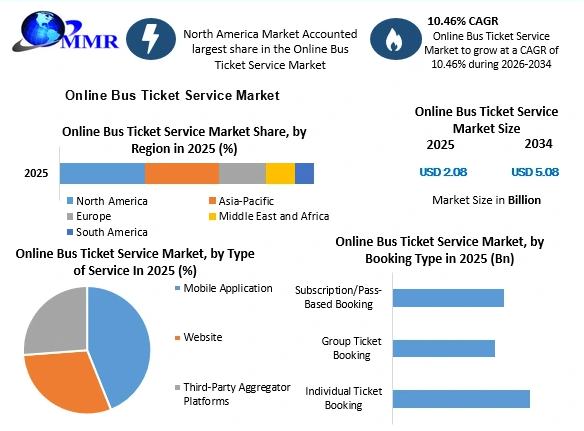
According to the market assessment, the Online Bus Ticket Service Market was valued at USD 2.08 billion in 2025 and is expected to reach approximately USD 5.08 billion by 2034. The market is anticipated to expand at a compound annual growth rate (CAGR) of 10.46% throughout the forecast period from 2026 to 2034.
The increasing preference for online booking is closely associated with the expansion of intercity transportation networks and the growing demand for affordable travel options. Passengers are increasingly using digital platforms to compare economy, air-conditioned, luxury, sleeper, and premium coach services before making travel decisions. This shift enables travelers to identify suitable routes, evaluate ticket prices, and book seats without visiting physical ticket counters.
Furthermore, the integration of digital wallets, mobile banking, credit and debit cards, and instant payment systems has simplified online transactions. Travel booking platforms are also investing in user-friendly interfaces, personalized recommendations, loyalty programs, and customer support services to strengthen customer engagement and retention.
The expansion of organized bus operators and the integration of public transportation services into digital platforms are creating additional opportunities. In emerging economies, particularly across Asia Pacific, increasing internet accessibility, smartphone adoption, and demand for cost-effective intercity travel are encouraging the development of online ticketing ecosystems.
To know more about the research methodology, request a free sample report.
Online Bus Ticket Service Market Growth and Dynamics
Market Drivers and Trends
Increasing Demand for Convenient and Flexible Travel Booking
Convenience is a major factor supporting the growth of the Online Bus Ticket Service Market. Traditional ticket purchasing methods often require passengers to visit booking counters or depend on local travel agents. Online platforms eliminate many of these limitations by providing access to schedules, seat availability, fares, and booking facilities at any time.
Passengers can compare multiple operators, select departure times, review available amenities, and receive electronic tickets directly on their devices. These benefits are particularly important for frequent travelers, students, tourists, and professionals who require flexible transportation arrangements.
Dive deeper into market insights, trends, segmentation, and competitive landscape here: https://www.maximizemarketresearch.com/request-sample/36017/
Rising Smartphone Penetration and Digital Payment Adoption
The growing use of smartphones and mobile internet is encouraging consumers to adopt mobile-based bus ticket booking applications. Mobile platforms enable passengers to make reservations while commuting, traveling, or planning journeys from home. Push notifications, digital boarding passes, saved passenger information, and integrated customer support further improve usability.
Digital payment infrastructure is also strengthening market development. UPI-based payments, digital wallets, online banking, and card transactions provide convenient alternatives to cash-based bookings. Although cash payments remain relevant in certain markets, the expansion of digital financial services is supporting faster transactions and a more streamlined booking experience.
Expansion of Intercity Transportation and Tourism
Increasing domestic tourism, business travel, educational travel, and cross-city mobility are creating demand for reliable intercity bus services. Buses remain an important transportation option because they can connect major cities with smaller towns and destinations that may have limited rail or air connectivity.
Online ticketing platforms help passengers discover routes, compare operators, and book transportation in advance. The growing availability of premium coaches, sleeper buses, and overnight services is also supporting demand among travelers seeking affordable alternatives to other modes of transportation.
Technology Integration and Personalized Booking Experiences
Technology innovation is becoming an important competitive factor in the online bus ticketing industry. Companies are improving their platforms through artificial intelligence, data analytics, automated customer service, personalized offers, and demand forecasting.
These capabilities can help operators understand passenger preferences, optimize seat inventory, adjust pricing strategies, and improve route planning. Aggregator platforms also enable customers to compare services from multiple operators through a single interface, increasing transparency and simplifying purchase decisions.
However, cybersecurity concerns, payment fraud, inconsistent service quality, cancellation disputes, and dependence on internet connectivity remain challenges. Companies must continue investing in secure payment infrastructure, transparent refund policies, reliable customer support, and accurate booking information to sustain consumer confidence.
Online Bus Ticket Service Market Segment Analysis
The global Online Bus Ticket Service Market is segmented by type of service, booking type, payment mode, bus type, end user, and region.
By Type of Service
Based on type of service, the market is categorized into mobile applications, websites, and third-party aggregator platforms.
Mobile applications are gaining popularity because they provide convenient access to booking functions, saved passenger details, digital tickets, payment options, and travel notifications. Mobile-first platforms are particularly relevant in markets where smartphones are the primary means of accessing online services.
Websites continue to serve customers who prefer desktop-based booking, detailed route comparisons, and advance travel planning. Third-party aggregator platforms provide access to multiple bus operators, allowing passengers to compare fares, schedules, seat availability, and service features in one place. These platforms also help bus operators expand their digital reach without independently developing extensive consumer-facing booking systems.
By Booking Type
The booking-type segment includes individual ticket booking, group ticket booking, and subscription or pass-based booking.
Individual ticket booking represents an important part of the market because it serves everyday passengers, tourists, students, and business travelers. Group ticket booking supports families, tour groups, educational institutions, and organizations requiring multiple seats on the same route.
Subscription and pass-based booking options can benefit frequent commuters and passengers who travel regularly between specific locations. These services may provide discounted fares, simplified repeat bookings, or access to selected routes, depending on the operator’s offering.
By Payment Mode
Based on payment mode, the market is segmented into online payment, cash on delivery, and others.
Online payment is an important market segment, supported by the adoption of digital wallets, UPI, credit and debit cards, and net banking. Digital transactions simplify booking confirmation and reduce the need for passengers to visit physical ticket counters.
Cash on delivery and cash-at-counter arrangements remain relevant in selected markets where digital payment adoption is comparatively limited or passengers prefer paying in cash. The others category includes promotional vouchers, prepaid credits, gift codes, and loyalty-based redemption options.
The continued expansion of digital payment infrastructure is expected to strengthen the role of online transactions in the bus ticketing ecosystem.
By Bus Type
The bus-type segment includes economy and non-AC buses, AC and semi-luxury buses, luxury and premium coaches, and sleeper and semi-sleeper buses.
Economy and non-AC buses remain important for price-sensitive passengers, particularly in developing transportation markets. Their affordability makes them suitable for routine intercity travel and journeys between smaller cities and towns.
AC and semi-luxury buses attract passengers seeking additional comfort without paying premium coach fares. Luxury and premium coaches appeal to travelers who prioritize amenities, spacious seating, onboard facilities, and enhanced service quality.
Sleeper and semi-sleeper buses are increasingly relevant for overnight journeys because they allow passengers to travel longer distances while reducing the need for daytime travel. The availability of different bus categories enables online platforms to serve a broad range of passenger budgets and preferences.
By End User
Based on end user, the market is divided into individuals, tourists and travelers, and corporate or institutional clients.
Individual passengers use online platforms for personal, educational, professional, and routine travel. Tourists and leisure travelers benefit from route discovery, advance reservations, digital tickets, and access to multiple operators.
Corporate and institutional clients may use online booking services to coordinate employee travel, educational trips, group transportation, and other organized journeys. As platforms develop more flexible booking and payment features, they can address the requirements of both individual consumers and business customers.
Dive deeper into market insights, trends, segmentation, and competitive landscape here: https://www.maximizemarketresearch.com/request-sample/36017/
Regional Analysis of the Online Bus Ticket Service Market
North America held the largest regional share of the Online Bus Ticket Service Market in 2025, according to the supplied market assessment. The region’s developed digital infrastructure, established online travel booking ecosystem, and demand for intercity transportation support market adoption.
The United States, Canada, and Mexico contribute to regional demand through domestic tourism, business travel, and cross-border passenger movement. Digital platforms enable travelers to compare schedules, book intercity coach services, and plan journeys between major metropolitan areas and smaller destinations.
Europe represents another important market, supported by cross-border travel, established coach networks, tourism, and the availability of digital transportation services. Online booking platforms help passengers compare routes and operators across different countries, although language, payment, and regulatory differences can influence service delivery.
Asia Pacific offers substantial growth opportunities due to its large population, expanding middle class, growing smartphone penetration, and strong demand for affordable transportation. Countries such as India, China, Japan, Australia, Indonesia, and Malaysia present diverse opportunities for online ticketing providers. The integration of state-operated bus services and private operators into digital platforms can further expand route coverage and passenger access.
The Middle East and Africa market is supported by tourism development, urbanization, and the gradual expansion of digital transportation infrastructure. South America is also witnessing opportunities associated with intercity mobility, tourism, and the adoption of digital booking services, particularly in markets with extensive long-distance bus networks.
Regional growth will depend on internet accessibility, transportation infrastructure, digital payment adoption, consumer trust, and the extent to which operators integrate their ticket inventory with online platforms.
Online Bus Ticket Service Market Recent Industry Developments
Recent developments illustrate how companies are expanding digital ticketing networks, integrating transportation services, and exploring technology-enabled operational improvements.
According to the developments supplied for this report, FlixBus signed a Memorandum of Understanding with Vertelo on April 28, 2025, to deploy 500 electric intercity coach buses across India. The proposed collaboration highlights the growing intersection between digital bus booking services and the transition toward electric mobility.
On September 25, 2025, AbhiBus, part of the ixigo Group, partnered with the Odisha State Road Transport Corporation (OSRTC) to integrate state bus inventory into its platform. The development was reported to expand digital ticketing access across approximately 4,800 daily bus services covering more than 190 cities and intercity routes.
On May 8, 2026, FlixBus India collaborated with Green Drive Mobility to introduce zero-emission electric intercity bus services on the Vijayawada–Visakhapatnam route. The initiative demonstrates the potential for digital booking networks to support the adoption of electric buses and cleaner transportation services.
On June 11, 2026, redBus established a strategic partnership with Noida International Airport to provide direct online bus ticket bookings from the airport terminal. The collaboration was reported to support multimodal connectivity, including direct access to more than 20 destinations across North India.
On July 29, 2026, Busbud established a new parent company named Terra Mobility and secured USD 40 million in financing from Vista Credit Partners, according to the supplied information. The development was intended to bring consumer ticketing platforms and the TerraOS operating system together to support technology-led revenue and inventory management for transportation operators.
These developments highlight several industry priorities: expanding operator partnerships, improving digital access to public transportation, supporting sustainable mobility, connecting airports with ground transportation, and applying technology to bus inventory management.
Note: The recent-development details above are based on the information supplied for this press release and should be independently verified before publication.
Major Industry Players in the Online Bus Ticket Service Market
The Online Bus Ticket Service Market includes digital travel aggregators, bus operators, reservation technology providers, and regional ticketing platforms. Competition is shaped by route coverage, operator partnerships, pricing transparency, platform reliability, customer service, payment integration, and mobile application performance.
Key players identified in the market include:
- Busbud, Inc.
- BusOnlineTicket.com
- Omio
- GotoBus.com
- MakeMyTrip
- Wanderu
- redBus.in
- Buupass.com
- Megabus
- FlixMobility
- AbhiBus
- Cleartrip
- Paytm Bus Booking
- Travelyaari
- TicketGoose
- MyBusTickets
- eTravelSmart
- VIA
- SRS Travels
- Goibibo
- Buster
- IntrCity SmartBus
- Yolo Bus
- CheckMyBus
These companies operate across different geographies and business models. Some focus on aggregating ticket inventory from multiple operators, while others combine ticketing technology with transportation operations or broader travel booking services.
Market participants are pursuing expansion through operator integrations, mobile application improvements, partnerships with public transportation agencies, enhanced payment options, customer loyalty initiatives, and the development of connected travel services. Competition is expected to remain closely linked to the ability to provide accurate schedules, competitive fares, dependable customer support, and convenient digital booking experiences.
Online Bus Ticket Service Market Scope
The report provides an assessment of the global Online Bus Ticket Service Market, covering historical performance, current industry conditions, growth drivers, market challenges, competitive developments, and future opportunities.
Market report coverage:
- Base year: 2025
- Historical period: 2020–2025
- Forecast period: 2026–2034
- Market size in 2025: USD 2.08 billion
- Projected market size in 2034: USD 5.08 billion
- Forecast CAGR: 10.46% from 2026 to 2034
- Segments covered: Type of service, booking type, payment mode, bus type, end user, and region
- Regions covered: North America, Europe, Asia Pacific, Middle East and Africa, and South America
The study evaluates market dynamics and competitive positioning using analytical approaches such as PESTEL, PORTER’s Five Forces, and SWOT/SVOR analysis, as applicable to the report methodology. It also examines the potential influence of economic, technological, regulatory, and consumer-related factors on the industry.
The report aims to help investors, transportation companies, digital platform providers, technology vendors, and other stakeholders understand market structure, assess growth opportunities, evaluate competition, and develop informed business strategies.
Frequently Asked Questions (FAQs)
1. What was the global Online Bus Ticket Service Market size in 2025?
The global Online Bus Ticket Service Market was valued at USD 2.08 billion in 2025.
2. What is the projected market size by 2034?
The market is expected to reach nearly USD 5.08 billion by 2034, according to the supplied market estimates.
3. What is the expected CAGR of the Online Bus Ticket Service Market?
The market is projected to grow at a CAGR of 10.46% during the forecast period from 2026 to 2034.
4. Which region held the largest share of the Online Bus Ticket Service Market in 2025?
North America held the largest share in 2025, according to the supplied market assessment. Demand is supported by digital booking adoption, intercity transportation networks, and travel and tourism activity.
5. What are the major factors driving market growth?
Key growth factors include increasing smartphone penetration, expanding digital payment infrastructure, rising intercity travel demand, the growth of online travel aggregators, and the convenience of comparing and booking bus tickets digitally.
Conclusion
The global Online Bus Ticket Service Market is positioned for continued expansion as consumers increasingly adopt digital booking channels and transportation providers strengthen their online presence. Rising demand for intercity mobility, widespread smartphone usage, the expansion of digital payment systems, and the integration of public and private bus operators are creating opportunities for market participants.
Connect With Us:
MAXIMIZE MARKET RESEARCH PVT. LTD.
2nd Floor, Navale IT park Phase 3,
Pune Banglore Highway, Narhe
Pune, Maharashtra 411041, India.
+91 9607365656
sales@maximizemarketresearch.com
About Maximize Market Research:
Maximize Market Research is one of the fastest-growing market research and business consulting firms serving clients globally. Our revenue impact and focused growth-driven research initiatives make us a proud partner of majority of the Fortune 500 companies. We have a diversified portfolio and serve a variety of industries such as IT & telecom, chemical, food & beverage, aerospace & defense, healthcare and others.