
Gene Amplification Technologies Market Overview
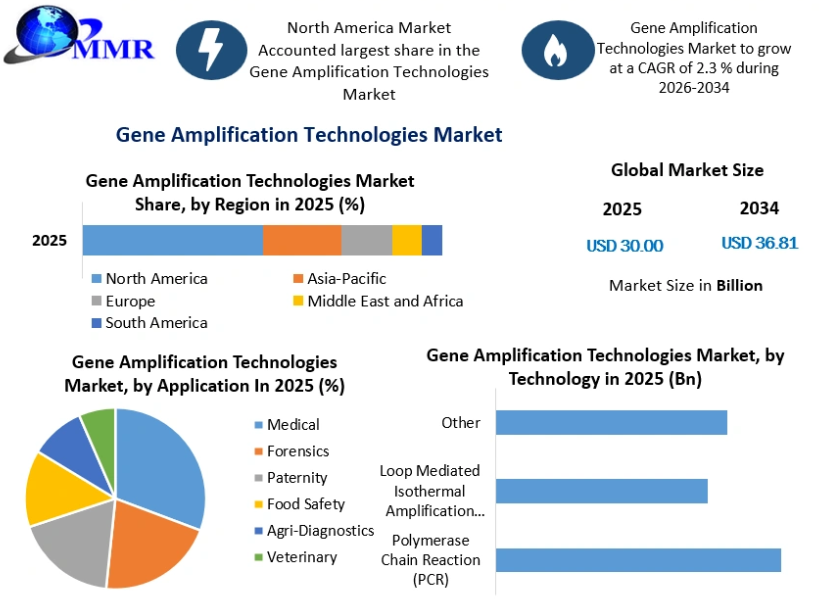
The global Gene Amplification Technologies Market is projected to reach US$ 36.81 billion by 2034, growing at a compound annual growth rate (CAGR) of 2.3% during the forecast period from 2026 to 2034, according to the provided market estimates. Gene amplification technologies play a crucial role in molecular diagnostics, genetic research, infectious disease detection, cancer screening, forensic investigations, and biotechnology development. These technologies enable the amplification and analysis of specific DNA or RNA sequences, allowing laboratories and healthcare professionals to detect genetic material even when it is present in very small quantities.
Get to Know More About This Market Study: https://www.maximizemarketresearch.com/request-sample/94211/
Polymerase Chain Reaction (PCR) remains one of the most widely adopted gene amplification techniques because of its sensitivity, specificity, relatively rapid processing time, and broad applicability. Other technologies, including Loop-Mediated Isothermal Amplification (LAMP) and digital PCR, are expanding the range of molecular testing applications by supporting rapid detection, improved quantification, and specialized testing workflows. These technologies are increasingly used in clinical laboratories, pharmaceutical research, academic institutions, food safety testing, veterinary diagnostics, and agricultural biotechnology.
Gene Amplification Technologies Market Drivers and Trends
Increasing Demand for Molecular Diagnostics
The rising adoption of molecular diagnostic testing is a major driver of the Gene Amplification Technologies Market. Traditional diagnostic methods may require longer processing times or may not provide sufficient sensitivity for detecting certain pathogens and genetic variations. Gene amplification technologies address these limitations by increasing the quantity of target genetic material, enabling more reliable detection and analysis.
PCR-based tests are widely used in the diagnosis of infectious diseases, including tuberculosis, HIV, hepatitis, influenza, and other respiratory infections. The demand for rapid and accurate molecular testing has encouraged healthcare institutions and diagnostic laboratories to invest in advanced amplification instruments and standardized assay kits. Continued emphasis on early disease detection is expected to support demand throughout the forecast period.
Get to Know More About This Market Study: https://www.maximizemarketresearch.com/request-sample/94211/
Expansion of Genetic Research and Personalized Medicine
Advancements in genomics and personalized medicine are creating new opportunities for gene amplification technology providers. Researchers use amplification techniques to analyze genetic mutations, identify disease-associated biomarkers, study gene expression, and investigate the molecular mechanisms of different diseases.
In oncology, amplification-based methods can support the identification of clinically relevant genetic alterations and help laboratories evaluate biomarkers associated with targeted treatment strategies. Pharmaceutical companies also use these technologies in drug discovery, preclinical research, clinical trials, and the development of companion diagnostic tests.
As precision medicine expands, demand for accurate and reproducible genetic analysis is expected to increase. This trend may encourage manufacturers to develop assays and instruments that offer greater analytical sensitivity, multiplexing capabilities, and compatibility with automated laboratory systems.
Technological Advancements in PCR and Isothermal Amplification
Continuous technological improvements are reshaping the gene amplification industry. Real-time PCR, digital PCR, multiplex PCR, and isothermal amplification methods offer different advantages depending on the application, sample type, and testing environment.
Real-time PCR enables the monitoring of amplification during the reaction, while digital PCR supports absolute quantification of nucleic acids through partition-based analysis. LAMP technology can amplify target genetic material at a constant temperature, reducing dependence on conventional thermal cycling and making it suitable for selected rapid-testing applications.
Manufacturers are also investing in automated sample preparation, integrated diagnostic platforms, improved reagents, and software-assisted interpretation. These developments can reduce manual intervention, improve workflow consistency, and support higher testing throughput.
Growing Applications in Cancer Research and Targeted Therapies
Gene amplification and related nucleic acid analysis technologies are increasingly important in cancer research and molecular oncology. They can help detect gene copy-number changes, identify mutations, and assess molecular markers associated with particular cancers.
The growth of targeted cancer therapies has increased the need for reliable biomarker testing. Gene amplification methods may be used alongside sequencing, immunohistochemistry, and other diagnostic approaches to characterize tumors and support treatment selection where clinically appropriate.
Continued investment in oncology diagnostics and companion diagnostic development is expected to create opportunities for companies supplying molecular testing instruments, reagents, and assay platforms.
Increasing Focus on Food Safety, Veterinary Testing, and Agricultural Diagnostics
Gene amplification technologies are not limited to human healthcare. Food producers, veterinary laboratories, agricultural researchers, and regulatory organizations use molecular methods to detect pathogens, identify organisms, and investigate biological contamination.
In the food industry, PCR-based tests can help identify microbial contaminants and support quality control procedures. Veterinary applications include the detection of animal pathogens, while agricultural diagnostics can help identify plant diseases and support crop-health monitoring.
These applications broaden the market’s customer base and create demand for specialized testing kits and instruments designed for different sample types and operating environments.
Market Restraints and Challenges
Despite favorable applications, several factors may restrict market expansion. Advanced PCR and digital PCR instruments can require substantial initial investment, while recurring expenditure on reagents, consumables, maintenance, and quality assurance can increase operating costs.
Gene Amplification Technologies Market Segment Analysis
The global Gene Amplification Technologies Market is segmented by technology and application. These segments reflect the different amplification methods used in molecular analysis and the broad range of industries that depend on genetic testing.
By Technology
Polymerase Chain Reaction (PCR): PCR represents a major technology segment because of its extensive use in clinical diagnostics, infectious disease testing, genetic research, and forensic analysis. The technique amplifies specific DNA sequences through repeated temperature cycles, allowing the detection of genetic material in relatively small samples. Real-time PCR and multiplex PCR have expanded its applications by supporting quantitative analysis and the simultaneous detection of multiple genetic targets.
PCR is also widely used in pharmaceutical research, biomarker identification, and laboratory-developed testing workflows. Improvements in assay sensitivity, automation, and reagent performance are expected to sustain its importance throughout the forecast period.
Loop-Mediated Isothermal Amplification (LAMP): LAMP is an alternative amplification technology that operates at a constant temperature. It can provide rapid results without requiring the conventional thermal cycling used in PCR, making it suitable for selected point-of-care and resource-limited testing environments. Its potential applications include infectious disease screening, veterinary diagnostics, agricultural testing, and field-based molecular analysis.
Other Technologies: This category includes additional nucleic acid amplification approaches and specialized methods used in research and diagnostic applications. Digital PCR, for example, supports highly sensitive nucleic acid quantification by partitioning samples into numerous individual reactions. Continued development of specialized amplification platforms is expected to support applications requiring precise genetic measurement and advanced analytical capabilities.
By Application
Medical: Medical diagnostics represent a major application area for gene amplification technologies. These methods are used to identify infectious pathogens, investigate genetic disorders, monitor viral loads, detect disease-associated mutations, and support cancer biomarker testing. Increasing demand for early diagnosis and personalized treatment is expected to support continued adoption in hospitals, diagnostic laboratories, and specialized healthcare facilities.
Forensics: Forensic laboratories use DNA amplification to analyze biological evidence collected during criminal investigations and other legal proceedings. PCR enables the analysis of small or partially degraded DNA samples, supporting human identification and genetic profiling when used with appropriate validated procedures.
Paternity Testing: Gene amplification supports genetic relationship testing by enabling the analysis of specific DNA markers. These applications are used in paternity testing and other kinship investigations, subject to applicable consent, privacy, and legal requirements.
Food Safety: Food manufacturers and testing laboratories use gene amplification methods to detect foodborne pathogens and identify selected biological contaminants. Molecular testing can support quality control, traceability, and food safety monitoring across processing and distribution networks.
Agri-Diagnostics: Agricultural applications include the identification of plant pathogens, detection of selected genetic traits, and analysis of biological material used in crop research. These technologies can help researchers and agricultural organizations monitor plant health and investigate disease outbreaks.
Veterinary: Veterinary laboratories use gene amplification methods to identify infectious diseases in livestock, companion animals, and other animal populations. Rapid molecular testing can support disease surveillance, herd health management, and veterinary research.
Get to Know More About This Market Study: https://www.maximizemarketresearch.com/request-sample/94211/
Gene Amplification Technologies Market Regional Insights
North America
North America is expected to maintain a significant share of the Gene Amplification Technologies Market during the forecast period. The region benefits from established healthcare infrastructure, substantial biomedical research activity, the presence of leading molecular diagnostics companies, and continued investment in biotechnology and pharmaceutical development.
The United States represents an important market because hospitals, clinical laboratories, universities, and biotechnology companies use amplification technologies for infectious disease testing, cancer research, genetic analysis, and drug development. Established regulatory frameworks and ongoing advances in laboratory automation also influence product development and adoption.
Canada contributes through healthcare research, diagnostic laboratory services, and biotechnology innovation, while Mexico offers opportunities associated with expanding diagnostic capabilities and demand for improved laboratory testing infrastructure.
Europe
Europe represents an important market supported by established healthcare systems, molecular biology research, pharmaceutical manufacturing, and clinical laboratory networks. Countries such as Germany, the United Kingdom, France, Italy, and Spain contribute to regional demand through medical research, infectious disease diagnostics, and biotechnology development.
The region’s emphasis on diagnostic quality, laboratory standards, and research collaboration supports demand for reliable amplification instruments and consumables. Opportunities are also emerging from precision medicine, oncology research, and the development of automated diagnostic workflows.
Asia-Pacific
Asia-Pacific is expected to offer opportunities for market expansion as healthcare infrastructure, biotechnology research, and diagnostic testing capabilities continue to develop across the region. China, Japan, India, South Korea, and Australia are important contributors to molecular diagnostics and life sciences research.
Increasing healthcare expenditure, expanding pharmaceutical manufacturing, growing awareness of early disease detection, and investment in domestic biotechnology capabilities may support market development. Demand for cost-effective testing solutions is particularly relevant in settings where diagnostic laboratories must manage large testing volumes and budget constraints.
Manufacturers that provide scalable instruments, accessible consumables, and simplified testing workflows may find opportunities across emerging healthcare and agricultural markets in the region.
Middle East and Africa
The Middle East and Africa market is influenced by investments in healthcare infrastructure, laboratory modernization, infectious disease surveillance, and diagnostic capacity. Gulf Cooperation Council countries are investing in advanced healthcare services, while South Africa, Egypt, and other markets contribute through diagnostic laboratories and medical research.
However, access to advanced testing equipment, skilled personnel, funding, and reliable laboratory supply chains varies across the region. Partnerships, training initiatives, and affordable diagnostic platforms may help expand the adoption of gene amplification technologies.
South America
South America presents opportunities associated with healthcare modernization, infectious disease diagnosis, agricultural biotechnology, and food safety testing. Brazil and Argentina are important markets for laboratory diagnostics and agricultural applications.
Demand may increase as healthcare providers expand molecular testing capabilities and food producers adopt more advanced biological testing methods. Market development will depend on investment levels, product accessibility, regulatory requirements, and the availability of trained laboratory professionals.
Major Industry Players in the Gene Amplification Technologies Market
The global Gene Amplification Technologies Market includes established diagnostic manufacturers, biotechnology companies, laboratory equipment suppliers, and specialized molecular testing developers. Competition is shaped by product performance, assay availability, automation, pricing, regulatory clearances, and the ability to serve different laboratory requirements.
Major companies identified in the market include:
- Abbott Laboratories
- Cepheid
- Agilent Technologies
- ID Biomedical Corporation
- Molecular Sensing PLC
- Orchid Biosciences Inc.
- Rubicon Genomics
- U.S. Genomics
- bioMérieux SA
- Bio-Rad Laboratories Inc.
- F. Hoffmann-La Roche Ltd.
- Merck KGaA
- PerkinElmer Inc.
- QIAGEN Group
- Takara Bio, Inc.
- Siemens Healthineers AG
- Thermo Fisher Scientific Inc.
- Becton, Dickinson and Company
- Bayer Corporation
These companies participate in different parts of the molecular diagnostics and biotechnology value chain, including amplification instruments, reagents, assay kits, sample preparation, and laboratory analysis. Their portfolios and market roles vary, and not every company focuses exclusively on gene amplification technologies.
Product innovation remains an important competitive strategy. Manufacturers are working to improve testing speed, analytical sensitivity, multiplexing capacity, automation, and ease of use. Strategic partnerships, acquisitions, research collaborations, and geographic expansion can also help companies strengthen their market positions.
For healthcare providers and research organizations, the choice of a platform often depends on testing volume, target applications, instrument compatibility, consumable costs, regulatory status, and laboratory workflow requirements.
Gene Amplification Technologies Market Recent Developments
Developments in molecular diagnostics and genetic analysis illustrate the broader technological direction of the market. The following examples are drawn from the development information provided for this report and should be verified against company announcements and regulatory records before publication.
Roche — March 30, 2026: F. Hoffmann-La Roche Ltd. was reported to have launched the cobas MPX-E assay, a multiplex real-time PCR test designed to detect and distinguish HIV, hepatitis C virus (HCV), hepatitis B virus (HBV), and hepatitis E virus (HEV). Multiplex testing can help laboratories consolidate multiple targets within a single testing workflow and support blood safety screening.
QIAGEN — March 10, 2026: QIAGEN N.V. was reported to have received U.S. regulatory clearance for advanced gastrointestinal panels on its QIAstat-Dx Rise syndromic testing system. Automated syndromic testing platforms can help laboratories investigate multiple potential infectious causes using integrated diagnostic workflows.
QIAGEN — January 10, 2025: QIAGEN announced an expansion of the capabilities of its QIAcuity digital PCR platform, increasing the number of targets that could be evaluated concurrently. Greater multiplexing capacity can support research workflows that require the analysis of several genetic markers from a single sample.
These developments highlight the industry’s focus on multiplex detection, automation, higher throughput, and improved laboratory efficiency. The commercial impact of individual product launches depends on regulatory authorization, clinical adoption, pricing, and the needs of specific testing markets.
Gene Amplification Technologies Market Scope
| Report Parameter | Details |
|---|---|
| Base year | 2025 |
| Historical period | 2020–2025 |
| Forecast period | 2026–2034 |
| Forecast CAGR | 2.3% |
| Market size in 2025 | US$ 30.00 billion, as supplied in the market brief |
| Market size in 2034 | US$ 36.81 billion, as supplied in the market brief |
| Technology segments | Polymerase Chain Reaction (PCR), Loop-Mediated Isothermal Amplification (LAMP), Other |
| Application segments | Medical, Forensics, Paternity, Food Safety, Agri-Diagnostics, Veterinary |
| Regions covered | North America, Europe, Asia-Pacific, Middle East and Africa, South America |
The report examines market size, growth opportunities, competitive dynamics, regional performance, and the influence of technological developments. It also provides a framework for evaluating market drivers, restraints, opportunities, and risks.
The analysis of industry participants considers product portfolios, strategic initiatives, geographical presence, and competitive positioning. Additional assessment of regulatory conditions, research expenditure, laboratory infrastructure, and end-user demand can help stakeholders identify opportunities for market development.
Frequently Asked Questions (FAQs)
1. What is the projected size of the Gene Amplification Technologies Market by 2034?
According to the supplied market estimates, the global Gene Amplification Technologies Market is projected to reach US$ 36.81 billion by 2034. This estimate is associated with a CAGR of 2.3% over the 2026–2034 forecast period.
2. What is the expected CAGR of the Gene Amplification Technologies Market?
The market is expected to grow at a CAGR of 2.3% during the forecast period from 2026 to 2034, based on the figures provided in the market brief.
3. Which region is expected to hold a prominent share of the market?
North America is identified as a leading regional market in the supplied report information. Its established healthcare infrastructure, biotechnology research activity, diagnostic laboratory networks, and presence of major industry participants support demand for gene amplification technologies.
4. Which technology dominates the Gene Amplification Technologies Market?
Polymerase Chain Reaction (PCR) is identified as a major technology segment because of its broad adoption in infectious disease testing, genetic research, molecular diagnostics, and forensic analysis. Its sensitivity, established workflows, and availability of commercial assays contribute to its widespread use.
5. What are the major factors driving market growth?
Key growth drivers include increasing demand for molecular diagnostics, advances in genetic research, expansion of personalized medicine, cancer biomarker testing, pharmaceutical development, and growing applications in food safety, veterinary diagnostics, and agricultural testing.
Conclusion
The Gene Amplification Technologies Market remains an important part of the molecular diagnostics and biotechnology industries. PCR continues to support a wide range of clinical and research applications, while digital PCR, isothermal amplification, multiplex assays, and automated testing platforms are expanding the available options for genetic analysis.
Connect With Us:
MAXIMIZE MARKET RESEARCH PVT. LTD.
2nd Floor, Navale IT park Phase 3,
Pune Banglore Highway, Narhe
Pune, Maharashtra 411041, India.
+91 9607365656
sales@maximizemarketresearch.com
About Maximize Market Research:
Maximize Market Research is one of the fastest-growing market research and business consulting firms serving clients globally. Our revenue impact and focused growth-driven research initiatives make us a proud partner of majority of the Fortune 500 companies. We have a diversified portfolio and serve a variety of industries such as IT & telecom, chemical, food & beverage, aerospace & defense, healthcare and others.