
Particle Counter Market Overview
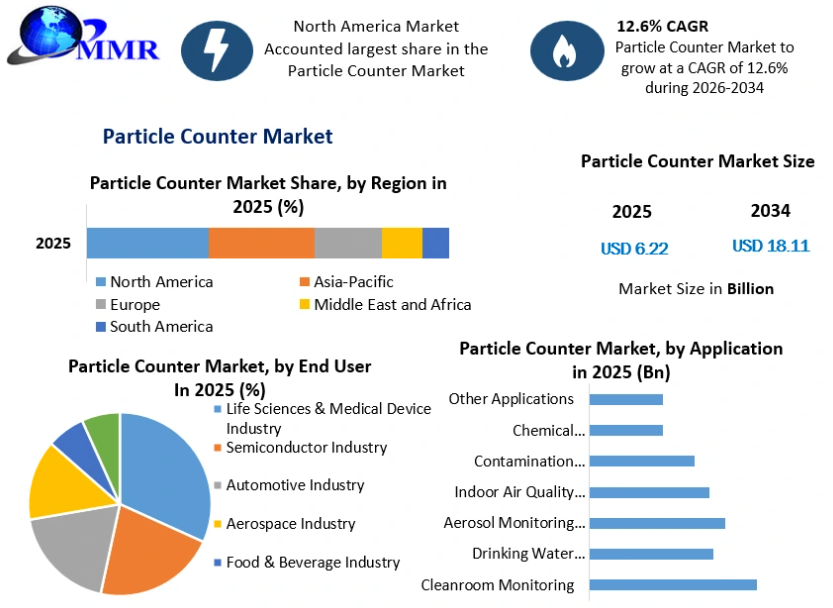
The global Particle Counter Market was valued at US$ 6.22 billion in 2025 and is projected to reach approximately US$ 18.11 billion by 2034, growing at a compound annual growth rate (CAGR) of 12.6% during the forecast period from 2026 to 2034. The market is experiencing significant growth due to increasing demand for contamination monitoring, stringent quality control regulations, expanding pharmaceutical and biotechnology manufacturing, and the growing adoption of advanced particle detection technologies across industrial applications.
Get to Know More About This Market Study: https://www.maximizemarketresearch.com/request-sample/126523/
Particle counters are specialized instruments used to detect, measure, and analyze particles suspended in air, liquids, and other process media. These instruments play a critical role in identifying contaminants and maintaining the required cleanliness levels in controlled environments. Their applications span pharmaceutical production, medical device manufacturing, semiconductor fabrication, aerospace, automotive manufacturing, food and beverage processing, water quality monitoring, and environmental research.
The growing importance of product safety, manufacturing precision, and contamination prevention has increased the adoption of particle counters across industries. Pharmaceutical manufacturers rely on these instruments to monitor cleanrooms and controlled production environments, while semiconductor companies use them to maintain stringent air quality requirements during the fabrication of sensitive electronic components. Similarly, liquid particle counters are increasingly used to assess contamination in high-purity water, chemicals, hydraulic fluids, and other industrial liquids.
Technological advancements in laser-based detection, real-time monitoring, automated data collection, and portable particle counting systems are further supporting market expansion. Manufacturers are developing instruments that deliver faster measurements, improved sensitivity, and better integration with digital quality management systems. These innovations are strengthening the role of particle counters in modern manufacturing and environmental monitoring.
According to the market assessment, the Particle Counter Market is expected to maintain strong growth throughout the forecast period as industries continue investing in advanced contamination control systems and compliance-driven production infrastructure.
Particle Counter Market Drivers and Trends
Increasing Demand for Cleanroom Monitoring
The growing use of cleanrooms across pharmaceutical, biotechnology, medical device, and semiconductor manufacturing facilities is a major factor driving the Particle Counter Market. Cleanrooms require continuous monitoring to ensure that airborne particles remain within specified limits. Particle counters help manufacturers evaluate environmental cleanliness, identify contamination sources, and maintain controlled production conditions.
Get to Know More About This Market Study: https://www.maximizemarketresearch.com/request-sample/126523/
The expansion of sterile drug manufacturing, injectable medicines, biologics, and sensitive electronic component production is increasing demand for reliable particle measurement instruments. Compliance with applicable cleanroom classification and contamination control requirements is also encouraging manufacturers to adopt automated and continuous monitoring solutions.
Stringent Regulatory Standards and Quality Assurance Requirements
Regulatory compliance is another significant driver of market growth. Pharmaceutical manufacturers, medical device companies, and semiconductor producers must maintain appropriate environmental controls to protect product quality and manufacturing consistency. Standards and guidelines related to cleanroom classification, pharmaceutical good manufacturing practices, and contamination monitoring have increased the importance of accurate particle measurement.
Particle counters support environmental qualification, routine monitoring, investigation of contamination events, and quality assurance procedures. As manufacturers expand production facilities and strengthen quality management practices, demand for dependable particle counting systems is expected to increase.
Expansion of Pharmaceutical and Biotechnology Manufacturing
The expansion of pharmaceutical research, biotechnology production, vaccine manufacturing, and advanced medical device development is creating substantial opportunities for particle counter manufacturers. These industries require carefully controlled environments to reduce contamination risks and maintain product integrity.
The increasing production of biologics, injectable formulations, implantable medical devices, and precision healthcare products is strengthening the need for environmental monitoring equipment. Pharmaceutical companies are also investing in modern manufacturing facilities equipped with automated monitoring systems, supporting the adoption of advanced airborne and liquid particle counters.
Technological Advancements in Particle Detection
Innovation in optical sensing, laser diffraction, condensation particle counting, and automated particle analysis is transforming the market. Modern instruments offer improved measurement accuracy, wider particle-size detection capabilities, and enhanced data management features.
The integration of connected monitoring systems and digital reporting tools allows manufacturers to collect particle concentration data continuously and identify potential contamination events more efficiently. Portable and remote monitoring instruments are also gaining importance because they enable flexible deployment across cleanrooms, laboratories, production lines, and field research locations.
These technological improvements are helping manufacturers increase operational efficiency, reduce manual monitoring requirements, and improve contamination control strategies.
Growing Focus on Environmental and Water Quality Monitoring
Increasing attention to air pollution, ultrafine particles, drinking water quality, and microplastic contamination is expanding the application scope of particle measurement technologies. Environmental research organizations, industrial facilities, and water treatment operators require instruments capable of identifying and measuring particulate contamination in different environments.
The development of advanced particle analysis systems is supporting research into airborne pollutants, industrial emissions, liquid contamination, and emerging environmental contaminants. As monitoring requirements become more sophisticated, demand for specialized particle counters and particle characterization instruments is expected to increase.
High Equipment Costs and Validation Expenses
Despite strong growth prospects, the Particle Counter Market faces challenges associated with equipment costs, calibration, maintenance, and compliance validation. Advanced instruments with high sensitivity, automated reporting, and continuous monitoring capabilities can require substantial upfront investment.
Smaller laboratories, academic institutions, and manufacturers operating with limited budgets may find it difficult to adopt sophisticated systems. Additional expenses related to staff training, instrument qualification, servicing, and data system integration can further influence purchasing decisions.
Manufacturers are addressing these challenges through the development of cost-effective portable instruments, simplified operating interfaces, and scalable monitoring solutions suitable for organizations with different budget requirements.
Particle Counter Market Key Segments Covered
The Particle Counter Market is segmented by type, end user, application, and region. Each segment reflects distinct requirements for particle measurement, contamination control, and environmental monitoring.
By Type
The market includes airborne particle counters and liquid particle counters, with airborne instruments further encompassing portable, remote, handheld, and condensation or ultrafine particle counting solutions. Liquid particle counters include online or inline and offline systems.
Airborne particle counters play a particularly important role in cleanroom monitoring and controlled manufacturing environments. Portable and handheld systems offer flexibility for routine inspections and localized measurements, while remote instruments support continuous monitoring and integration with facility management systems.
Liquid particle counters are used in applications such as high-purity water monitoring, pharmaceutical liquid analysis, hydraulic fluid cleanliness assessment, and chemical processing. Online and inline systems can provide continuous information about particle contamination, supporting faster identification of process deviations.
By End User
The market serves the life sciences and medical device industry, semiconductor industry, automotive industry, aerospace industry, food and beverage industry, and other end users.
The life sciences and medical device industry represents a major application area because contamination prevention is essential to maintaining product quality and manufacturing consistency. Pharmaceutical facilities use particle counters to monitor controlled environments, while medical device manufacturers use them to support cleanliness assessments during production.
The semiconductor industry also represents a significant source of demand. Modern chip manufacturing requires highly controlled environments because microscopic particles can interfere with fabrication processes and affect production yields. Automotive, aerospace, and food and beverage manufacturers use particle counters to support specialized quality assurance and contamination monitoring requirements.
By Application
Key applications include cleanroom monitoring, drinking water contamination monitoring, aerosol monitoring and research, indoor air quality monitoring, liquid contamination monitoring, chemical contamination monitoring, and other applications.
Cleanroom monitoring remains a central application because it supports environmental qualification, routine cleanliness assessments, and contamination investigations. Indoor air quality monitoring and aerosol research are gaining attention as organizations seek improved information about particulate exposure and environmental conditions.
Liquid contamination monitoring is also important in pharmaceutical production, water treatment, chemical manufacturing, and industrial fluid management. The growing diversity of these applications is expanding the addressable market for specialized particle measurement systems.
Get to Know More About This Market Study: https://www.maximizemarketresearch.com/request-sample/126523/
Particle Counter Market Regional Analysis
North America
North America is a major market for particle counters, supported by established pharmaceutical and biotechnology industries, advanced semiconductor research, and substantial investment in scientific instrumentation. The United States and Canada have well-developed research infrastructure and a strong presence of companies involved in contamination control and environmental monitoring.
Demand is supported by pharmaceutical manufacturing, medical device production, cleanroom infrastructure, and the adoption of advanced monitoring technologies. The region’s emphasis on quality assurance and regulatory compliance also encourages manufacturers to invest in reliable particle measurement systems.
Europe
Europe represents an important market due to its established pharmaceutical, biotechnology, automotive, aerospace, and industrial manufacturing sectors. Germany, the United Kingdom, France, Italy, and other European countries have significant demand for precision measurement instruments used in quality control and contamination monitoring.
Investment in advanced manufacturing, pharmaceutical research, and environmental monitoring is supporting market development. The increasing importance of industrial process efficiency and controlled production environments is also creating opportunities for particle counter manufacturers.
Asia Pacific
Asia Pacific is expected to offer substantial growth opportunities as pharmaceutical manufacturing, semiconductor fabrication, electronics production, and biotechnology research continue expanding across China, India, Japan, South Korea, and other regional markets.
Increasing investment in cleanroom infrastructure, growing healthcare manufacturing capacity, and the development of advanced electronics facilities are strengthening demand for particle monitoring equipment. The expansion of industrial research and environmental quality monitoring is also expected to support regional market growth.
Middle East and Africa
The Middle East and Africa market is supported by investment in healthcare infrastructure, pharmaceutical manufacturing, industrial development, and water treatment facilities. The expansion of specialized laboratories and manufacturing operations is creating opportunities for particle counting instruments in selected applications.
South America
South America presents opportunities associated with pharmaceutical manufacturing, food and beverage processing, industrial development, and environmental monitoring. Brazil and Argentina are among the markets where increasing attention to production quality and contamination management may support demand for particle measurement systems.
Major Industry Players in the Particle Counter Market
The Particle Counter Market is competitive, with established instrument manufacturers focusing on product innovation, measurement accuracy, customer support, and expansion into specialized applications. Companies compete through developments in optical detection technology, portable monitoring equipment, automated data analysis, and integrated contamination control solutions.
Major companies operating in the market include:
- Particle Measuring Systems (United States)
- Beckman Coulter (United States)
- RION Co., Ltd. (Japan)
- Lighthouse Worldwide Solutions (United States)
- TSI Incorporated (United States)
- Climet Instruments Company (United States)
- Met One Instruments, Inc. (United States)
- Particle Plus (United States)
- Setra Systems (United States)
- PAMAS (Germany)
- Chemtrac (United States)
- HAL Technology (United States)
- Konamax (United States)
- Veltek Associates (United States)
- PCE Instruments (United Kingdom)
- GrayWolf Sensing Solutions (United States)
- Extech Instruments (United States)
- Palas GmbH (Germany)
- HYDAC International (Germany)
- Fluke Corporation (United States)
These companies serve a range of applications, including cleanroom qualification, pharmaceutical quality control, semiconductor manufacturing, liquid contamination monitoring, and environmental research. Competition is increasingly influenced by product performance, instrument reliability, data connectivity, calibration services, and the ability to address industry-specific monitoring requirements.
Recent Industry Developments
The particle measurement industry continues to evolve through product launches, manufacturing investments, and advances in analytical technologies. Recent developments reported across the broader particle analysis sector include the introduction of water-based condensation particle counters, the expansion of particle characterization systems for microplastic research, and the development of advanced particle size and shape analyzers.
Such innovations reflect growing demand for solvent-free ultrafine particle measurement, automated analysis, faster testing, and broader environmental and industrial research applications. Readers should verify individual product launch dates and company announcements against official releases before citing them in formal market publications.
Frequently Asked Questions (FAQs)
1. What is the Particle Counter Market size in 2025?
The Particle Counter Market was valued at approximately US$ 6.22 billion in 2025, according to the market estimates provided for this report.
2. What is the projected Particle Counter Market size by 2034?
The market is projected to reach approximately US$ 18.11 billion by 2034.
3. What is the expected CAGR of the Particle Counter Market?
The Particle Counter Market is expected to grow at a CAGR of 12.6% during the forecast period from 2026 to 2034.
4. What are the major factors driving the Particle Counter Market?
The principal growth drivers include rising demand for cleanroom monitoring, stringent quality control requirements, expansion of pharmaceutical and biotechnology manufacturing, increasing semiconductor production, and technological advancements in particle detection.
5. Which segment is a major contributor to the Particle Counter Market?
Airborne particle counters are a major product category because of their widespread use in cleanroom monitoring and controlled manufacturing environments. The life sciences and medical device industry is also a major end-user segment due to its contamination control requirements.
Conclusion
The Particle Counter Market is positioned for substantial growth through 2034 as industries place greater emphasis on contamination prevention, product quality, and controlled manufacturing environments. Increasing pharmaceutical and biotechnology production, expanding semiconductor fabrication, and growing environmental monitoring requirements are creating demand for accurate and reliable particle measurement technologies.
Connect With Us:
MAXIMIZE MARKET RESEARCH PVT. LTD.
2nd Floor, Navale IT park Phase 3,
Pune Banglore Highway, Narhe
Pune, Maharashtra 411041, India.
+91 9607365656
sales@maximizemarketresearch.com
About Maximize Market Research:
Maximize Market Research is one of the fastest-growing market research and business consulting firms serving clients globally. Our revenue impact and focused growth-driven research initiatives make us a proud partner of majority of the Fortune 500 companies. We have a diversified portfolio and serve a variety of industries such as IT & telecom, chemical, food & beverage, aerospace & defense, healthcare and others.